
How to Build an AI Product: From Business Idea to Production
Validation, data, architecture, evaluation and monitoring, in the order you will face them.
 Yevhenii Sukhov·Publication date·15 min read
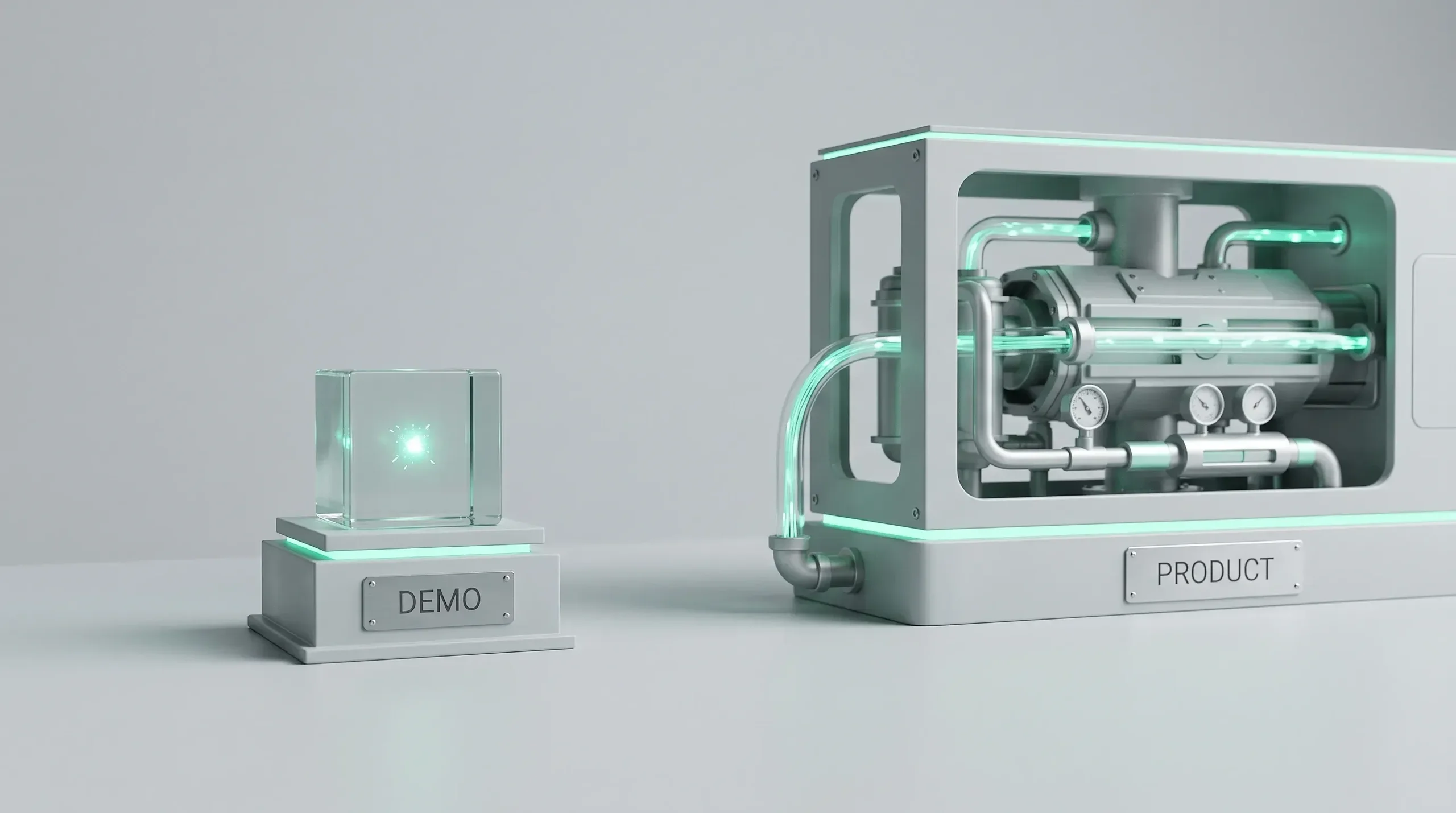
A working demo and a working product are two different things. A prototype answers well in a controlled test. A product handles messy inputs, unclear cases, integrations, permissions, cost limits and the day the model returns something wrong.
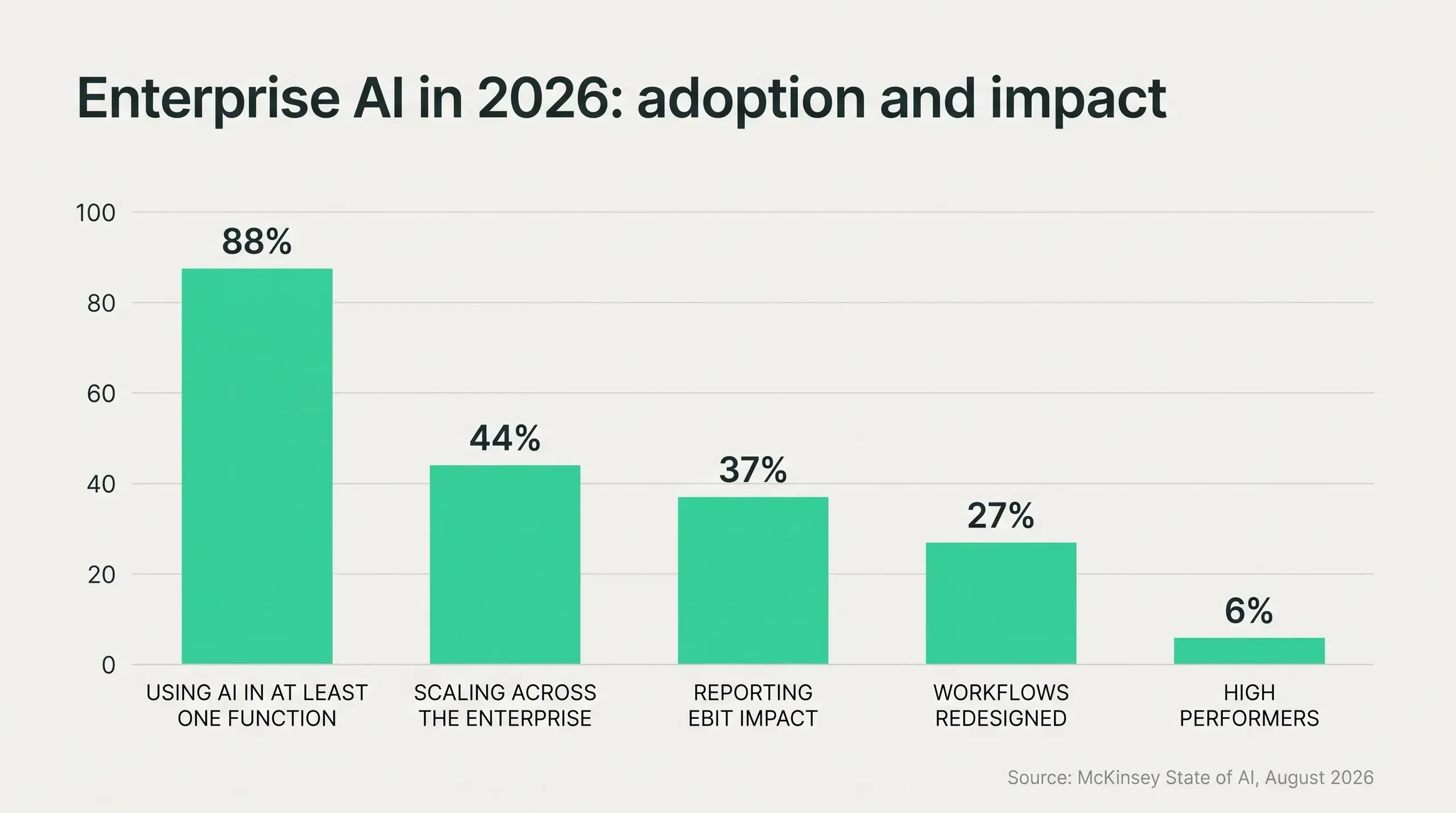
That gap is where most budgets disappear. Gartner reported in January 2026 that at least half of generative AI projects are abandoned after the proof of concept. The reasons it lists are poor data quality, weak risk controls, rising costs and unclear business value. Connecting an AI API or training a model covers a small part of the work. The rest is validation, data readiness, architecture, product UX, evaluation, integration, deployment and monitoring.
This AI product development guide is written for founders, CTOs, product leaders and operations owners who plan to move an AI idea into production. At the earliest stage it overlaps with ordinary software development for startups, because the first release still has to ship. It describes the decisions in the order you will face them.
How Do You Build an AI Product?
Start with one business problem and a measurable outcome. Check whether the task repeats often enough to pay for automation. Confirm that you have data or access to it. Build a small proof of concept with real inputs and a clear success metric. Design the architecture around cost, latency and failure handling. Release a narrow first version to real users, measure quality against agreed metrics, then scale the scope and the infrastructure.
What Makes AI Product Development Different from Traditional Software?
Traditional software behaves the same way every time it runs. An AI product produces answers with a probability attached, so the same input can give a different result after a model update. That single difference changes planning, testing, pricing and support. The second difference is data. Regular software needs a database. An AI product needs representative examples, rules for edge cases and a way to see quality drop over time.
What changes in planning
- The same input can return a different answer after a model update
- Done means a quality score on real data
- Every request carries an inference cost that scales with usage
Traditional Software and AI Products Compared
Every row that differs from your current process adds work to the plan.
Behavior
Traditional software: Deterministic, same output for same input. AI product: Probabilistic, output varies with model and context.
Definition of done
Traditional software: Feature works to specification. AI product: Quality meets an agreed metric on real data.
Main input
Traditional software: Requirements. AI product: Requirements plus representative data.
Testing
Traditional software: Pass or fail test cases. AI product: Evaluation sets, scoring, human review.
Cost model
Traditional software: Mostly build cost, then hosting. AI product: Build cost plus per-request inference cost.
Failure mode
Traditional software: Error message or crash. AI product: Confident wrong answer.
Release
Traditional software: Version ships, behavior stays stable. AI product: Quality shifts with data, prompts and model versions.
Support
Traditional software: Bug reports. AI product: Bug reports plus quality monitoring and retraining.
Does the Product Need AI?
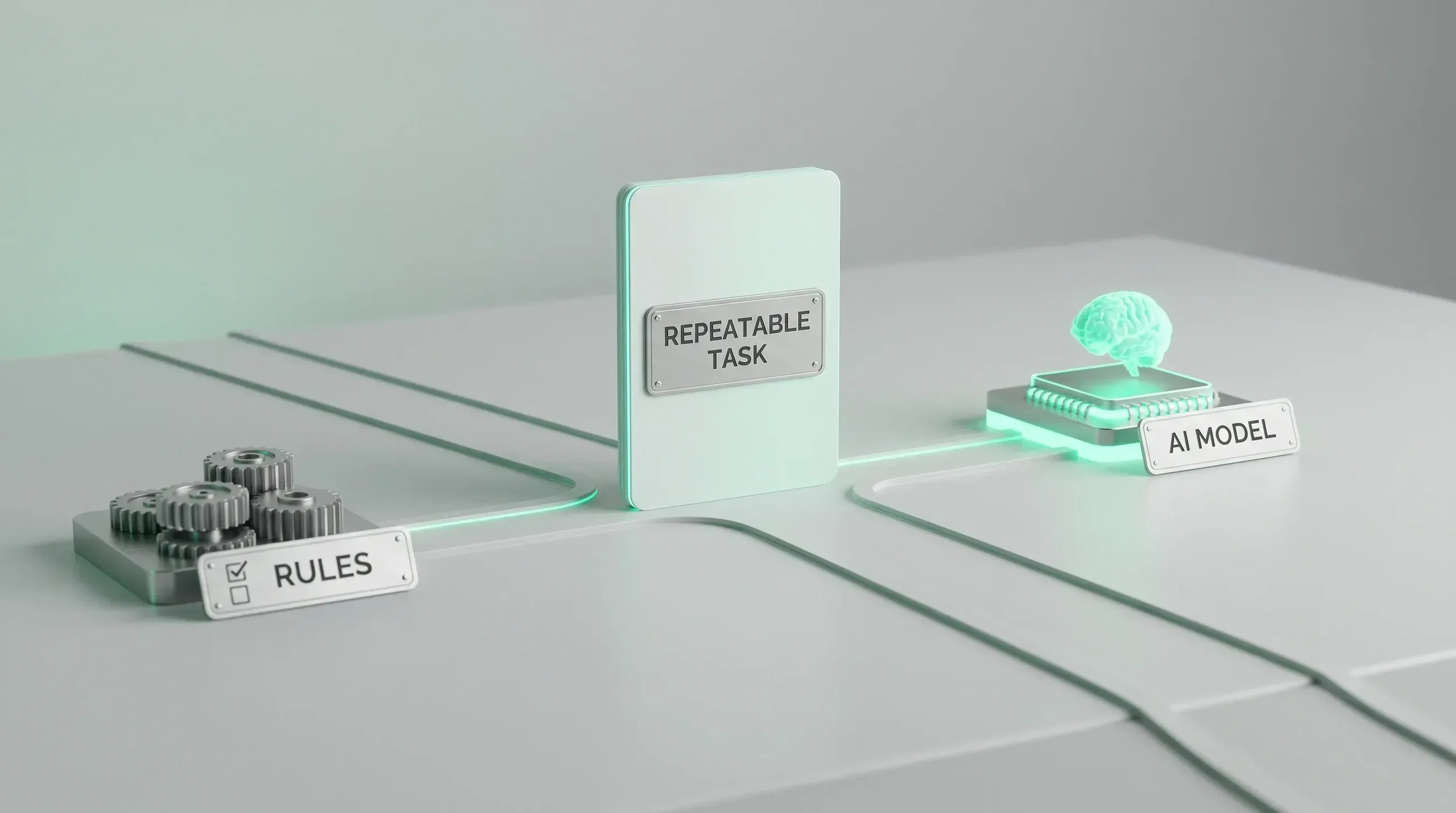
Start with a question that saves money: would a rule, a filter or a plain integration solve the same problem? Answering it first is the cheapest step in the AI product development process. AI earns its place when the task repeats, the rules are hard to write down and the result can be measured. Our published case studies show which way that call went on real projects.
Settle these at the scoping stage:
- Which specific user task should the product complete?
- Why is rule-based automation weak here?
- Which repeatable action can AI improve?
- Which number changes if it works: hours, error rate, cost per case, revenue?
- How expensive is a wrong answer for the user and for you?
- Do you have the data, or legal access to the data source?
- Can a person review disputed results, and at what volume?
- Does the value hold when competitors get the same base models?
Signs AI Is a Good Fit
The patterns that make an AI product worth building.
The work repeats every day
Document review, ticket triage, matching, ranking and drafting all run hundreds of times a week.
The rules resist description
Your best specialist can decide in seconds, yet the policy document has forty exceptions.
The input is unstructured
Email text, PDFs, images, audio and free-form notes carry the information you need.
A person can check the output
Approval takes seconds, so an imperfect answer stays safe.
Signs You May Not Need AI
The patterns where a simpler system wins.
A rule already answers it
Fixed thresholds, lookup tables and validation logic are cheaper and predictable.
Errors are expensive and unreviewable
Payments, safety interlocks and legal filings need deterministic control with AI in a support role.
The data does not exist
No examples, no access and no path to collect them means no product yet.
The volume is small
Twenty cases a month rarely repay the cost of building and running an AI system.
The Honest Answer Is Sometimes a Smaller System
The honest answer is sometimes a smaller system. A workflow tool with two integrations can remove the same hours, and it keeps running with no evaluation work. Hygge Software builds both, so the recommendation comes after the numbers.
What to check at scoping
- A rule engine and two integrations can remove the same hours
- A smaller system needs no evaluation set and no retraining
- Hygge recommends the cheaper path when the numbers support it
Start From the Number the Business Wants to Move
Hygge starts every AI project from the number the business wants to move.
 Alina Sukhova
CEO & Co-Founder
"Most teams arrive with a feature in mind and a model already chosen. We ask for the number the business wants to move and the person who owns it. When that number exists, the scope gets smaller and the product gets finished. When it does not exist, the project turns into research with a deadline."
Check Whether Your Product Needs AI
Hygge Software can assess the business case, available data, technical constraints, and the fastest way to validate the idea before full-scale development.
The AI Product Development Roadmap: From Idea to Production
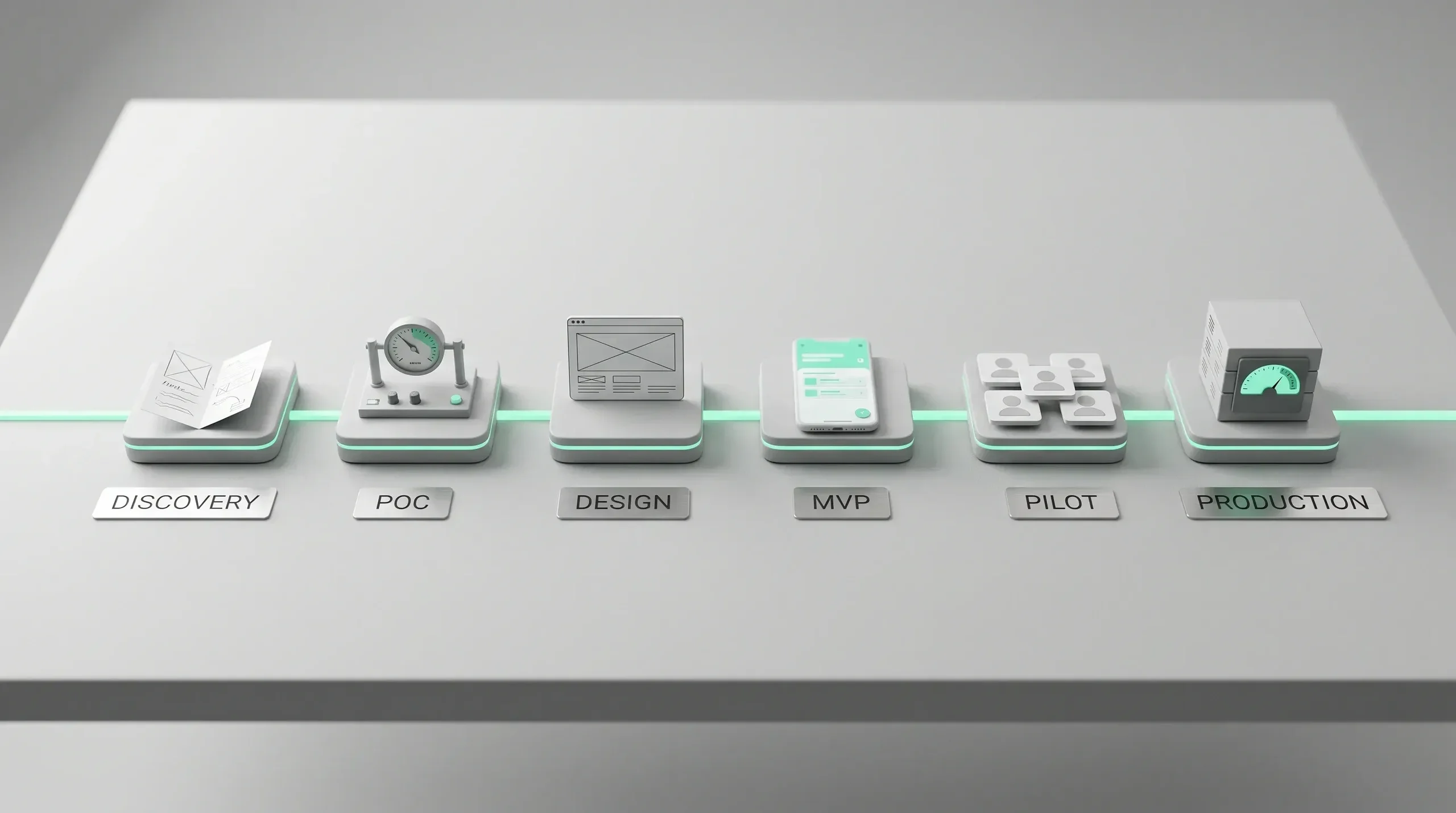
A roadmap for an AI product is a sequence of decisions with exit criteria. Each stage answers one business question and produces one artifact that the next stage needs. A stage that ends without a decision is a stage that repeats itself later.
Stages, Deliverables and Decision Points
Goal, activities, deliverable and the decision that closes each stage.
Stage 1. Discovery
Goal: agree on the problem and the metric. Activities: process mapping, data inventory, risk review, cost of the current process. Deliverable: a one-page problem statement with a baseline number. Decision: proceed when the metric and the data source both exist.
Stage 2. Feasibility and proof of concept
Goal: test the hardest assumption. Activities: build an evaluation set from real cases, test approaches, measure quality and cost per request. Deliverable: a scored prototype and an architecture recommendation. Decision: proceed when quality clears the threshold agreed in Stage 1.
Stage 3. Product design
Goal: make the answer usable. Activities: design the workflow, the review step, confidence display, correction and escalation paths. Deliverable: flows and interface for the full task. Decision: proceed when a user can act on the output without leaving the product.
Stage 4. MVP build
Goal: ship one complete workflow. Activities: data pipeline, inference layer, application, integrations, evaluation harness, logging. Deliverable: a product a pilot group can use daily. Decision: release when the evaluation suite passes and the failure path works.
Stage 5. Pilot
Goal: prove value with real users. Activities: onboarding, quality review, feedback capture, cost tracking, prompt and model tuning. Deliverable: measured results against the Stage 1 baseline. Decision: scale when the number moves and users keep using it.
Stage 6. Production and scale
Goal: run it as a business system. Activities: monitoring, drift detection, retraining, access control, cost controls, support process. Deliverable: an operated product with an owner. Decision: expand scope when quality and cost stay inside limits.
Choose the Right AI Architecture Before Development Gets Expensive
Validate whether your product needs an AI API, RAG, fine-tuning, a custom model, or a hybrid architecture.
Architecture Decisions Are Cost Decisions
Architecture is where the running cost of an AI product gets decided.
Yevhenii SukhovCTO & Co-Founder
"Architecture decisions are cost decisions. An API call per user action looks cheap in a demo and becomes the largest line in the bill at scale. We size the pipeline against expected volume, latency and the price of a wrong answer, then pick the smallest model that clears the bar. The result is a system the client can afford to run for years."
From AI Prototype to Production: What Usually Breaks?
Most AI projects stop between a working prototype and a running product. The failures repeat across industries, and each one has a design answer.
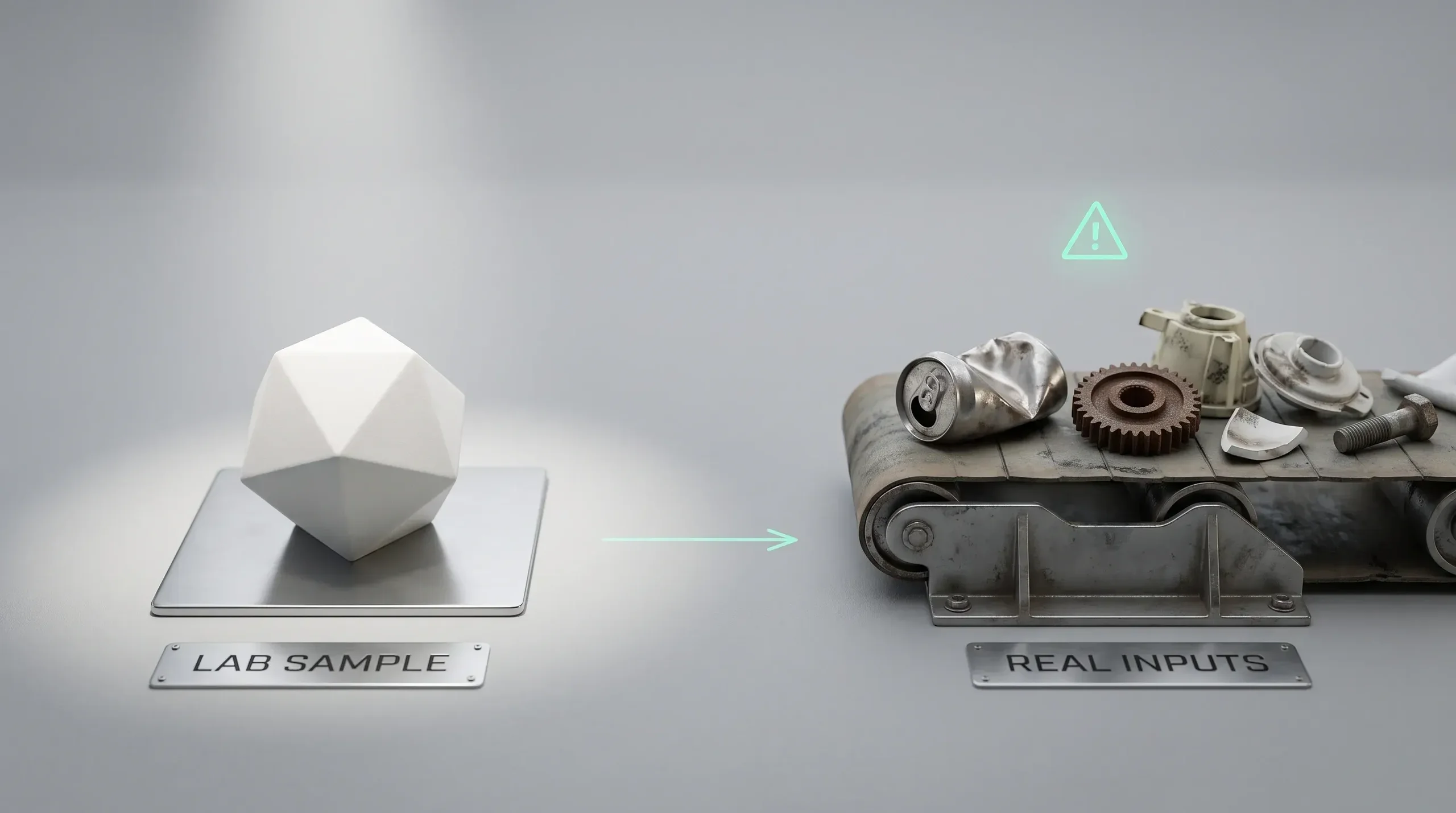
The Model Works in Testing but Fails on Real Inputs
Demos run on clean examples. Production receives scans at an angle, mixed languages, half-filled forms and copy-paste from a chat. The fix is an evaluation set built from real historical cases, including the ugly ones, before the build starts.
AI Quality Cannot Be Measured Consistently
Teams argue about whether an answer is good. Without a scoring method, every release becomes an opinion. Define the metric per task: accuracy on a labeled set, exact-match on extracted fields, human score on a fixed sample, or task completion rate.
Costs Grow Faster Than Usage
Token costs, retries, long context windows and background jobs all scale with traffic. In the McKinsey State of AI, August 2026, about one in five respondents report that AI operating costs limited their use of AI. Price the cost per request at the design stage, then set caps, caching and smaller models for routine steps.
The Product Has No Safe Failure Mode
A confident wrong answer damages trust faster than a slow one. Every AI feature needs a defined behavior for low confidence: ask for confirmation, route to a person, show sources, or return a partial result with a warning.
The AI Feature Does Not Fit the User Workflow
An answer inside a separate tab adds a step to someone's day. Value appears when the output lands where the work already happens: the ticket, the order, the document, the CRM record.
AI Product Architecture and Technology Stack
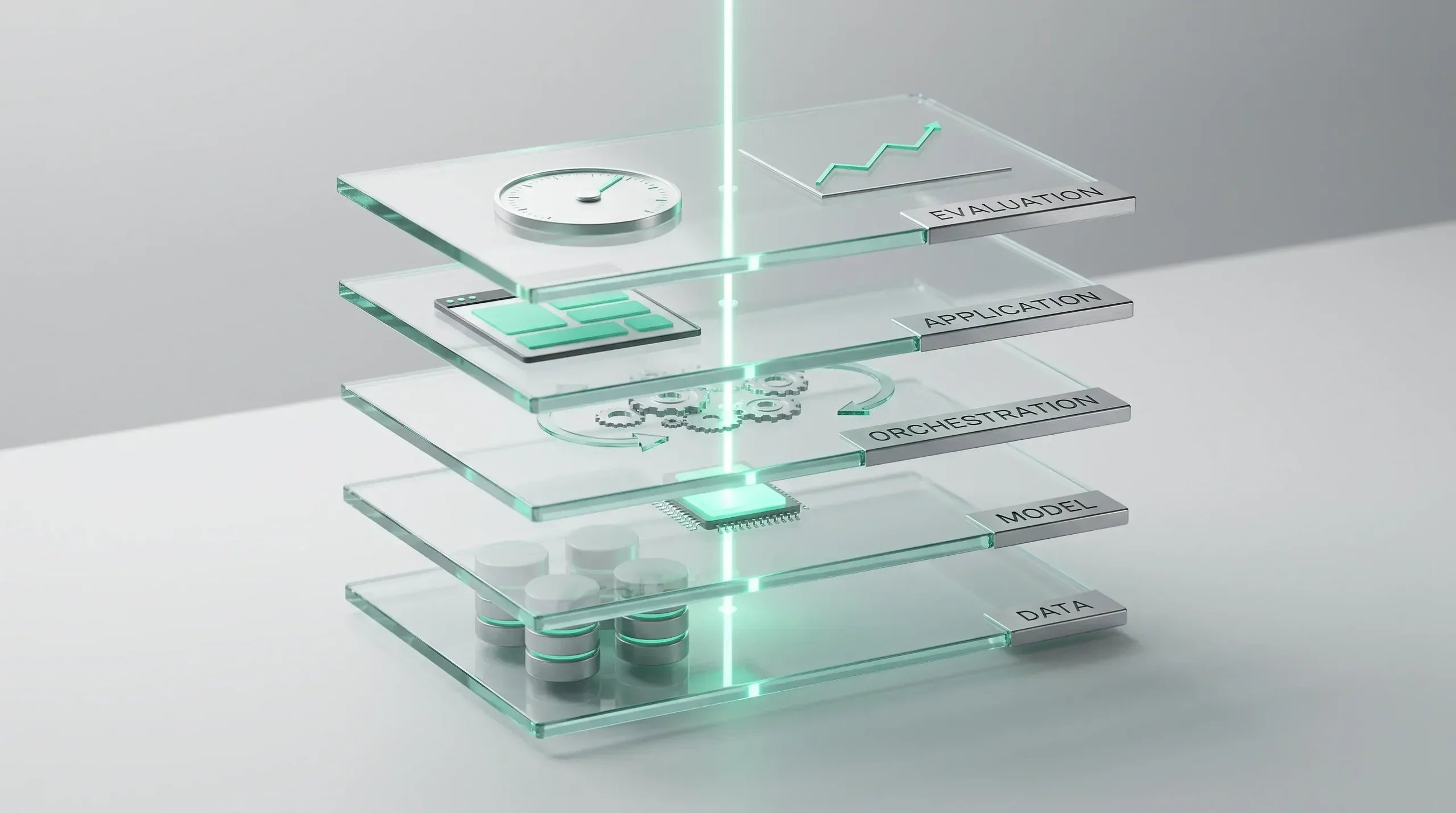
An AI product is a distributed system with a model inside it. Design the layers first, then choose tools for each layer.
Data Layer
Sources, ingestion, cleaning, storage and access rules. For retrieval products this layer also holds chunking, embeddings and the vector index. Data quality decisions made here set the ceiling for everything above.
Model Layer
The decision is between a hosted API, retrieval on top of an API, a fine-tuned open model and a custom model. Start from the task, the data you own and the cost per request. Our AI development services page describes when each option fits.
Orchestration Layer
Prompts, chains, tool calls, retries, fallbacks, queues and business rules. This layer decides what happens when the model is slow, unavailable or unsure.
Application Layer
The product itself: interface, review actions, permissions, audit trail and the integrations that carry the result into other systems.
Evaluation and Monitoring Layer
Evaluation sets, automated scoring, human review sampling, cost dashboards, drift alerts and version history for prompts and models. A product without this layer cannot be improved safely.
What Team Do You Need to Build an AI Product?
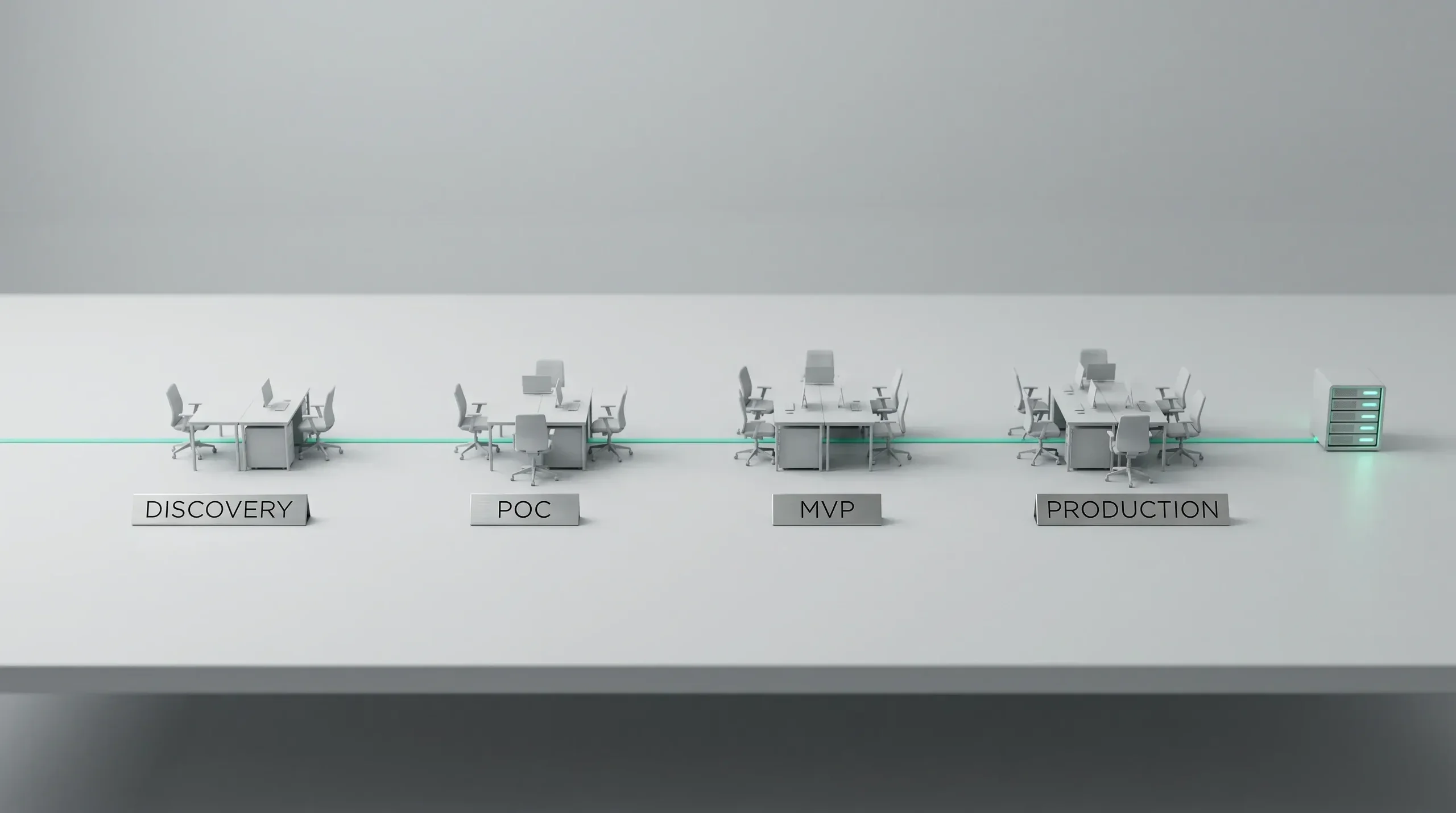
Team size follows the stage, the data volume and the compliance load. A discovery phase needs three or four people. A production system with regulated data needs more.
At discovery and proof of concept you need a product owner with domain access, an AI or ML engineer, and a data engineer when sources are messy. At MVP you add backend, frontend, QA and design. At production you add MLOps, security review and a support owner.
Who You Need at Each Stage
Roles join as the product moves from discovery to production.
Discovery team
Required: Product owner or BA, Domain reviewer. Part-time or as needed: AI or ML engineer, Data engineer, UX designer, Security or compliance.
PoC team
Required: Product owner or BA, AI or ML engineer, Data engineer, Domain reviewer. Part-time or as needed: Backend engineer, MLOps or DevOps, Security or compliance.
MVP team
Required: Product owner or BA, AI or ML engineer, Data engineer, Backend engineer, Frontend engineer, UX designer, QA engineer, Domain reviewer. Part-time or as needed: MLOps or DevOps, Security or compliance.
Production team
Required: Product owner or BA, AI or ML engineer, Data engineer, Backend engineer, Frontend engineer, QA engineer, MLOps or DevOps, Security or compliance. Part-time or as needed: UX designer, Domain reviewer.
The Product Type Changes the Mix
The mix also depends on product type. A retrieval assistant over internal documents leans on data engineering. A computer vision product leans on annotation and edge deployment. A regulated product carries a compliance role from the first week.
How the team grows
- Discovery and proof of concept run with three or four people
- MVP adds backend, frontend, QA and design
- Production adds MLOps, security review and a named owner
How Long Does It Take to Build an AI Product?
Anyone working out how to develop an AI product runs into the same constraint: data access sets the schedule more than headcount does. The honest answer is a range per stage, with a checkpoint that can stop the work.
Discovery takes one to three weeks. A focused proof of concept takes two to six weeks, depending on data access and the number of approaches tested. An MVP for one workflow takes two to four months. Hardening for production adds one to three months, and a pilot runs in parallel with it.
These ranges move on data access speed, integration count, compliance review depth and the number of approvers. Access delays are the most common cause of a slipped date.
What Determines the Cost of AI Product Development?
Cost has two halves. The build cost is people and time. The running cost is inference, infrastructure, monitoring, review labor and future retraining.
Model prices keep falling, and that misleads budgets. Cheap tokens do not make a cheap product. Volume, context size, retries, embeddings, storage and human review add up every month, and they grow with adoption. Price the cost per request at the design stage, then track it like any other unit economic.
Six drivers explain most quotes: the number of workflows in scope, data readiness and annotation effort, the chosen model approach, integration count, latency and reliability requirements, and compliance scope. A product that reads two document types and writes to one system costs a fraction of a platform with ten integrations and an audit trail.
Get a Realistic Roadmap for Your AI Product
Receive a structured assessment of the product scope, data requirements, architecture, team, risks, timeline, and next development stage.
Example: How to Build an AI Scrum Master SaaS Product
This worked example takes an AI Scrum Master SaaS product from a business problem to a production plan. The decisions repeat elsewhere, so the same sequence covers how to build an AI SaaS product in any other category.
Business Problem
Delivery managers spend hours each week chasing status, rewriting tickets and preparing reports. Teams lose time in status meetings that produce information the tracker already holds.
Initial AI Use Case
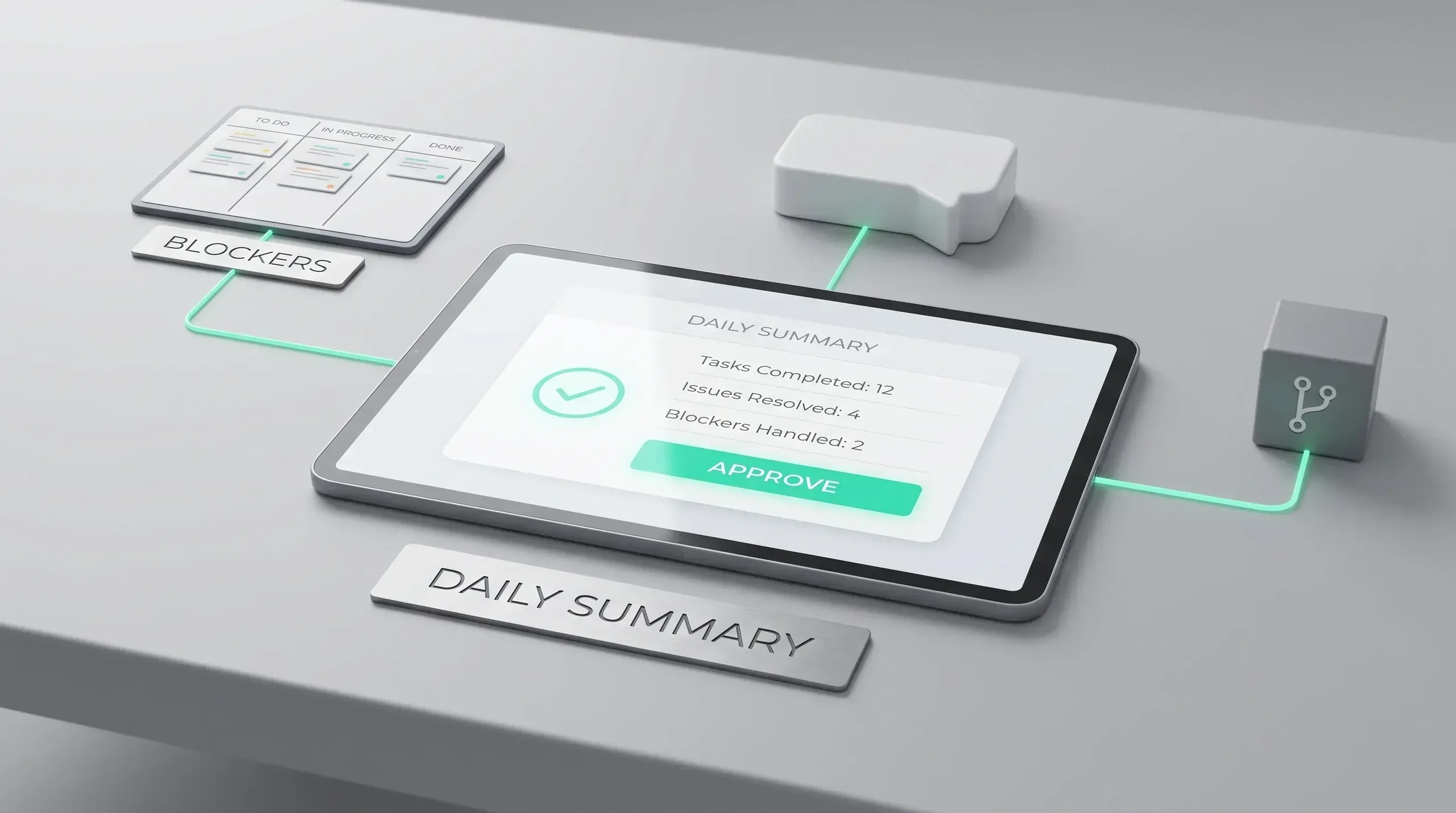
One workflow: read the project tracker, produce a daily status summary with blockers, risks and stale tickets, and post it where the team works.
Data Sources
Tracker issues and comments, sprint history, repository activity, chat threads in the project channel, and calendar entries for ceremonies. Access rules and personal data handling are agreed before ingestion.
MVP Scope
One team, one tracker, one chat channel. The product generates the daily summary, flags blockers, and lets the delivery manager correct any item in one click. Corrections are stored as training and evaluation data.
Architecture Choice
A hosted model with retrieval over project data covers the first release. Prompts and rules live in the orchestration layer, so the same pipeline serves other trackers later. A smaller model handles classification tasks such as stale ticket detection, which keeps the cost per team predictable.
Success Metrics
Minutes saved per manager per week, share of summaries accepted without edits, blocker detection recall against a labeled sample, and weekly active teams after four weeks.
Production Risks
Tracker data is incomplete, so the summary can miss work done outside the tool. Team-specific language causes misread statuses. Permissions must match the tracker exactly, because a summary can expose private items. Each risk has a control: source display, correction flow, permission mirroring and a confidence threshold that routes weak items to the manager.
Common Mistakes When Building an AI Product
Building an AI product fails in predictable ways. These eight cover most of the projects that stall after the demo.
Starting from the model
The tool is chosen before the task, so the scope bends to fit the tool.
No baseline number
Without the current cost, error rate or handling time, no one can prove the product worked.
Demo data only
Clean samples hide the cases that break the pipeline in week two.
No evaluation set
Quality becomes an opinion, and every release is a debate.
Ignoring the cost per request
Unit economics appear after launch, when redesign is expensive.
No human in the loop
Disputed results have nowhere to go, so users stop trusting the output.
Scope spread across many workflows
Five half-built features prove nothing. One finished workflow proves the case.
No owner after launch
Models drift, data changes and prompts age. Without an owner the product decays quietly.
How Hygge Software Helps Move AI Products from Idea to Production
Hygge Software builds custom software and AI systems for US and European companies, with seven years of production delivery and 200+ completed projects. The work is organized around the same stages this article describes.
Discovery produces a problem statement, a metric and a data inventory. A proof of concept tests the hardest assumption against real records, with quality and cost measured. The MVP covers one workflow end to end, with evaluation and monitoring built in from the start. Every milestone ships working software into the client's own repository, and the same senior team stays with the product after launch.
Two published cases show the pattern. On Smarter Humans, seven years on one product included AI content generation and a retrieval chat, with a 20-second document load cut by 93%. On Country Navigator, a decade-old monolith became services with zero downtime during migration, and each enterprise received an isolated AI knowledge base. More examples sit in our AI product development projects.
Delivery Record
Numbers published on hygge.software and in the case studies.
AI Product Development Checklist
Use this list when the budget is on the table. Each answer should be one sentence with a fact in it.
- The problem is written as one user task with a baseline number.
- The success metric is agreed with the person who owns that number.
- Data exists, is accessible, and legal review is done.
- An evaluation set of real cases is ready before development starts.
- The model approach is chosen against cost, latency and quality targets.
- The failure path is designed: low confidence, wrong answer, model outage.
- The first release covers one workflow end to end.
- Monitoring, logging and a retraining trigger are part of the MVP scope.
- A named owner is responsible for quality after launch.
Conclusion
Knowing how to create an AI product is mostly knowing when to stop. The rest is making sure what ships survives contact with real data. Stop when the metric is missing. Stop when the data is not there. Stop when the cost per request cannot work at your volume.
Teams that ship start small, measure early and design for the wrong answer. That is what turns a promising demo into a product the business keeps using.
Turn Your AI Idea into a Production Product
Get a structured assessment of scope, data, architecture, team and budget, and a clear next development stage.
AI Product Development FAQ
Direct answers to the questions teams ask at the start.
 What should you validate before building an AI product?
What is the difference between an AI PoC, MVP, and production-ready product?
How do you choose between an AI API, RAG, fine-tuning, and a custom model?
How much data do you need to build an AI product?
How long does it take to develop an AI product?
How do you keep an AI product reliable after launch?
Plan a Custom System Around One Business Number
Describe the process that slows your team down. Hygge maps it, names the metric the system should move, and sends a scoped plan with an exact price.

Describe the Bottleneck
Share the process, the tools in use and where manual work piles up.
Get a Workflow Review
Hygge maps the workflow and the data behind it, and brings that map to the first detailed call.
Receive a Scoped Plan
The approach, team, timeline and exact price, tied to the metric the system should move.