


LLM Development Services
Language model features built into a product, with the prompt layer versioned like code and an evaluation set that catches a regression before your users do. Hygge's llm development services start by proving the model can do the task on your own examples.
What Goes Into LLM Application Development
The layers between a model that demos well and a feature that holds up on Monday morning. Hygge scopes which your case needs after testing on your real examples.
Task Definition and Evaluation Set
What a correct answer looks like, written down as scored examples before any prompt gets tuned. Without this, every later change is judged by whoever read the output last.
Model Selection
Candidates benchmarked on your task for quality, latency, and cost per call. A small model that scores well on your specific job beats a frontier model on every line of the budget.
Prompt Architecture
System instructions, few-shot examples, and structured output schemas held in one place and versioned. LLM development stops being guesswork once prompts live under source control.
Grounding and Retrieval
Connecting the model to your own documents and records so answers cite a source. Retrieval covers most cases where a team assumes it needs a trained model.
Fine-Tuning Where It Pays
Training a model on your own labelled examples when format consistency or domain vocabulary justifies the cost. Custom AI model training gets recommended after the cheaper options have been measured.
Guardrails and Output Validation
Schema checks, refusal handling, and content rules applied to every response, so a malformed answer never reaches the part of your product that trusts it.
What Gets Decided Before an LLM Build Starts
Hygge opens with a paid feasibility check on your own examples. A llm development company that quotes before running the task on your data is quoting on a demo.
The check settles each of these:
- Whether the task is within reach of a current model at all, measured on your examples.
- Which approach carries it: prompting, retrieval, fine-tuning, or a combination.
- The evaluation set and the score the feature has to clear before launch.
- Cost per call at your projected volume, and where the data is allowed to go.
- Fixed scope and price for the build, agreed after the audit.

What Sends a Team to Build on an LLM
The situations behind most enquiries Hygge scopes.
Prompts spread, quality drifts, and nobody can prove a change made things better. LLM development treats prompts like code: versioned, tested against a fixed question set, measured before release. The audit builds that evaluation set from your own examples.
The Prompt Works Until It Does Not
A prompt written by hand covers the cases someone thought of. A new phrasing arrives, the output shifts, and there is no test that would have caught it.
Prompts Live Everywhere
Strings scattered across the codebase, edited by three people, with no record of which version produced last month's results. A fix for one case quietly breaks another.
Nobody Can Say Whether It Got Better
Changes get shipped on the impression of whoever read a handful of outputs. With no scored evaluation set, improvement and regression look identical.
Fine-Tuning Was the First Answer
A team commits to training before testing whether prompting or retrieval already clears the bar, and spends the budget on labelling data the task never needed.
The Model Changed Under the Same Name
A provider updates a model behind the same version string, output quality moves, and the first signal is a support ticket.
How We Build an LLM Feature
From a feasibility check on your examples to a feature running behind an evaluation gate. Every llm development company project at Hygge follows the same path, with something to review each week.
Feasibility Check
Two weeks on your task and your examples, ending in a scored baseline, an approach recommendation, and an exact price.
Build the Evaluation Set
Scored examples covering the normal cases and the awkward ones, agreed with the people who will judge the output in production.
Iterate Against the Score
Prompt, retrieval, and model changes measured against the same set every time, so a weekly demo comes with a number attached.
Ship Behind a Gate
The feature reaches a share of traffic once it clears the agreed score, with output logging and a rollback that takes one toggle.
Handover
Prompt versioning, the evaluation harness, dashboards, and a session with your engineers, so your team changes a prompt without calling us.
What Changes Once the Prompt Layer Is Engineered
A prompt change gets scored before it reaches users, so quality moves on evidence. When a provider updates a model underneath you, the same evaluation set says exactly what changed, and rollback takes one version bump. LLM application development covers the product around the model: retrieval, approval, fallbacks and the interface people work in. Custom LLM development goes further, where a general model cannot hold your terminology or your rules. LLM integration services cover the connection to the systems that already hold your data. LLM evaluation runs across all three, because without a fixed set of real questions and a score per release, a change that helps one answer and breaks four ships unnoticed.

The Standards LLM Evaluation Is Held To
These are the targets the work is built to hit, measured on your own numbers.
Where Language Models Earn Their Cost
Sectors where the work is reading, writing, or classifying text at volume.

LegalTech
Drafting and summarisation over the firm's own documents, with a citation on every claim so a lawyer can check the source in one click.

EdTech
Content and feedback generated inside the course material, so what a learner reads stays aligned with what was taught.

Retail & E-Commerce
Product copy, search rewriting and support replies produced at catalogue scale, with brand rules applied before anything publishes.

Sales & Marketing Technology
Call summaries, follow-up drafts and CRM field filling produced from the conversation itself, so the record stays current.
Language Model Features in Production
LLM development services Hygge has shipped into products with live users.
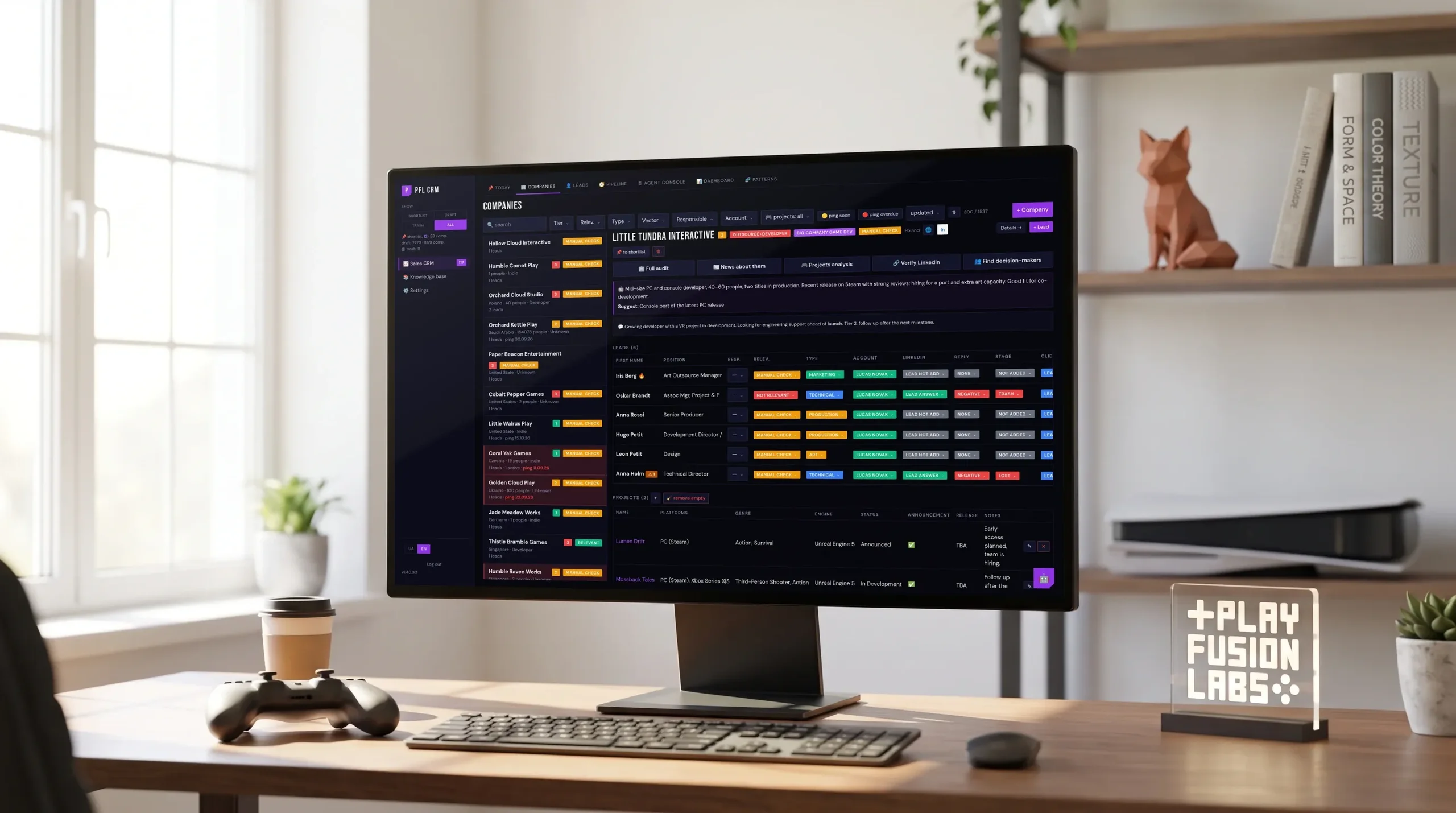
PlayFusionLabs CRM
Custom CRM development for a game studio. An agent researches companies, Today lists who to ping, and finance sits in one database.
- ~2 monthsFrom first call to daily use
- 150+Releases since launch
- 1 databaseFor sales, projects and finance
- $0In per-seat licences

Clia
Two AI apps for consultants on one core, with a trained model that turns legal references into links.
- Auto-linkedCitations a consultant used to look up by hand
- 1 passA document read once, every reference resolved
- 2 appsOn one platform, shipping apart

Offra
An AI gift finder built in about a month for a startup whose marketing was booked against a Black Friday date.
- 3 milestonesDelivered before the holiday launch window
- 100 %Of results are products a buyer can order
- ~1 monthAgainst a Black Friday date that could not move
What You Get From the Feasibility Check
A scored baseline on your own examples, an approach recommendation with the benchmark behind it, a cost model at your projected volume, and a fixed scope and price. LLM development services that start with evidence the task is achievable.
The Stack Behind Custom LLM Development
Chosen against your task, your data boundary, and what your own engineers will maintain, including whether ai model fine tuning belongs in the build at all.
The model behind the feature, weighed on accuracy for your task, latency a user will accept, and cost per thousand calls at production volume.
 OpenAI API
 Anthropic Claude API
 Google Gemini
 Llama
Llama Mistral
 Cohere
 AWS Bedrock

Frequently Asked Questions
What product and engineering leads ask.
 What is a large language model?
How do large language models work?
What are large language models used for?
What does large language model mean?
What is the best description of a large language model?
Should we fine-tune a model or use prompting?
Which model should we build on?
How do you know the feature works?
What happens when a provider updates the model?
How much does custom AI model training cost?
Can the model run on our own infrastructure?
Who owns the prompts and the fine-tuned model?
From a Language Task to a Feature With a Score
Tell us what the model has to read or write and show us a handful of real examples. Every llm development company pitch should start there: you get a scored baseline, an approach, and a price.

Tell Us What the Model Has to Produce
Share the feature you have in mind, the accuracy it needs, and the budget per thousand requests.
Get a First Consultation
We review your use case, data, and accuracy targets for anything that would change scope, cost, or timeline.

Receive a Detailed Proposal
A scoped plan with the approach, timeline, and cost, built around your actual accuracy and cost targets.