
AI Integration Services
Adding AI to a product that already has users, without a rewrite and without a migration. Hygge's AI integration services connect models through the APIs your product already exposes, behind a cost ceiling and a fallback path, so a slow provider never takes your feature down with it.
What Enterprise AI Integration Covers
The layers that decide whether an AI feature holds up inside a live product. Hygge picks which your case needs after reviewing your architecture.
Model Selection and Routing
Which provider handles which request, and what happens when one is slow or down. LLM integration in production means a routing layer, so a single provider outage stays an internal event.
API and Product Integration
Wiring the model into your existing endpoints, queues, and permissions. Nothing in your product gets rebuilt to make room for it, and the AI feature ships behind the same auth as everything else.
Cost Control and Rate Limits
Token budgets per user and per feature, caching for repeated calls, and alerts before a bill surprises anyone. An ai api integration without a spend ceiling is an open invoice.
Latency and Streaming
Streaming responses, background processing for anything slow, and timeouts that degrade to something useful. The interface stays responsive while the full answer arrives.
Fallbacks and Failure Handling
What the product does when the model returns nonsense, times out, or refuses. Every path has a defined answer, so a failed call never surfaces as a blank screen.
Evaluation and Monitoring
Logging on prompts, outputs, latency, and cost per call, plus a quality check that catches a provider silently changing model behaviour under the same version name.
What the Review Decides
Hygge opens with a review of your architecture and the feature you have in mind. AI integration services work is scoped from that review, which keeps the estimate honest.
The review settles each of these:
- Where the AI call sits in your existing flow, and what it blocks while it runs.
- Provider choice, benchmarked on your actual prompts at your actual volume.
- Cost ceiling per user and per month, with the enforcement mechanism agreed.
- Data boundary, what leaves your infrastructure and what a provider is contractually allowed to retain.
- Fixed scope and price for the integration, agreed after the audit.

What Sends a Team to AI Agents Integration
The situations behind most enquiries Hygge scopes.
The gap is usually between a demo and something people depend on. AI integration attaches the model to the product you already run, with cost per request measured before it ships. The audit says what your stack exposes and where the model plugs in.
Competitors Shipped an AI Feature
Your product is solid and a competitor shipped something that demos well. The pressure is real, and the wrong response is bolting on a feature nobody scoped against your architecture.
The Prototype Works, Production Does Not
Someone on the team wired an API call in a weekend and it works beautifully for one user. At a hundred concurrent users it hits rate limits, and there is no fallback.
The Bill Grew Faster Than Usage
An AI feature shipped without token budgets or caching, and now finance is asking why the line item tripled while signups stayed flat.
No One Owns the Prompt Layer
Prompts live scattered across the codebase, nobody versions them, and a change made to fix one case quietly breaks another.
The Data Cannot Leave
Legal or contractual limits mean customer data cannot go to a third-party API. That rules out the hosted path and puts an architecture decision in front of the feature design.
How We Integrate AI Into a Live Product
From ai integration services at the architecture stage to a feature running behind a cost ceiling, with something shippable every week.
Architecture Review
Two weeks on your codebase, your traffic, and the feature you want, ending in a provider recommendation and an exact price.
Benchmark on Your Prompts
Candidate providers tested on your real prompts at your real volume, scored on quality, latency, and cost per call. The choice comes back as a table.
Build Behind a Flag
The integration ships behind a feature flag from week one, so it reaches a small share of traffic before it reaches everyone.
Ramp and Watch
Traffic increases in stages while latency, cost, and output quality get watched at each level, with a rollback that takes one toggle.
Handover
Prompt versioning, dashboards, runbooks, and a session with your engineers, so your team owns the feature afterwards.
What Changes Once AI Is Inside the Product
The feature ships inside the product your customers already use, with no separate tool to learn. Cost per request is known before launch and watched after it, so the bill stops outgrowing usage. When a provider changes a model, the swap is a config change. AI data integration is the part most projects underestimate: getting a model to read what your systems already hold, in the form they hold it. AI agents integration adds the write path, where an action taken by a model has to land in a real system under real approval rules. Enterprise AI integration covers the access model and the audit trail an internal review will ask for. Retail AI integration usually starts at the catalogue, because a recommendation is only as good as the stock and margin data behind it.

The Standards AI Integration Is Held To
What Hygge commits to on this service, and how each commitment is measured.
Where Retail AI Integration Gets Added to Working Products
Sectors where Hygge has put a model inside software that already had users.

Sales & Marketing Technology
AI features added next to the CRM your team already lives in, respecting its API limits and its data residency terms.

Retail & E-Commerce
Model calls wired into checkout, search and support flows, with a fallback path so a provider outage stays invisible to shoppers.

Media & Entertainment
Tagging, transcription and recommendation calls added to an existing publishing pipeline while the release calendar keeps running.

Healthcare & Staffing
AI features added to systems under access rules, with a log of which record fed which output on every call.
AI Added to Products Already in Production
AI integration company work shipped into software with live users.

Freight Rate Forecasting for a Forwarder
Freight rate forecasting for a forwarder in Lithuania. It flags truck shortages and rate jumps by lane before the trip is quoted.
- By laneSpot Rate and Shortage Forecast
- 1 storeFor ERP, Exchange and Public Data
- TestedOn the Forwarder's Own Trips
- 1 tapFor the Driver's Route

Sickstadium
An AI video clipping MVP: bring in a long video, describe the moments you want, and review ranked clips to title, score and export.
- ~2 monthsFrom First Call to Working MVP
- Multiple promptsPer Pass Over the Footage
- 60 hoursOf Independent QA on a Second Product
Invoice Data Extraction
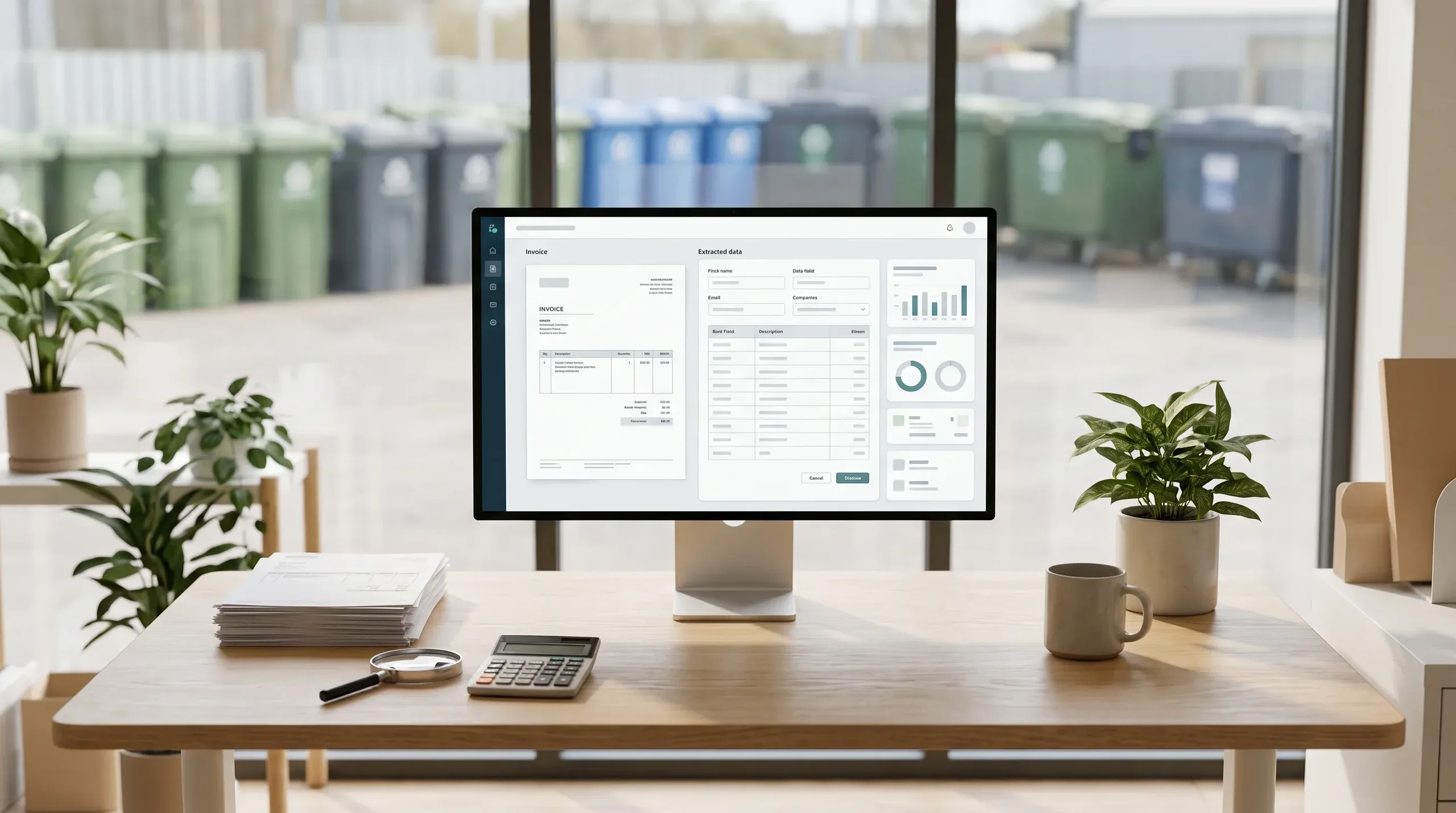
Invoice data extraction for a US waste broker: hauler prices from 500 PDF invoices a month feed a price history, quick quotes and a marketplace for regular services.
- On the callWhen Sales Can Name a Price
- ExceptionsWhat People Still Review
- 12 monthsOf Invoices Read in One Run
- To the centOn the Client's Sample Invoices

Logistics Data Exchange Platform
A logistics data exchange platform that puts shipment data from emails, PDFs and calls in one record and moves dock slots for late trucks.
- On the roadWhen a Delay Is Caught
- 1 actionTo Confirm a New Dock Slot
- EUServers for Shipment and eFTI Data
- 1 recordFor Shipper, Warehouse and Carrier

AI Meal Planning Platform
An AI meal planning platform built from scratch. It turns the ingredients someone already has into personal, ready-to-cook meals in seconds.
- SecondsFrom Ingredient List to Meal Ideas
- From scratchBuilt End to End by Hygge
- Less wasteThe Goal the Product Is Built On

Revvy
CRM analytics by voice: a salesperson speaks a question into a mobile app and gets back the chart that answers it.
- 1 phraseFrom Question to Chart
- 3 stepsSpeech, Query, Chart
- Any managerCan Ask the CRM
Hygge Lead Generation
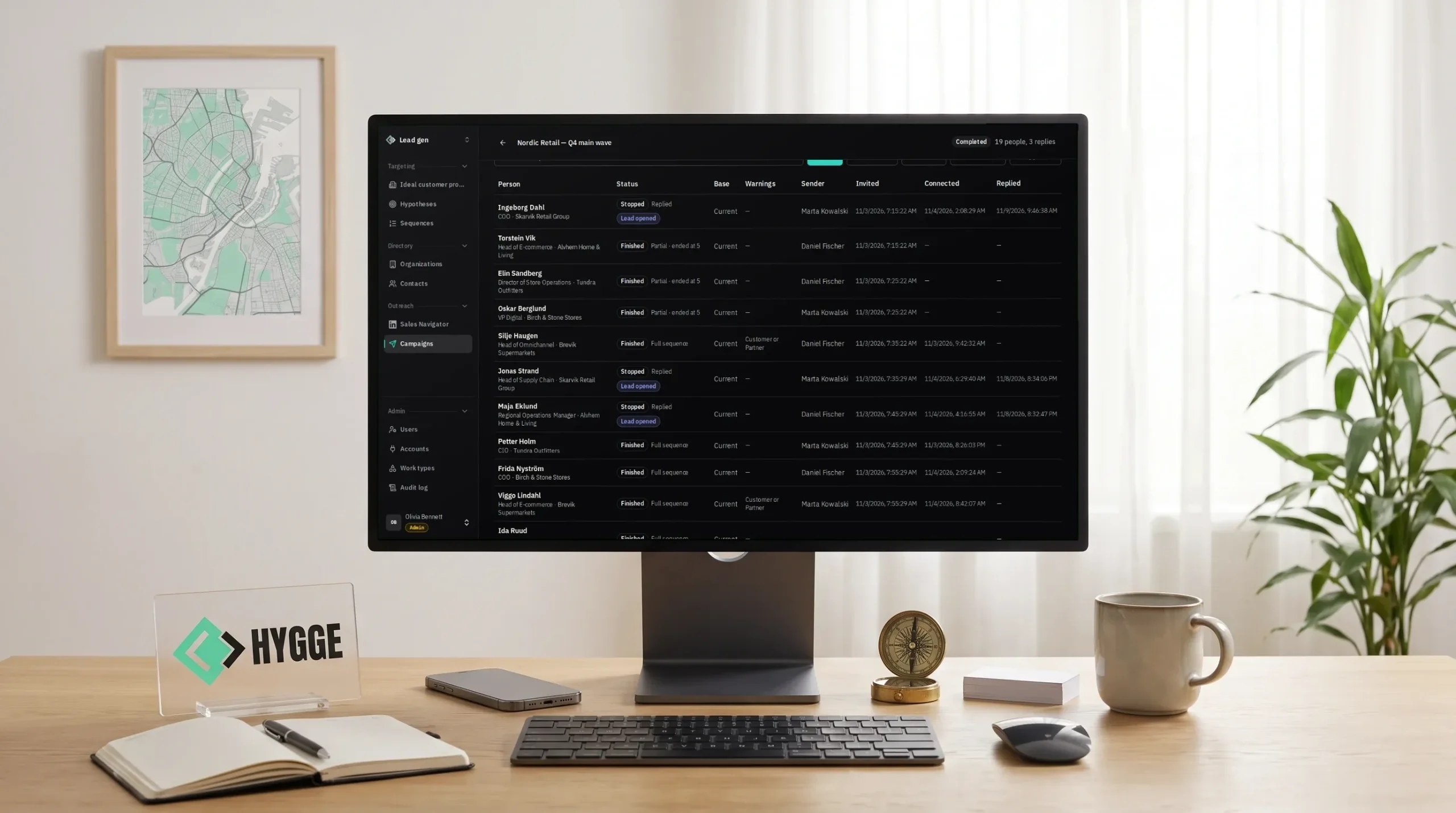
Hygge's own outbound platform, where only approved hypotheses run campaigns. Every reply traces back to the targeting behind it.
- 5 toolsReplaced by one platform
- 0Scripted messages sent after a reply
- Every leadTraced to its hypothesis
- Per accountDaily and weekly sending limits
Hygge Presale
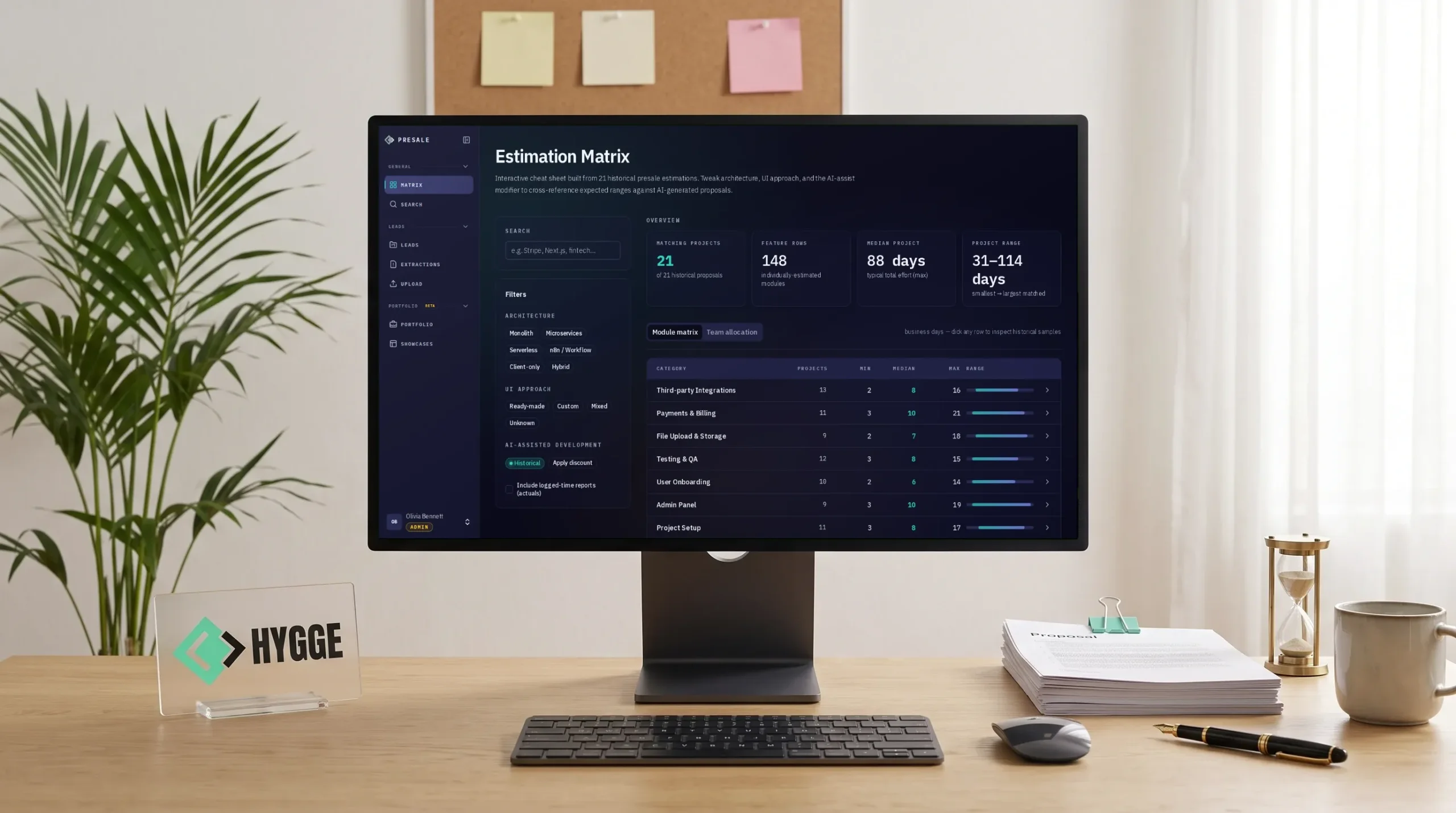
Hygge's own presale workspace, where an AI agent drafts estimates from past deals. People approve them, and every proposal feeds the next.
- 6 sub-statusesDrive each pipeline stage
- Every moduleAnchored to evidence
- 5 formatsFrom one approved deck version
- 3 modesOf case disclosure, enforced
Hygge HR
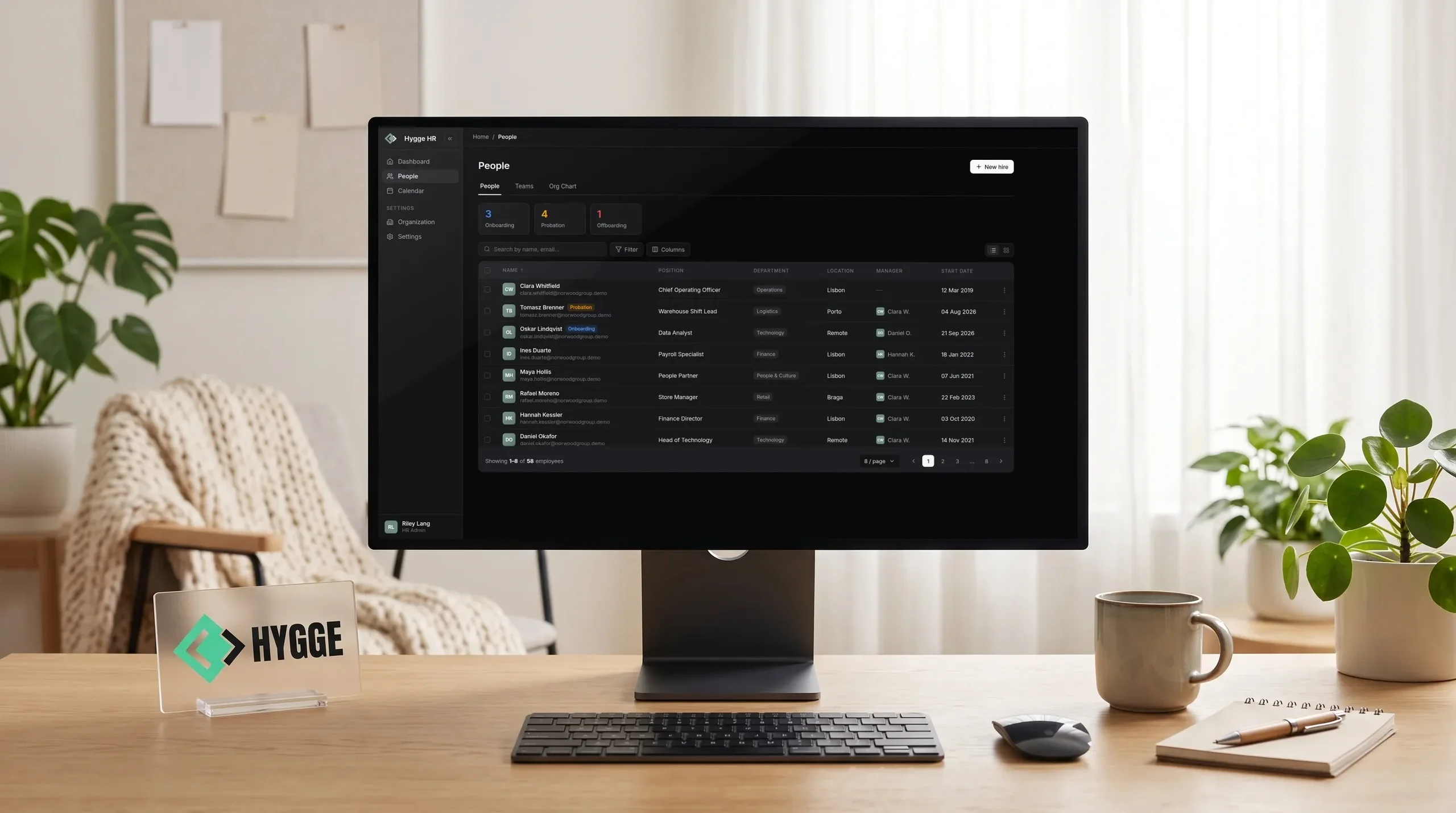
Hygge's own HR platform: people, time off, hiring and projects in one system. Balances, reminders and pay history update every night.
- 0Manual balance recalculations
- 3+ yearsTenure days added on their own
- 1 platformFor people, time off, hiring and projects
- Any dateRole and pay history on record
PlayFusionLabs CRM
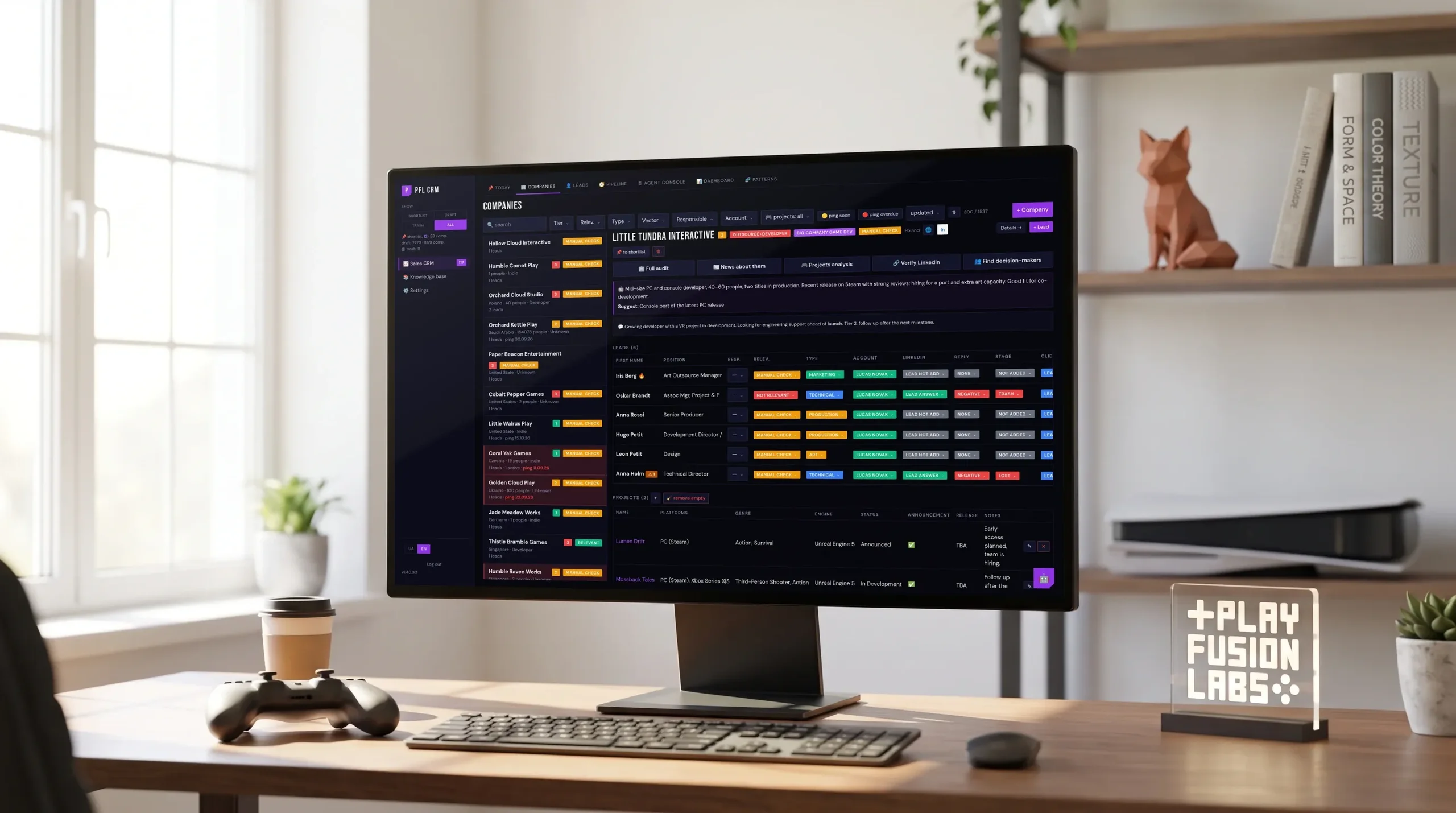
Custom CRM development for a game studio. An agent researches companies, Today lists who to ping, and finance sits in one database.
- ~2 monthsFrom first call to daily use
- 150+Releases since launch
- 1 databaseFor sales, projects and finance
- $0In per-seat licences
What You Get From the Architecture Review
A provider recommendation with the benchmark table behind it, a cost model at your projected volume, the integration points named in your own codebase, and a fixed scope and price. AI integration services that end in numbers.
The Stack Behind AI Data Integration
Chosen against your data boundary, your volume, and what your own engineers will maintain.
The providers the product calls, with a fallback path so an outage at one of them stays invisible to your users.
 OpenAI API
 Anthropic Claude API
 Google Gemini
 Azure OpenAI Service

Frequently Asked Questions
What product teams ask about AI integration services.
 What is AI integration?
How to integrate AI into your business?
What is integrated AI?
Which service includes AI agent integration services?
Can AI be added to my existing product without a rebuild?
How much does AI integration cost to build and to run?
Which AI provider should I use?
What happens when the AI provider goes down?
Can I stop AI costs from running away?
What if my data cannot go to a third-party API?
Who owns the prompts and the integration code?
What does artificial intelligence integration involve?
From an AI Idea to a Feature in Your Product
Tell us what your product does and what you want the AI to do inside it. You get the same starting point every ai integration company project at Hygge begins with: a provider recommendation, a cost model, and a price.

Tell Us Which Systems Need to Talk to the Model
Share the platforms already running your business and where an AI feature has to plug into them.

Get a First Consultation
We review your systems and integration points for anything that would change scope, cost, or timeline.

Receive a Detailed Proposal
A scoped plan with the approach, timeline, and cost, built around your actual systems.