
Digital Asset Management Software for Brand and Creative Teams
Creative teams lose hours finding the approved version of a file and remaking work that already exists. Hygge builds the systems that keep assets, rights and brand rules in one place.
Where a Creative Automation Platform Wins Back Studio Time
What marketing and creative leads describe when they call us. Assets live in a folder somebody named two years ago, the approved version is whichever one was emailed last, and a resize request eats an afternoon. The team is paid for ideas and spends the day on file admin.
None of this reads as a software problem on the day. It reads as a busy quarter. The cost turns up somewhere else: in hours spent looking for files, in work produced twice, and in an asset that went out carrying a claim the legal team retired. Digital asset management software removes the repetition and puts the rest in one place.
Nobody Can Find the Approved Version
Finished work sits across drives, chat threads and somebody’s laptop. Finding the current logo, the signed-off photo or last quarter’s layout means asking three people, and the fastest answer is usually to make it again.
The Team Rebuilds Work That Already Exists
The same asset gets resized for a new channel, retyped into a new deck, and re-approved because nobody could prove it was approved before. Every rebuild is a chance for an old price, an expired claim or a retired logo to go out.
You Pay Per Seat in Four Tools That Do Not Talk
A storage tool, a project tool, a proofing tool and a brand portal, each billed per person, each holding part of the story. The one rule your business runs on, who may approve what for which market, lives in none of them.
Unreleased Work Leaks Through Links Nobody Closed
Campaign assets go out on share links for review and stay live long after the job. A freelancer keeps access from a project two years ago, and an embargoed launch appearing early costs more than the shoot did.
Digital Asset Management Software Hygge Builds for Creative Teams
Each card is a system a team moves to once a manual process stops holding. On the right is what changes and by how much.
Retail Media & AdTech Platforms
Booking, scheduling and reporting for the inventory you sell to advertisers, whether that is screens, placements or sponsored slots. Booked, delivered and invoiced are compared in one place, so a month closes without a spreadsheet.
- 100 %Of bookings reconciled against what was delivered
- 1 dayTo close a month across advertisers
- 3 xMore campaigns handled by the same operations team
Marketplace Development
A two-sided platform where brands find and book production talent, and the money, the brief and the delivery sit in the same record. This fits when the creative supply chain is the product itself.
- 48 hFrom brief posted to a booked creator confirmed
- 100 %Of payouts released against a delivered and accepted brief
- 3 xMore projects handled by the same coordination team
Business Process Automation
Every route an asset takes from brief to published, held in the system where anyone can see it. Who reviews, in what order, and what happens when somebody is away are rules the tool follows, so a launch stops waiting on a reply.
- 3 xFaster from final draft to approved and published
- 100 %Of approvals recorded with who signed and what they saw
- 1 routeOne defined path per asset type, the same at every office
Vendor Management Software
Photographers, agencies, freelancers and production partners held with their contracts, rates and usage rights in one record. When an asset is reused next year, the licence behind it is attached and its expiry raises a flag before it lapses.
- 100 %Of assets carrying the licence and the market they are cleared for
- 90 daysWarning before a usage right expires
- 1 rate cardApplied across every supplier, so nobody bills off-contract
Business Intelligence & Reporting
Which assets get used, by whom, in which market, and what happened after they ran. The report answers whether the shoot was worth the money, which is the question a finance lead asks about creative spend.
- 1 dayFrom month end to a usage and spend report per brand
- 100 %Of spend traceable to the assets it produced
- 5 xMore questions answered without an analyst building an export
API & Payment Integration
The connections between your storage, your project tool, your ad platforms and the CMS the work ends up in. An approved asset appears where it is needed without anyone exporting and re-uploading it.
- 100 %Of published assets pulled from the approved record
- 1 uploadAn asset is stored once and read by every channel
- 1 hFrom a failed sync to somebody knowing about it
Customer & Partner Portal Development
A brand portal where agencies, regional teams and partners take the current approved assets themselves, within the rights and the market they are cleared for. Your team stops being the download service.
- 80 %Of asset requests served without anyone on your team
- 100 %Of downloads limited to what that partner is licensed to use
- 1 placeThe current version, with the retired one out of reach
What a Creative Automation Platform Draws On
Why each of these gets used on a creative operations build, in the order it usually gets needed. This work touches a brand asset, an approval chain, a campaign budget and a partner link in the same campaign. These are the services that hold those together.
UI/UX & Product Design
Creative teams abandon a tool the moment it is slower than the folder they were using before. The interface has to be faster than the workaround on the first day, or adoption never happens. Design work here is what decides whether the system gets used at all.
Open the serviceGenerative AI Development
Resizing, versioning and first-draft copy eat the hours a team would rather spend on the idea. Generative work handles the mechanical variants and leaves the judgment with the people you hired for it. Every output stays inside your brand rules, because those rules are what the model is held to.
Open the serviceBackend, API & Database
Large files, many versions and simultaneous editors arrive together at a deadline. This layer keeps the library fast at that moment and keeps one version history everyone reads from. It is also where permissions on unreleased work are enforced.
Open the serviceSystem Integration
The asset library, the project tool, the ad platforms and the finance system were bought separately. Making one campaign the same record across all of them is what connects a piece of creative to the money it earned. Reporting then comes out of one source.
Open the serviceData Engineering
Spend, performance, asset usage and production time sit in different tools. Joining them shows which creative earns its production cost and which formats quietly lose money. A budget conversation then rests on a number.
Open the serviceSecurity Consulting
Unreleased work, client material and partner access sit across systems set up at different times, often through links shared once and never closed. Reviewing that is what stops a campaign leaking before its launch date. It is also what a brand client reviews before handing you their library.
Open the serviceWhat Brand Management Software Is Measured On
Agreed with you before digital asset management software is built, then measured against how the team works today. Every number here comes out of the audit, so it describes your own asset volume and your own approval chain. That is what makes the delivery date and the price hold.
The Stack Behind Brand Management Software and Creative Automation
Creative teams adopt a tool that works on the material they already have, so this stack is chosen around the assets, rights and history sitting behind a brand. Generation is one layer of it, and the record of what was approved outlives any single output.
Models and the orchestration around them. Output is shaped by your brand rules and your own reference material, so what comes back is usable at the first pass. Cost per generation is measured, because at team scale it decides whether the feature survives. Model choice is swappable, so a cheaper release next quarter is a config change.
 OpenAI API
 Anthropic Claude API
 LangChain
 Hugging Face Transformers
Advertising Software Development With the Same Shape
Each of these turned a creative or judgement-heavy process into a product: an agency method made into a tool, a character pipeline, a recommendation engine, and a platform that drafts and scores outreach. Every one started with expertise living in a few people and no way to scale it. What you see is the system that carried it further.

Sickstadium
An AI video clipping MVP: bring in a long video, describe the moments you want, and review ranked clips to title, score and export.
- ~2 monthsFrom First Call to Working MVP
- Multiple promptsPer Pass Over the Footage
- 60 hoursOf Independent QA on a Second Product
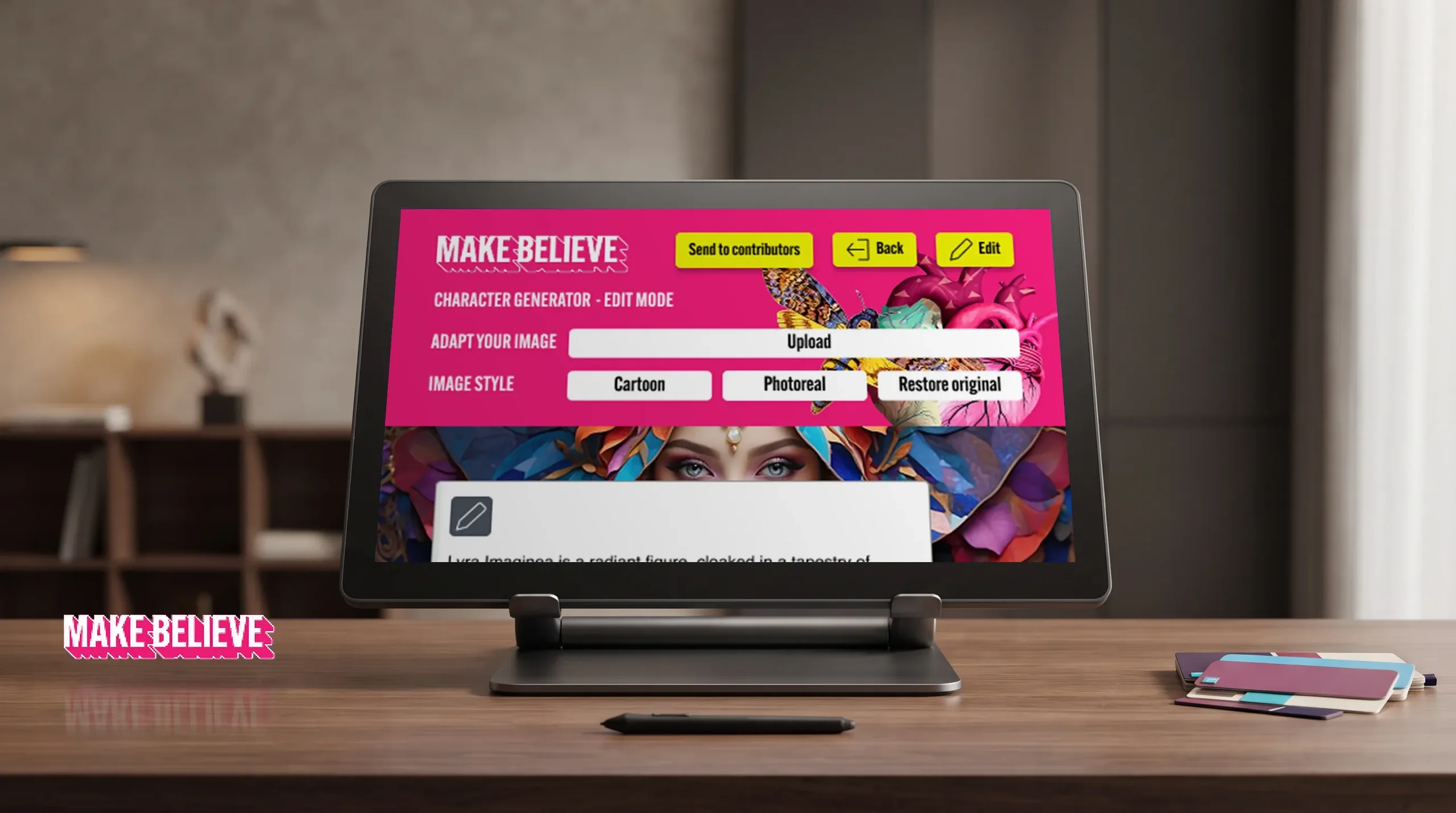
MB Character Tool
An embeddable AI character generator living inside an agency marketing site, built in eight weekly milestones.
- 1 promptFrom landing on the site to a result
- 1 iframePuts the tool inside the existing site
- 8 weeksFrom an empty repository to live on the site

CreAItivity
Creative agency software that runs a UK agency's ideation method without a facilitator, now in its third year.
- 36 widgetsCarry a method that needed a facilitator
- 20+ yearsOf agency practice turned into software
- 3rd yearOn the architecture chosen at the start
Creative AI Frequently Asked Questions
Brand control at volume, embedding a generative tool inside a site you already run, and what the model bill looks like each month are the first things creative teams ask about. The answers below come from tools already used by working teams. They also cover who owns the outputs and where unreleased work is stored.
 What is digital asset management?
What is a digital asset management system?
Why use a digital asset management system?
How does digital asset management work?
Why is digital asset management important for creative teams?
How is this different from a generic AI writing tool?
How do you keep generated output on brand at volume?
Can a tool be embedded in our existing site?
What does a generative product cost to run?
What does marketing software development usually start with?
What does creative operations software need to get right first?
From Scattered Sources to One Reliable Layer
Tell us what systems you run and what question you cannot answer today. You get a source inventory, a scope, and a price.

Tell Us What's Running Unmonitored
Share the models, the stack, and where deployment or monitoring is still manual, whatever's costing your team time right now.

Get a First Consultation
We map your current models and infrastructure for anything that would change scope, cost, or timeline.
Receive a Detailed Proposal
A scoped plan with the approach, timeline, and cost, built around your actual stack.