


AI Agent Development
Hygge works as an AI agent development company, building agents that execute multi-step tasks across your existing systems, within approval rules and access limits your team sets, scoped against the time or cost the process takes today.
What Goes Into an AI Agent Build
What each piece of a production agent does on its own, and how Hygge decides which combination your project needs after reviewing your process and systems.
Task & Tool Design
The exact job the agent is allowed to do and the tools it can call to do it, a defined set of actions in your CRM or ERP that your team signs off on before the agent goes live.
Multi-Step Orchestration
The logic that lets the agent plan a sequence of steps, check the result of each one, and decide what to do next, the mechanics that turn a single AI call into a task that finishes.
Approval & Access Rules
The line between what the agent can do on its own and what waits for a person to confirm, set by your team, applied every time, and logged.
Fallback & Error Handling
What happens when a step fails, a system times out, or the agent hits a case it wasn't scoped for, a defined path back to a person, so the failure shows up in a log where someone will see it.
Data & Systems Integration
We connect the agent through the APIs your CRM, ERP, and internal tools already expose, so it acts on your real records.
Deployment & Monitoring
The agent goes live with logging and monitoring in place, so a rise in failed steps or escalations shows up on a dashboard promptly.
What Gets Decided Before an AI Agent Goes Into Development
The concrete choices behind the agent, settled with you during the audit, before an AI agent development company can commit to scope or price.
Settled During the Audit:
- Success metric agreed with you, the hours or cost saved, the number the project is judged on
- The exact scope of what the agent can touch, which systems, which actions, and which it never gets access to
- Approval points, set with your team, where a person confirms before the agent acts
- Integration through your existing APIs, nothing in your systems gets rebuilt to fit the agent
- Cost and scope agreed, a fixed number for the build, set after the audit maps the systems the agent needs to touch

What Pushes a Team to Build an AI Agent
A process that still needs someone to copy data between two systems, a queue of exceptions nobody's fixed the root cause of, or a task that only runs when a specific person is available, the costs the audit puts a number on before we recommend a build.
Work stalls between systems, and the automation that exists breaks the moment something is unusual. AI agent development puts approval rules and access limits around the agent before it touches anything that costs money. The audit maps the handoffs worth automating first.
Manual Handoffs Between Systems
Someone still copies data from one system to another, checks it, and moves it again, a multi-step process that eats hours every week and only grows as the business does.
Automation That Breaks on the First Exception
Simple rule-based automation works until a case it wasn't written for shows up, and then it fails silently or hands the whole process back to a person anyway.
Agent Pilots That Never Get Trusted With Real Systems
A demo agent completes one clean task against a test account and looks ready to ship. Then it hits a record with a missing field, a system that's slow to respond, or a case two steps outside what it was shown, and without approval rules and a defined fallback, it either takes an action nobody signed off on or stalls mid-task with no one noticing.
Unclear Return on Investment
The budget for an agent project gets approved without a number attached to the hours or the handoffs it should remove, and the project loses its champion the moment someone asks what it saved.
How We Build an AI Agent
From your process to an agent running in production, the path every project at Hygge follows, with a working demo you can watch complete a real task at the end of each step.
Audit
We review your process, the systems it touches, and where an agent pays off first. That review is what defines which steps the build can run on its own and which ones need a human sign-off first.
Architecture
We lock in the task scope, the tools the agent can call, and the approval rules chosen during the audit, and map how it connects into your existing systems.
Build
The agent gets built against your real systems and approval rules from week one, so every weekly demo shows it completing an actual multi-step task end to end.
Deploy
The agent goes live in your infrastructure, rolled out in stages so it earns trust on lower-risk tasks before it touches the rest.
Support
We stay on after launch to monitor performance, review escalations, and adjust the rules as your process changes.
What AI Agents for Business Change in Your Workflow
The handoff between systems happens on its own, with a record of every action the agent took. Anything outside the rules you set waits for a person, so an unusual case stops the flow. AI agents for business are worth building once the approval rules are clear: what the agent may do alone, what needs a person, and where it stops. That is what AI agent consulting is for, and it usually takes a week. Firms that start an AI agent development project without it pay twice, once for the build and once for the rules it should have followed.
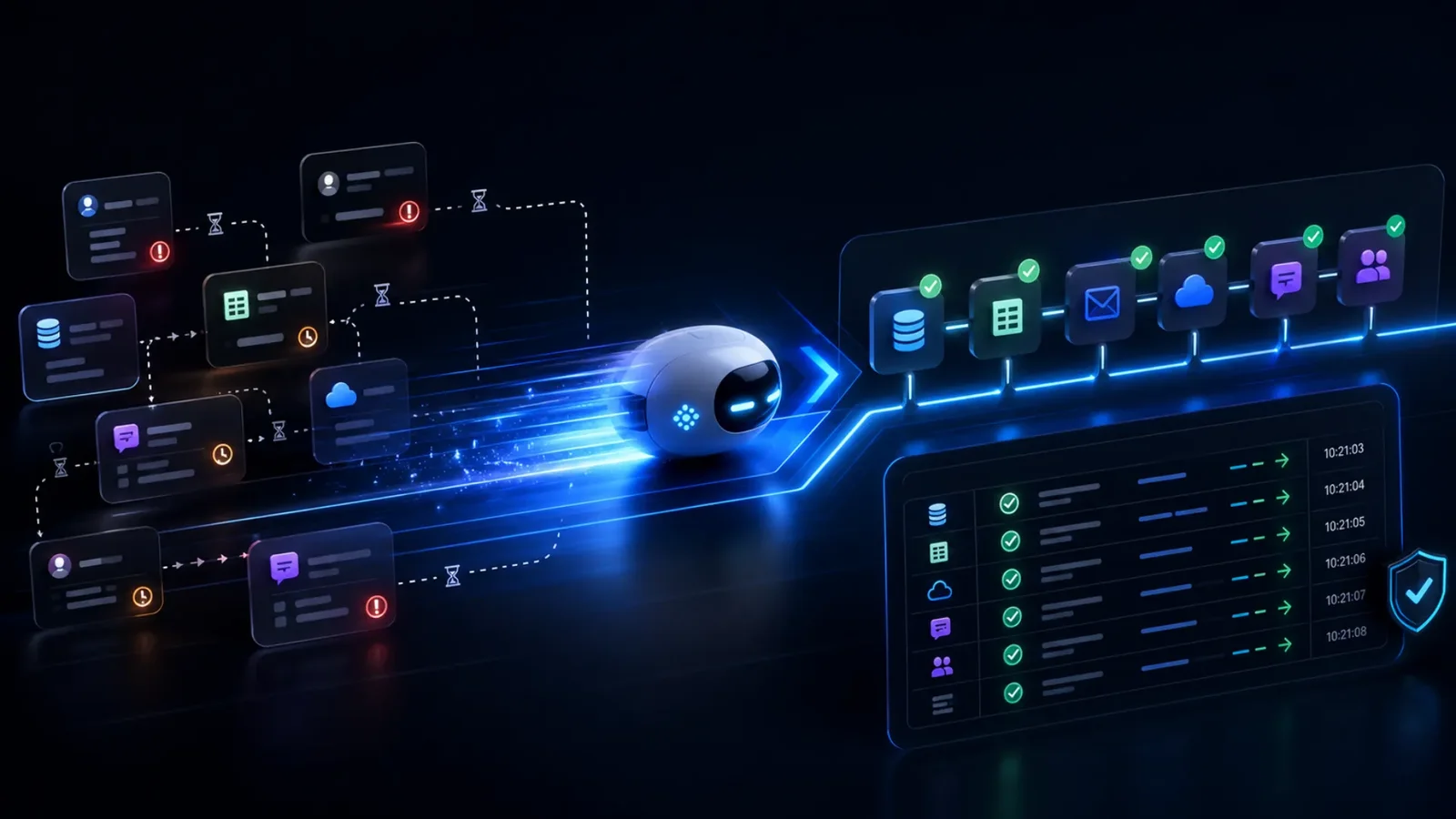
The Standards AI Agent Development Services Are Held To
What Hygge commits to on this service, and how each commitment is measured.
Where We've Already Built This
Industries where Hygge's AI systems are already running in production, the base we build on once a use case is ready for a multi-step agent.

Sales & Marketing Technology
Agents that work a queue inside the CRM, taking the routine steps and stopping at the approval rules you set.

Healthcare & Staffing
Agents handling intake and scheduling inside your perimeter, with every action logged and an approval gate on anything clinical.

HR & Recruitment
Agents screening, scheduling and chasing paperwork, with the reasoning recorded so a decision can be explained to a candidate.

Retail & E-Commerce
Agents handling order questions, returns and stock checks end to end, escalating to a person on the cases that cost money.
Hygge's AI Agents Already in Production
A sample of autonomous AI agents already carrying real production tasks, the stage most agent pilots never reach.
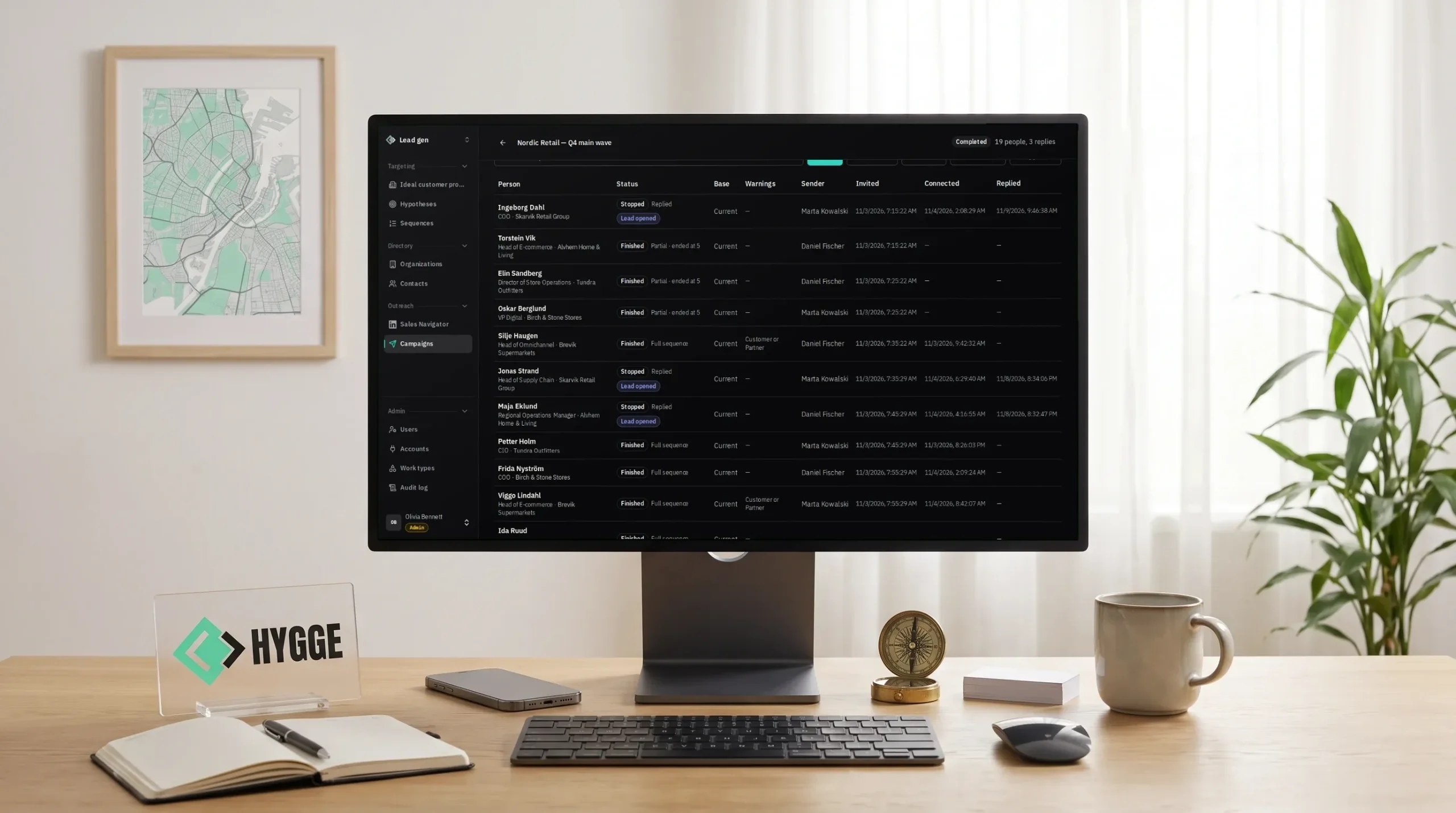
Hygge Lead Generation
Hygge's own outbound platform, where only approved hypotheses run campaigns. Every reply traces back to the targeting behind it.
- 5 toolsReplaced by one platform
- 0Scripted messages sent after a reply
- Every leadTraced to its hypothesis
- Per accountDaily and weekly sending limits
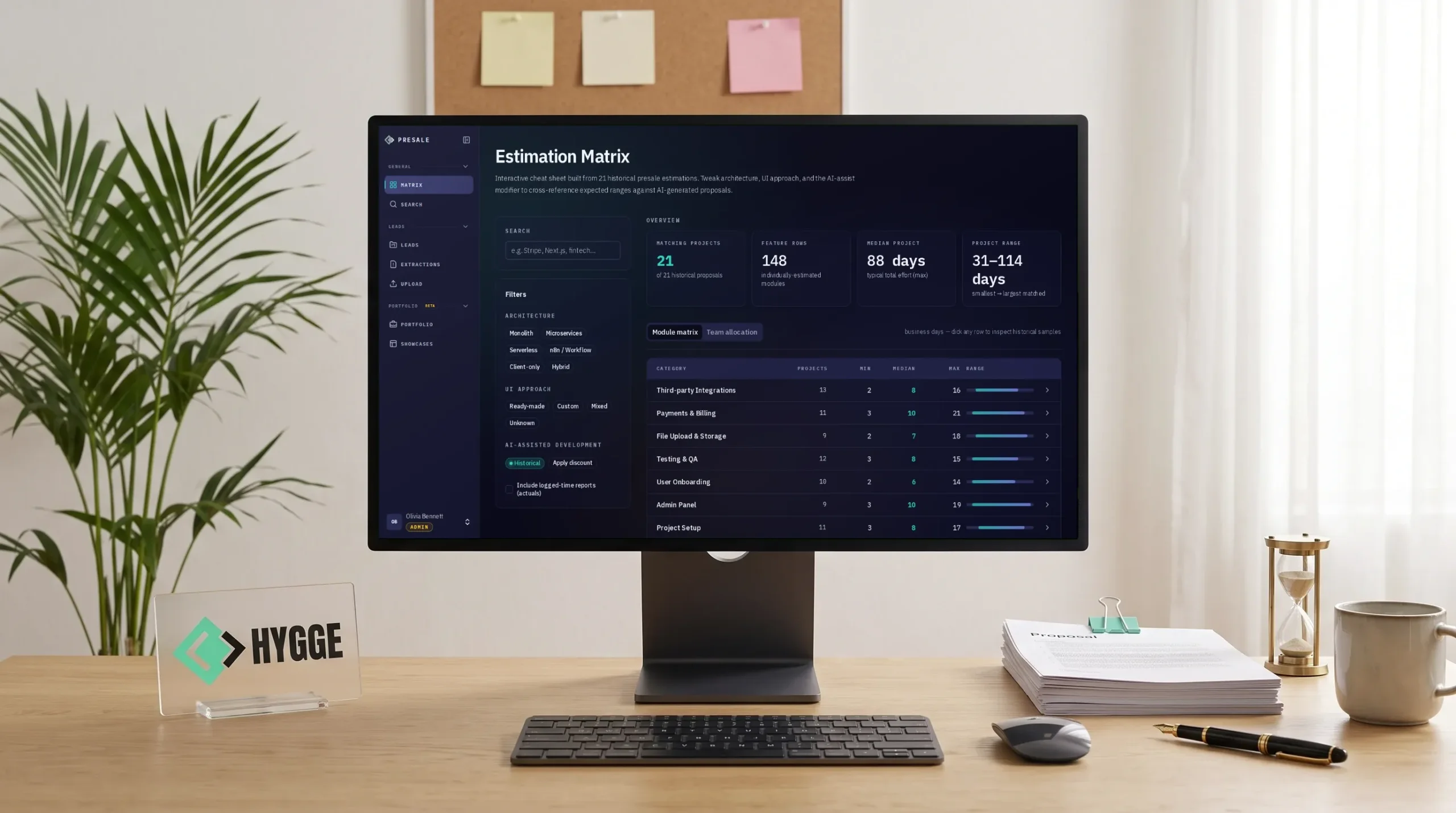
Hygge Presale
Hygge's own presale workspace, where an AI agent drafts estimates from past deals. People approve them, and every proposal feeds the next.
- 6 sub-statusesDrive each pipeline stage
- Every moduleAnchored to evidence
- 5 formatsFrom one approved deck version
- 3 modesOf case disclosure, enforced
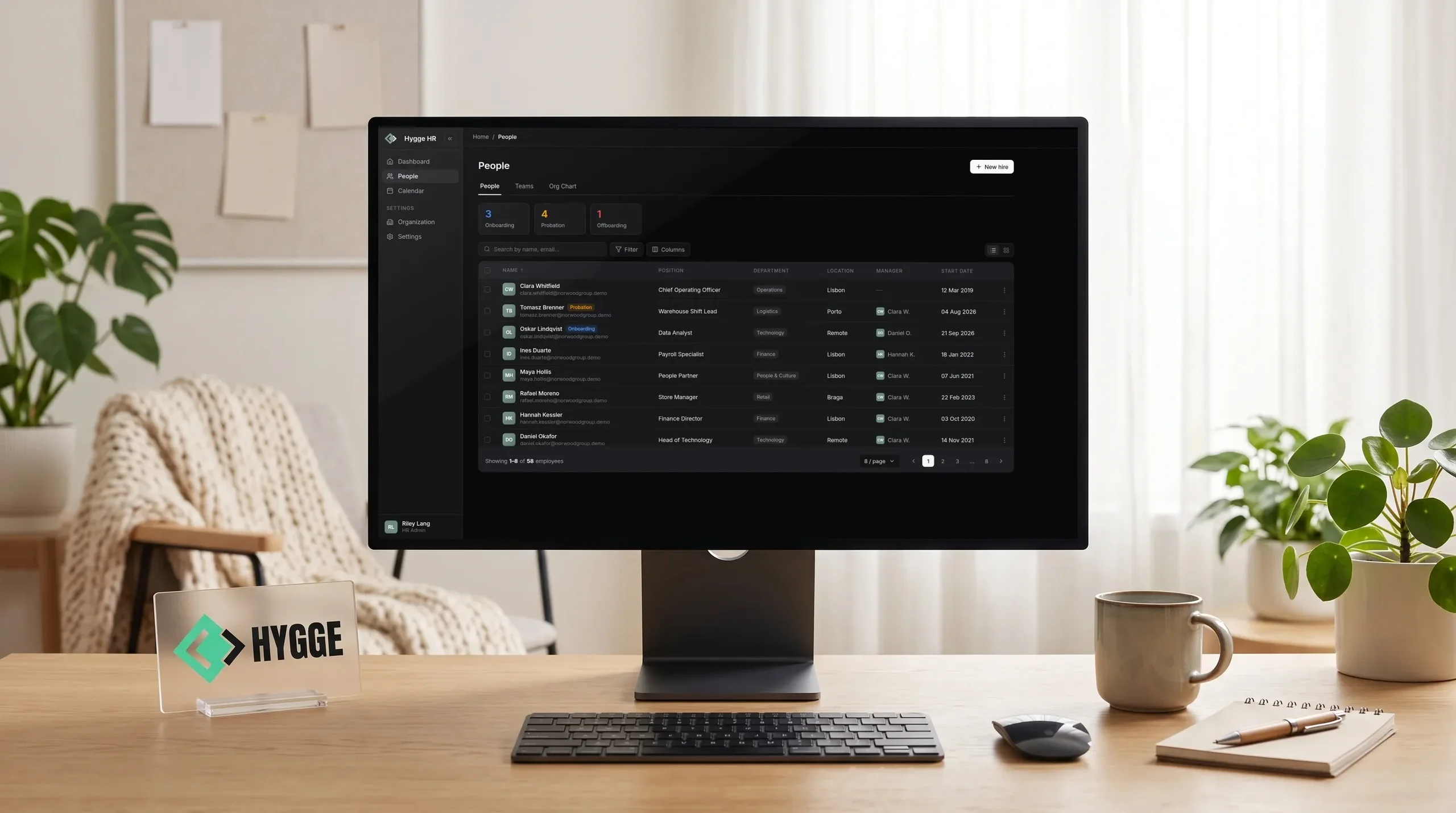
Hygge HR
Hygge's own HR platform: people, time off, hiring and projects in one system. Balances, reminders and pay history update every night.
- 0Manual balance recalculations
- 3+ yearsTenure days added on their own
- 1 platformFor people, time off, hiring and projects
- Any dateRole and pay history on record
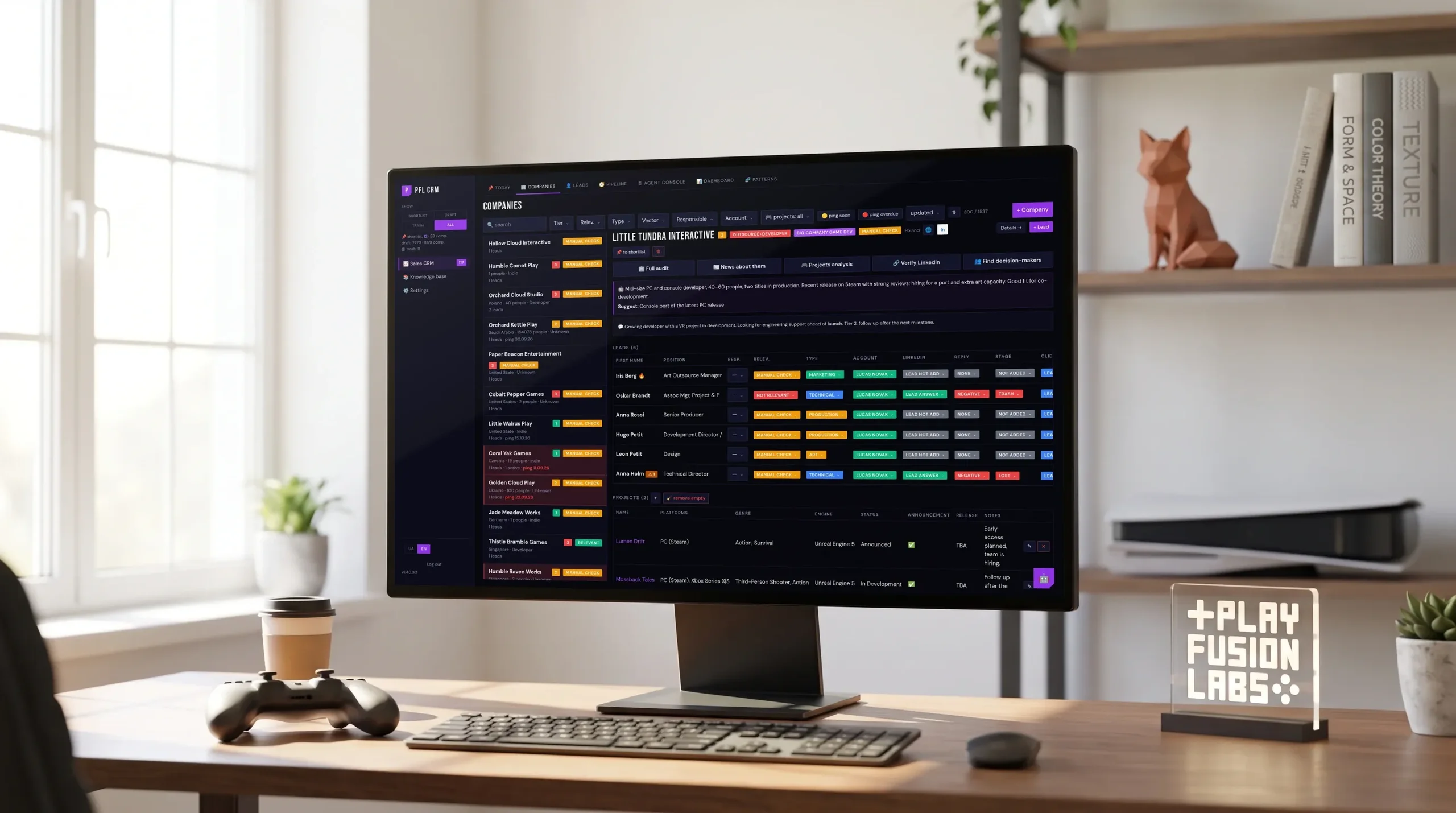
PlayFusionLabs CRM
Custom CRM development for a game studio. An agent researches companies, Today lists who to ping, and finance sits in one database.
- ~2 monthsFrom first call to daily use
- 150+Releases since launch
- 1 databaseFor sales, projects and finance
- $0In per-seat licences
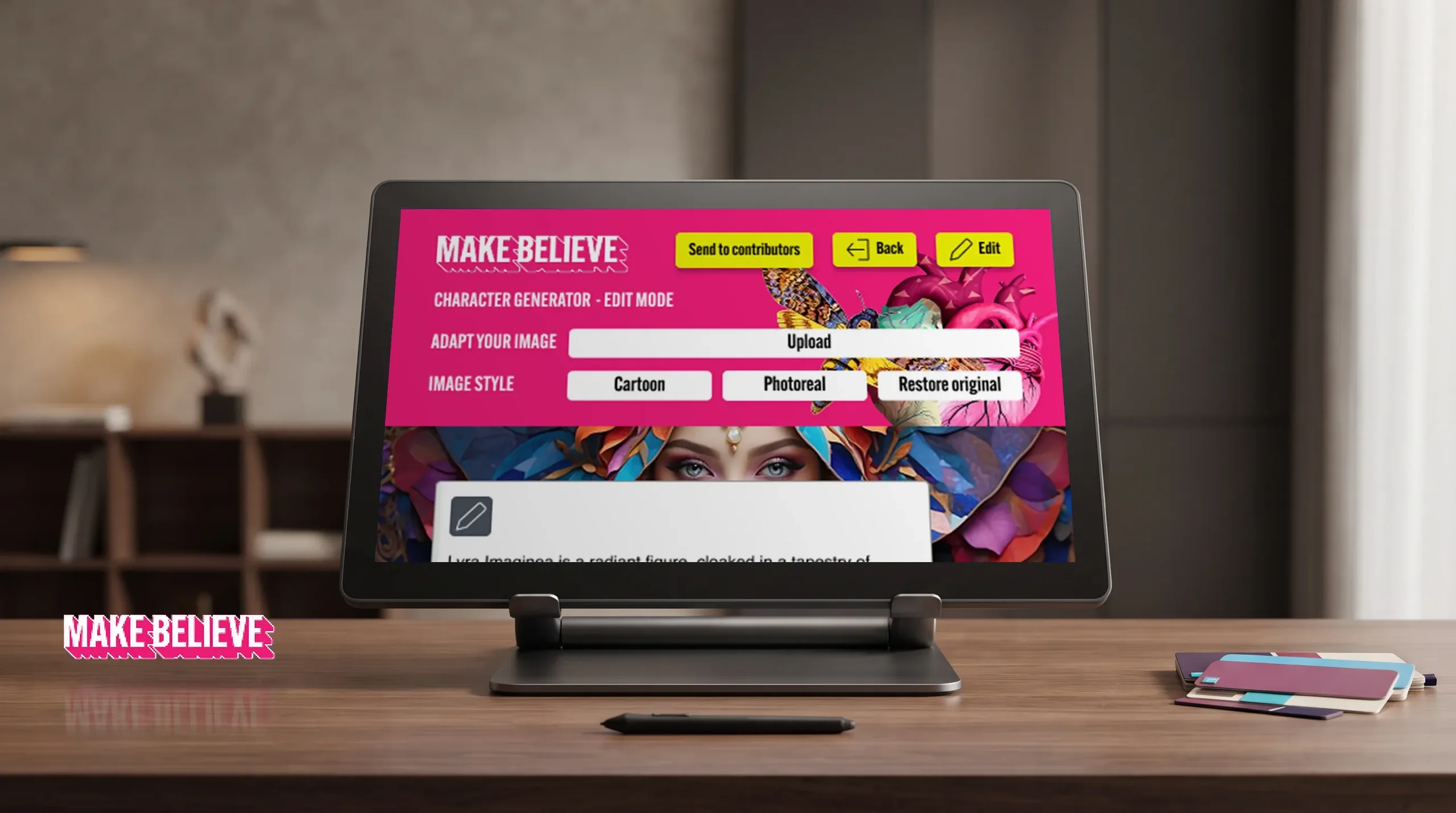
MB Character Tool
An embeddable AI character generator living inside an agency marketing site, built in eight weekly milestones.
- 1 promptFrom landing on the site to a result
- 1 iframePuts the tool inside the existing site
- 8 weeksFrom an empty repository to live on the site
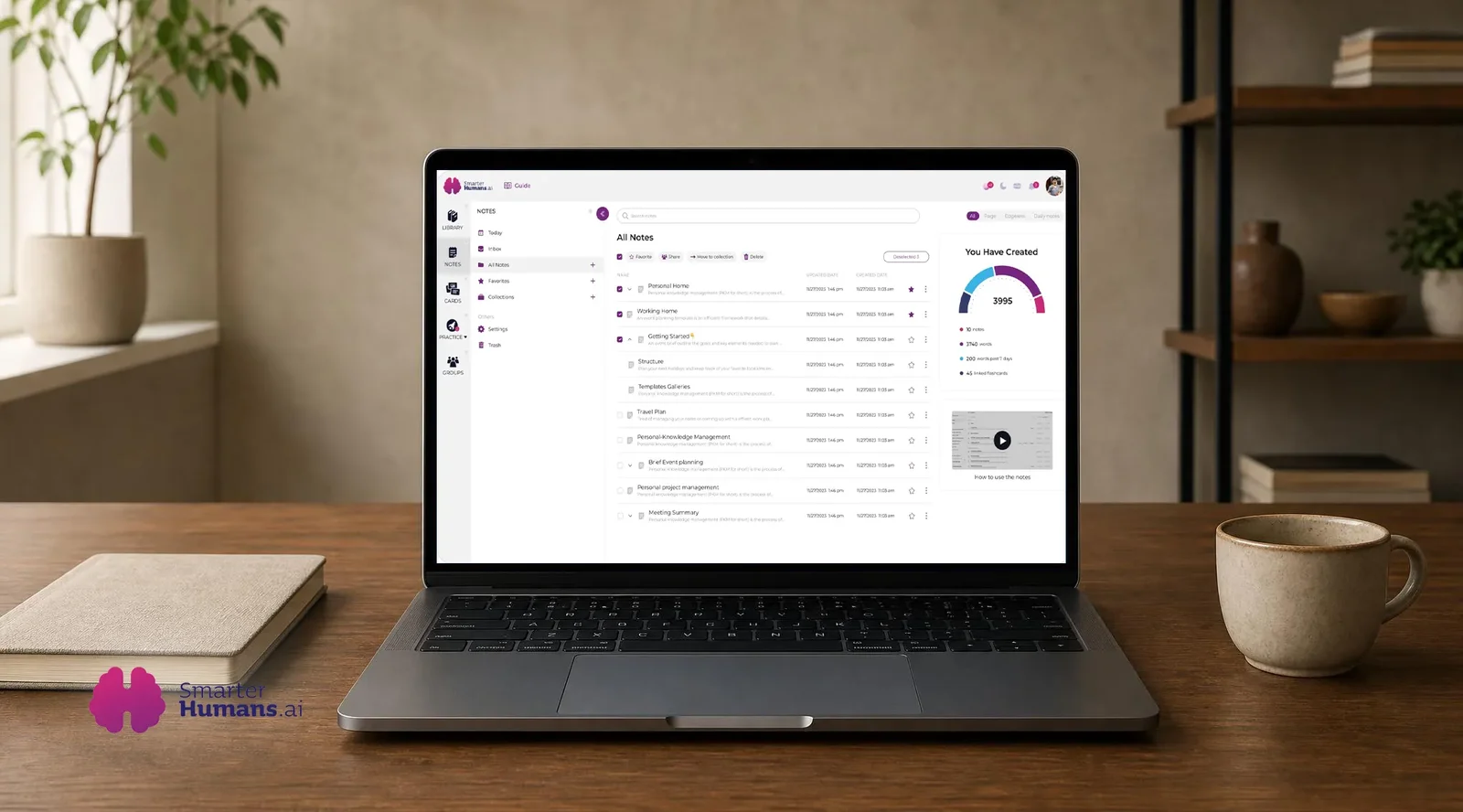
Smarter Humans
A spaced repetition app built by the same team since 2019. About a million users moved to the rebuilt system with zero downtime.
- 93 %Cut off a 20-second document load
- 1 uploadReplaces the card writing people quit over
- 7 yearsOn one product with the same team
What You Get From AI Agent Consulting
We review your process, the systems it touches, and where autonomous AI agents pay off first, then hand you a scope, a timeline, and a price you can use to compare any AI agent development company.
The Stack Behind an AI Agent Build
The languages, models, and infrastructure behind every agent Hygge runs.
The model layer the feature runs on, weighed on accuracy for your task, the latency a user will sit through, and what a call costs at production volume.
 Python
 Hugging Face Transformers
 Anthropic Claude API
 Azure OpenAI Service
 LlamaIndex
 OpenAI API
 LangChain
 LangGraph
 PyTorch
Frequently Asked Questions
What teams ask about scope, safety, and cost about an AI agent build.
 What are AI agents?
How does an AI agent work?
What are AI agent skills?
What are agentic AI frameworks?
What are the different types of AI agents?
Do I need an AI agent or is rule-based automation enough?
How do you stop the agent from doing something it shouldn't?
Can an AI agent work alongside my team?
What happens after the agent goes live?
How much does AI agent development cost?
What if my systems do not have a clean API to connect to?
Are autonomous AI agents safe to run in production?
What does custom AI agent development cost?
From Your Process to a Scoped Plan
Tell us the process that still needs a person to move it between systems. Hygge scopes the project around a measurable outcome.
Tell Us Where the Handoffs Happen
Share the process, the systems it touches, and where a person is still doing the work an agent could do.

Get a First Consultation
We map the systems the agent needs to touch and flag anything that would change scope, cost, or timeline.

Receive a Detailed Proposal
A scoped plan with the approach, timeline, and cost, built around your actual process and systems.