


How to Create a Multi-Vendor Marketplace Website
The build stages, the money path across several sellers, and the checks that stop money moving in ways nobody agreed.
 Yevhenii Sukhov·Publication date·16 min read
Two sellers, one basket, one card payment. The buyer sees a single order. Your system owes money to two businesses, has two delivery promises to track, and will be asked to refund one of them without touching the other. That split is the whole job, and it is what separates a marketplace from a shop.
The build runs in eight stages, from proving both sides want the niche through to opening with a small group of sellers.
This article covers each stage, what to decide at it, and the checks that stop a marketplace launching with money moving in ways nobody agreed.
What to Settle at the Planning Stage
These shape every later decision. Each is a business rule that the software will encode whether or not you make it deliberately.
Who sells the item
The seller of record decides tax treatment, who issues the invoice, and whose name appears on the customer's statement.
Who holds the money, and for how long
The payment path decides who is liable for a refund and a chargeback. It is a legal position before it is a configuration.
Who answers the customer
Returns, complaints and delivery questions each need one named owner, and the answer can differ per process.
What counts as one product
One page with offers from several sellers, or one page per seller, changes search, pricing and the whole catalogue.
Step 1: Define Your Niche and Validate Both Sides of the Marketplace
A marketplace has two customers and fails if either stays away. Buyers arrive for selection and price. Sellers arrive for demand they cannot reach alone. At this stage you want a named category, a named launch market, and evidence from both groups that is stronger than agreement in a meeting.
Identify Your First Buyers and Sellers
Interview both sides separately and ask what they do today and leave what they would like for another conversation. For sellers the useful question is which channels they already list on and what each costs them. For buyers it is where they buy the category now and what goes wrong.
Then test with a catalogue small enough to assemble by hand. A spreadsheet of fifty products from five sellers, a landing page and a manual order process will tell you more than a survey. Interest in an idea and willingness to list stock are different things. Structured product discovery services run this test with both sides before any code is written.
Decide What "Like Amazon" Means for Your First Version
Anyone who wants to create a multi vendor marketplace website like Amazon is describing a set of capabilities, and it helps to split them. Several sellers under one catalogue, search, product pages, orders and settlements: those are the marketplace. Own logistics, an advertising network, a subscription programme and operations in twenty countries are something else. They are a large business built on top of a marketplace over two decades.
Pick the first set. The second set is what you earn the right to build.
Sellers Who Want the Channel Send a File
Hygge tests a marketplace idea on what sellers do, never on what they say.
 Alina Sukhova
CEO & Co-Founder
"We treat a marketplace idea as validated when sellers have sent us their product data without being asked twice. Sellers who want the channel send a file. Sellers who are being polite send a meeting invitation."
Step 2: Set Your Revenue Model and Operating Rules
The commission model and the seller rules are not commercial decisions that the software merely reflects. They are the specification. A commission taken per item behaves differently from one taken per order the moment a buyer returns one line of a two-line order.
Choose How the Marketplace Earns Revenue
Commission per order is the common starting point because it aligns the platform with sales and asks nothing of a seller who has not earned yet. A listing fee produces revenue before liquidity exists and suppresses catalogue growth. That is usually the wrong trade in year one. A subscription suits a market where sellers are few, large and committed, and where the platform's value is access more than volume.
Agree on Seller Responsibilities and Customer Support
Write down who does what while the model is still on paper. Cover admission criteria, listing quality, stock levels and dispatch windows. Then name who answers the first customer message, who decides a return, and who pays for the return shipping. The operator does not have to own stock and does not have to hand all service to sellers. What matters is that every process has exactly one owner and that the owner is visible to the buyer.
Responsibility Split, Written Down
A worked example for a marketplace where sellers ship their own stock. Settle the same rows for your own model, then take it to a quote.
Listing accuracy
Seller writes and maintains it. Operator sets the required fields and rejects what fails them. The rule to settle: who may edit a live listing.
Stock levels
Seller owns the number. Operator decides the maximum acceptable staleness and what happens to an order against stock that has gone.
Dispatch and tracking
Seller dispatches and supplies the tracking reference. Operator holds the deadline and the consequence when it is missed.
First-line support
Operator answers, because the buyer bought from the marketplace. Seller answers anything about the specific item within an agreed window.
Returns and refunds
Operator decides eligibility against the published policy. Seller inspects. The commission rule on a refund has to be written before launch.
Disputed payments
Operator carries it if the charge was on the platform, which is the usual case. Recovery from the seller is a separate step and needs a contractual basis.
The Returns Rule Arrives Last and Costs Most
Hygge asks for the returns rule in the first workshop, because it moves the estimate most.
 Zinaida Shelomkova
Head of Delivery
"The requirement that moves a marketplace estimate most is the returns rule, and it is the one that arrives last. Who refunds, from whose money, and what happens to the commission. We now ask for it in the first workshop."
Step 3: Choose a Marketplace Platform or Custom Development
Multi-vendor marketplace platforms, an extension on a shop you already run and a custom build go against one set of criteria.
Test Your Critical Workflow Before Choosing
Run one complete buying path in a demo environment of each candidate. Register a seller, publish a product, place an order against it, then refund one line of a two-line order and look at where the money went. Separately confirm the countries supported and whether one basket may hold items from several sellers. Check too whether your delivery rules can be expressed at all.
A feature list is a claim. A completed refund in a sandbox, with the balances visible afterwards, is evidence. If no candidate passes that test, the gap you found is where marketplace development services start.
The Three Routes Against One Set of Criteria
Same criteria for all three: process fit, how the seller is modelled, payments, integrations, maintenance and whether you can export and leave.
Hosted marketplace platform
Fastest to a live catalogue. Seller model, payout schedule and commission rules are the vendor's. They differ most in how deeply the seller is modelled: a first-class entity with its own balance, policies and permissions, or a tag attached to a product. Consider it when your processes are close to standard and speed matters more than fit.
Extension on an existing shop
Reuses the storefront, the theme and the integrations you already run. Consider it when the shop is the business and sellers are an addition. It costs most when the extension has to fight the shop's assumption that one business owns all the stock. Check how it handles split orders before anything else.
Custom development
Fits the processes you run today and carries the full maintenance cost. Consider it for a confirmed gap. That might be a settlement rule the platforms do not model or a category structure they cannot express. It might also be a compliance requirement in your launch market, or a volume of sellers that makes manual operations impossible. Price the ongoing line alongside the build.
Start From the Gap, Never From the Platform
Send the seller rules, the commission model and one awkward order you need to support. You get a written view of which platforms model it and where custom work starts.
Step 4: Define the Features Your First Version Needs
List multi vendor marketplace features by the task they complete, never by the screen they live on. Features for multi-vendor B2B marketplace projects follow the same rule, with approvals and contract prices on the buying side on top of everything below. A feature is ready when a named role can finish a job without a person in your team intervening. A grocery marketplace adds stock sync, substitutions and delivery slots on top, the core of our grocery delivery app development work.
Map What Buyers, Sellers and Admins Have to Finish
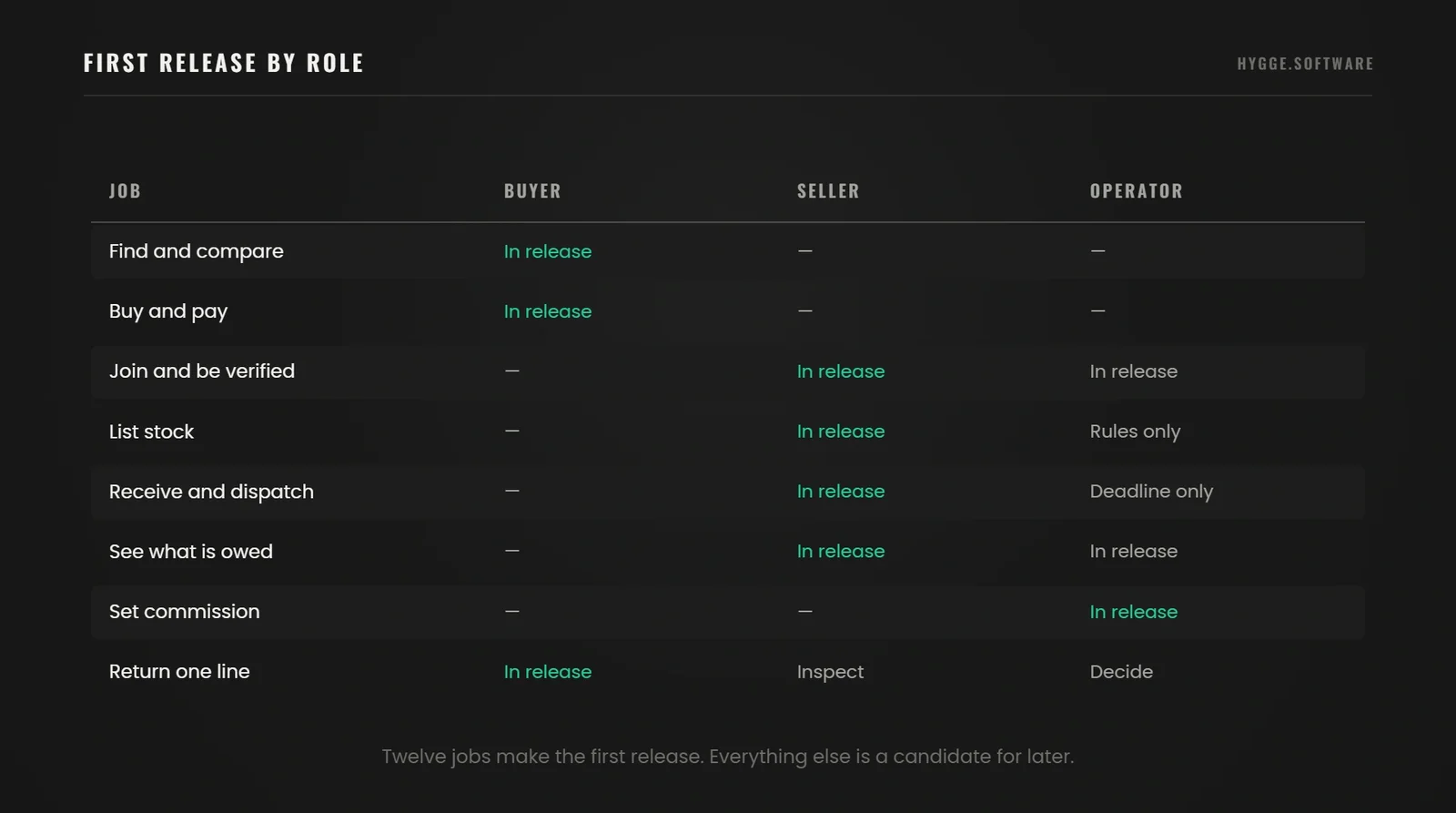
The buyer has to find an item, trust the seller behind it, buy it, track it and return it. The seller has to join, be verified, list stock, receive an order, dispatch it, and see what they are owed and when. The operator has to admit or reject a seller, enforce listing rules, set and change commission, and see every order and payout.
Those jobs are the first release, and they are the features worth arguing about. Everything else is a candidate for later, and the discipline of saying so is what keeps a launch inside a year.
Structure Products, Seller Offers and Inventory
This is the decision that is expensive to reverse. One shared product page carrying offers from several sellers gives buyers a price comparison and keeps search clean. It also needs a catalogue discipline that most new marketplaces do not have. One page per seller is simpler to launch and produces near-duplicate pages, split reviews and a search result that shows the same item six times.
Pick deliberately, write down which attributes identify "the same product", and decide who owns that match.
Make the Website Usable and Searchable
Most marketplace traffic arrives on a product or a category page, from a phone. Keep category and product addresses readable and stable. Treat filter parameters as a crawl problem first and a design detail second.
Google's own guidance is direct about this. Filters that combine additively multiply URLs, and Googlebot only needs a small number of lists from which it can reach each product page. Google advises using as few parameters as you can and trimming the ones that do not change the content. Block the problematic combinations in robots.txt.
Source: URL structure and faceted navigation, Google Search Central, read October 2026.
Step 5: Design Payments, Orders, Shipping and Returns
One payment from a buyer becomes obligations to several businesses. Keep two questions apart: how the order is processed, and how the money moves. They are connected and they fail separately. The order side often grows into its own system, built as custom order management software.
Separate Customer Payments, Seller Transfers and Bank Payouts
Three events get collapsed into one in most early plans. The buyer pays. Funds reach a seller's balance on the payment provider. The provider pays that balance into the seller's bank account. Each has its own timing, its own failure mode and its own reversal path.
Stripe's Connect documentation is a useful model because it names the choice precisely. Direct charges put the payment on the connected account, so refunds and chargebacks reduce the seller's balance. Destination charges put the payment on the platform and transfer a portion onward. Refunds and chargebacks then reduce the platform's balance. Separate charges and transfers put the payment on the platform first and move funds to several connected accounts afterwards. Stripe describes this as the fit for "an e-commerce marketplace that allows a single shopping cart for goods sold by multiple businesses."
That third option is the one most multi-seller baskets need, and like destination charges it leaves the platform liable. The platform balance is debited for Stripe fees, refunds and chargebacks. Recovery from the seller happens through a transfer reversal. Decide that position knowingly, and design the checkout around it.
Source: How charges work in a Connect integration, Stripe, read October 2026.
Split Orders and Handle Partial Returns
One buyer order becomes one sub-order per seller, each with its own dispatch state, tracking reference and return window. The buyer sees one order and one total; your system holds the parts.
Write the recalculation rules while the model is still on paper. Settle what happens to the commission when one line is refunded. Agree whether delivery is refunded with the item or only when the whole sub-order goes back. Then decide what reverses when a seller cancels after funds have already moved.
Walk Through a Two-Seller Order
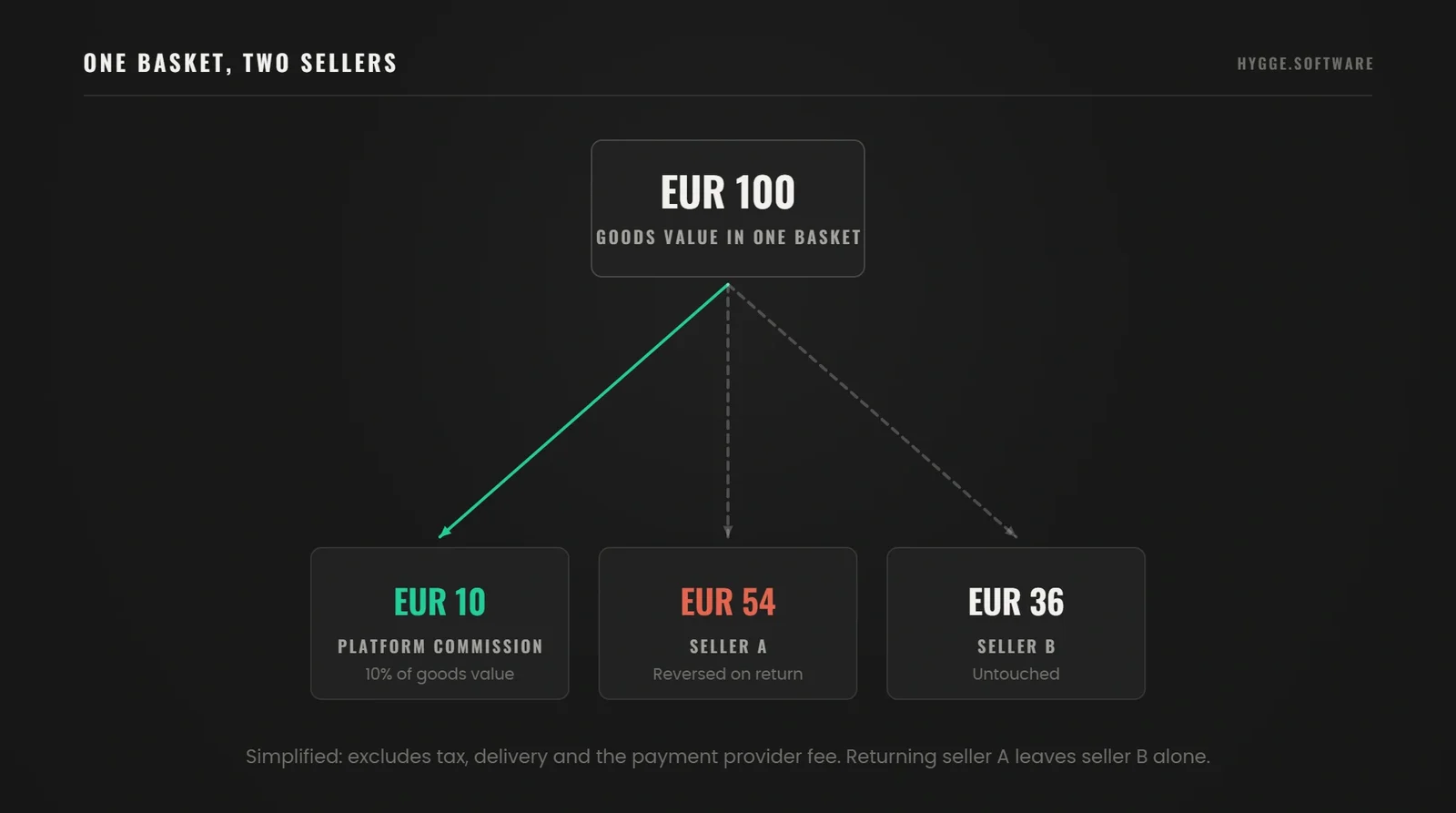
Take a basket with €60 of goods from seller A and €40 from seller B, and a platform commission of 10% of goods value. Commission is €10. Seller A is owed €54, seller B €36. This simplified figure excludes tax, delivery and the payment provider's own fee, all of which land before the seller sees a balance.
Now return the item from seller A under a rule that returns the commission with the sale. Seller A's €54 reverses, the platform gives back the €6 it earned on that line, the buyer receives €60, and seller B's €36 is untouched. The platform ends the order with €4. If instead the rule keeps the commission on a returned item, the platform refunds the same €60, reverses seller A's €54 and takes the remaining €6 from the seller's next payout. The €6 stays with the platform, and the seller carries the commission on a sale that did not stand. Both are defensible. Only one can be in your terms, and it belongs there on the day you open to sellers. The same rule has to be built into the marketplace payment integration, so the provider and your ledger agree on every reversal.
A Retried Notification Must Never Become a Second Payout
Hygge builds the ledger before the dashboard that reads from it.
Yevhenii SukhovCTO & Co-Founder
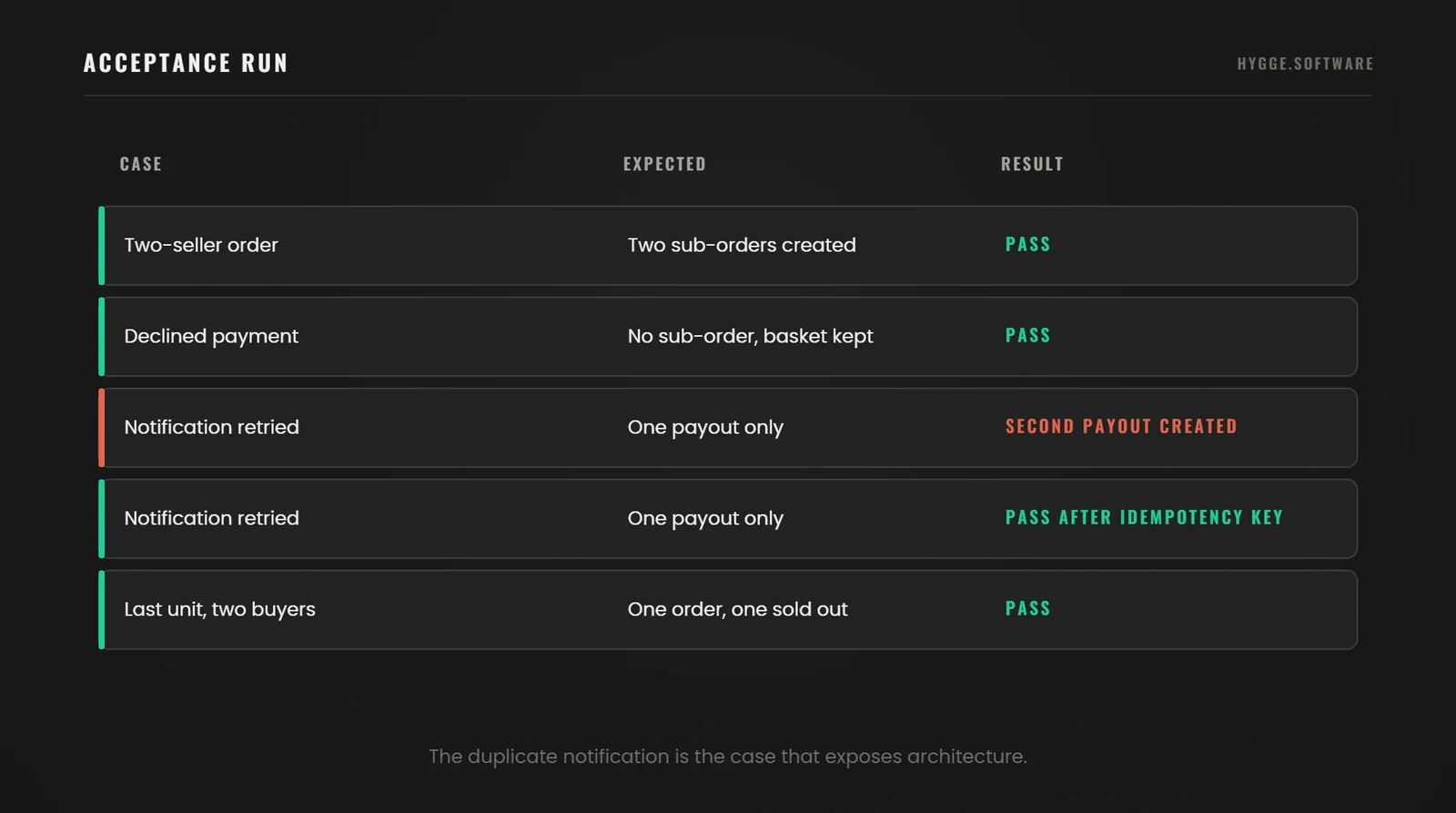
"Payment providers retry notifications, and they are right to. If your handler is not keyed on the event identifier, a retry becomes a second payout. We build the ledger to reject a repeat, and the screen that displays it comes after."
Check the Money Path Before It Is Built
Send the commission model, the payout schedule you want and your returns rule. You get the charge type that fits, who carries refunds and chargebacks under it, and what reverses on a partial return.
Step 6: Build Trust and Address Launch-Market Requirements
Buyer trust and legal obligation overlap here, and in the European Union the obligation is specific enough to design against.
Verify Sellers and Moderate Listings
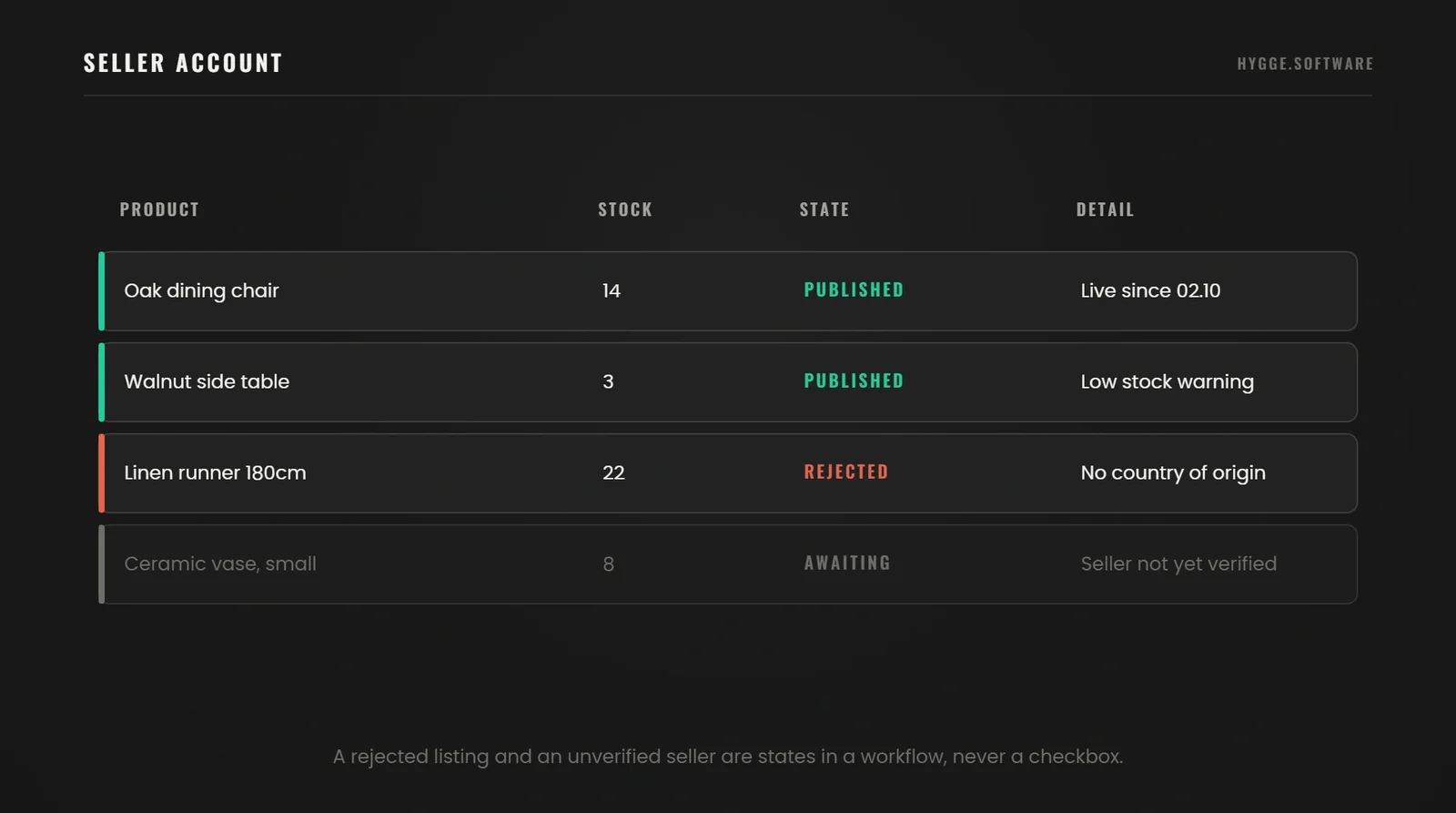
Article 30 of the Digital Services Act applies if your marketplace is available in the EU and lets consumers conclude distance contracts with traders. Micro and small companies are exempt until a year after they outgrow that size. Building the checks in early is still cheaper than adding them later. It sets what you collect before a trader may use the service. That means name, address, telephone number and email, plus a copy of an identification document or an electronic identification. It also means payment account details and trade register details where the trader is registered. The last item is a self-certification that the trader will offer only products and services that comply with Union law.
The rest of the same article shapes the build at least as heavily as the list does. You must make best efforts to check that this information is reliable and complete. Use freely accessible official databases or supporting documents from a dependable source. In practice, verification is a workflow with states. You must also show the trader's name, contact details, registration details and compliance commitment where the product is shown, in a clear and comprehensible manner. The seller identity belongs on the product page itself.
Source: Article 30, Digital Services Act, read October 2026.
Protect Data and Define Access Permissions
A seller must see their own orders and no one else's. That isolation belongs on the server, checked on every request against the account that owns the record. By definition, a seller account is an untrusted user of your admin surface. Add an action log for commission changes, payout edits and listing removals. Protect the operator accounts that can perform them more strongly than anything else in the system.
Step 7: Build and Test the Whole Buying Path
Readiness is measured in buying paths a real person can finish, never in finished screens. A marketplace is ready when a seller who has never seen it can join, list and get paid on their own. A buyer must also be able to order from two sellers and return one item without help from your team.
Connect Only the Systems Your Launch Needs
For each integration, name the data it carries, the system that owns each field and what the marketplace does when it is unavailable. Payments and seller verification are usually unavoidable. Accounting exports, carrier labels and a support desk can often run manually for the first months, and saying so out loud is how a launch date survives.
Test Failures as Well as Successful Orders
The successful order is the first test and never the suite. Run a declined payment and a repeated provider notification carrying one event identifier. Run two buyers taking the last unit at the same moment, and a cancellation of one seller's part after the other has dispatched. Add a refund requested after the payout has left, and an external system that times out mid-checkout. Each needs an expected result written down before it runs.
How Hygge Runs a Marketplace Build
These rules shape our multi vendor marketplace development services, and the order is the part that matters.
The money model drives the data model. We settle and write down charge type, commission timing, payout schedule and the returns rule while the schema is being designed. Each one changes the data model underneath.
One ledger, built first. Every movement of money is a row with an external reference on it, and the ledger rejects a repeat of that reference. We build it before the dashboards that read from it.
Seller verification as a state machine. Submitted, under review, verified, suspended, with a named owner and a recorded reason for each transition. The regulation asks for best efforts, and best efforts have to be evidenced.
Two sellers in every test. No order in acceptance has one seller in it. A single-seller order hides exactly the bugs a marketplace is made of.
Handover inside the build. The runbook for a stuck payout, a named owner for the exception queue, and a re-test trigger tied to each payment provider release.
Two published projects carry the lessons directly. On the PlayFusionLabs CRM we put sales, projects and finance into one database in about two months. The schedule held because every record was given one owning system at the data-model stage. A marketplace ledger needs the same discipline. On BoardsOnline a founder had paid for a platform that status reports described as finished. Sorting what existed into three buckets made the following six months plannable. It is why we open marketplace work with an audit.
Our Delivery Record
Numbers published on hygge.software and in the case studies linked above.
Step 8: Launch with a Focused Seller Group and Improve
Open in one category and one market, with sellers you have prepared, never with sellers recruited in volume. A seller who joins before their catalogue is ready becomes a dead listing, and a marketplace of dead listings teaches buyers not to return.
Prepare Sellers and Product Listings for Launch
Before the doors open, each seller needs published products with photographs and prices. They also need stock levels they can keep current, delivery terms they can meet, and one named person who answers. There is no universal minimum number of sellers. There is a minimum per category: enough that a buyer who searches finds a choice and never a single result.
Measure Transactions and Seller Activation
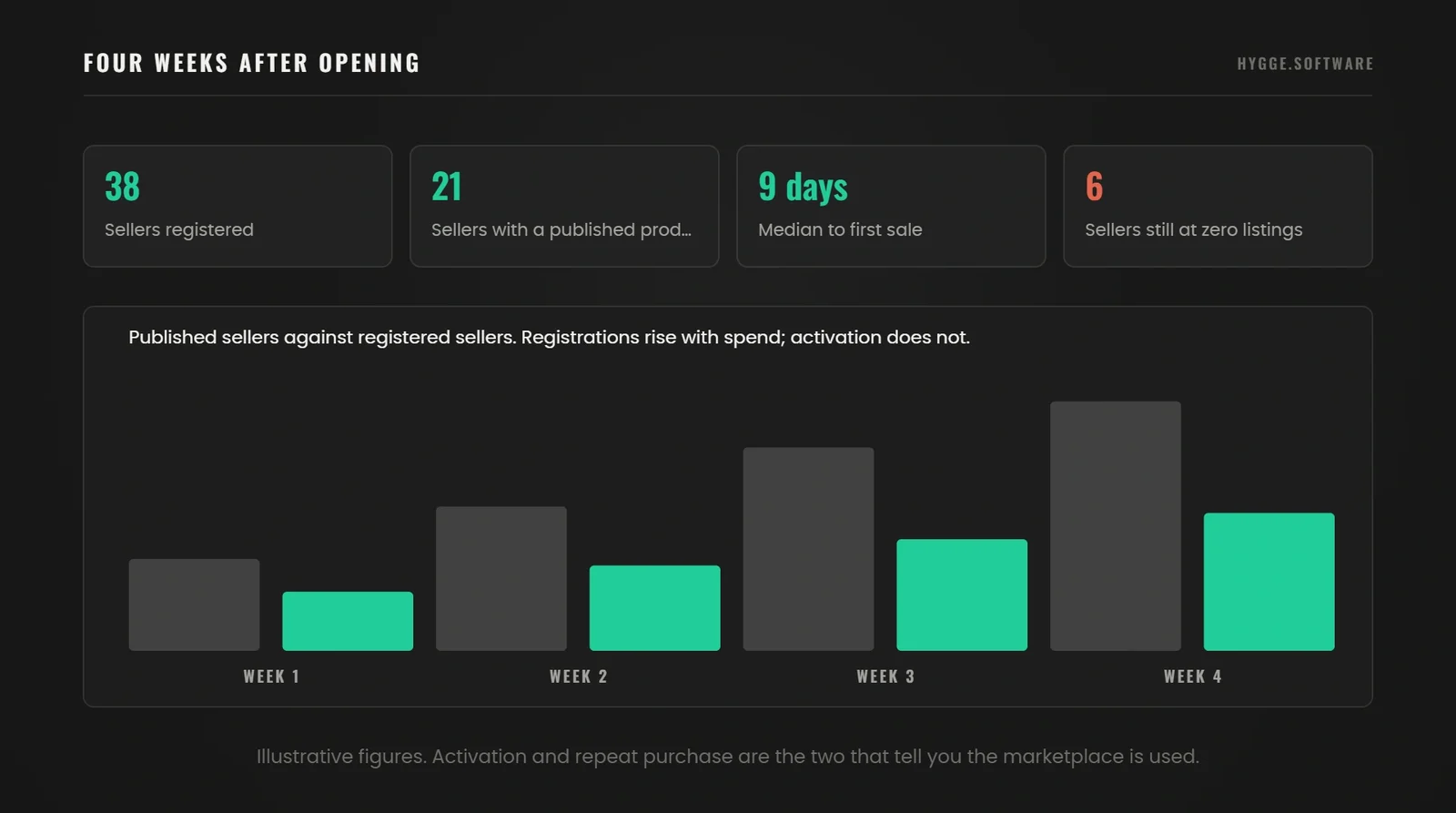
Track the share of registered sellers who have published a product, and the time from seller registration to first sale. Then track buyer conversion on product pages, cancellation rate by seller, and repeat purchase. Registrations and gross merchandise value both rise when you spend money, which is why neither proves the business works. Activation and repeat purchase are the two that tell you whether the marketplace is being used.
What Determines Marketplace Development Cost and Timeline?
These move a marketplace estimate more than anything else, and most of them are business decisions.
The route, because a hosted platform, an extension and custom multi-vendor marketplace development have different shapes of cost. A hosted platform is mostly licence and configuration. A custom build is mostly build and ongoing maintenance. The payment design, because separate charges and transfers need a ledger, reversals and payout reporting. That is several times the work of a single-seller checkout. The number of launch markets, because each adds tax treatment, consumer rules and usually a language. The integrations, because every one is a contract with a system you do not control. Data migration, when sellers and catalogue come from somewhere else. And the operational requirements after launch, which decide how much of the admin surface has to exist at launch.
Split the number into the build and the running line. The running line carries licences, infrastructure, payment provider fees and support. It also carries the re-test that each provider release forces on you. Once the feature list and the seller rules are written down, they are enough to discuss your marketplace project in concrete terms.
What Moves a Marketplace Estimate
Hygge asks about returns and multi-seller baskets before putting a number on a marketplace.
 Artem Petrov
CFO & Co-Founder
"Two inputs move a marketplace estimate more than the feature list. The returns rule, and whether one basket may hold several sellers. We ask for both, and the quote states what it assumed."
Price the Build and the Running Line Separately
Send the feature list, the seller rules and the markets you open in. You get the split between one-time build and the monthly line, with the assumptions written beside each number.
Figures in This Article
From the Digital Services Act and from Stripe Connect documentation, both read in 2026.
Multi-Vendor Marketplace FAQ
The questions founders ask while the marketplace is still being scoped.
 Which multi-vendor marketplace development features belong in the first version?
What drives multi-vendor ecommerce marketplace development cost?
Can I turn an existing online store into a multi-vendor marketplace?
Can I sell my own products alongside third-party vendors?
Do I need a mobile app to launch a marketplace?
Is a multi-vendor marketplace the same as dropshipping?
Can sellers use different shipping methods?
Can I move to another marketplace platform later?
Scope Your Multi-Vendor Marketplace
Send the seller rules, the commission and payout model, and one awkward order you have to support. We will come back with the route that fits, what a packaged platform covers and where custom work starts.
Send Your Seller Rules
Who sells, the commission and payout model, and one awkward order you have to support.

Get a Route Review
Hygge checks your rules against packaged platforms and shows where custom work starts.

Receive a Scoped Plan
The route that fits, the payment design, a timeline and a price for the build and the running line.