
IoT in the Retail Industry: A Guide to Applications and Connected Stores
Which connected use cases pay for themselves, what has to be integrated, and how to prove a pilot worked.
 Yevhenii Sukhov·Publication date·15 min read
The system says there are fourteen. The shelf has none. Somewhere between the stockroom, the planogram and the last delivery, the number stopped matching the building. The same gap shows up in the chiller that drifted two degrees overnight and told nobody until the morning check. Incisiv published its Unified Commerce Benchmark on 23 March 2026. Retailers with real-time inventory visibility and dynamic allocation ran higher inventory turns: around 50 per cent higher in North America and 45 per cent in EMEA. This article covers what connected devices can report, what has to be integrated for the report to matter, and how to pick the first project.
Source: Manhattan Associates release of the 2026 Unified Commerce Benchmark by Incisiv, read October 2026.
What Is IoT in Retail, and Where Does It Pay Off First?
IoT for retail means connected devices, such as shelf tags, chiller probes and door counters, that report what happens in a store to software that acts on it. Start where a problem already costs money and someone owns the response, then prove it in one store before scaling.
What Is IoT in the Retail Industry?
Most IoT in retail industry projects start with devices that sense or identify something in a store and send that observation to software that can act on it. Temperature probes in a chiller, passive tags on garments, counters above a door, current meters on a compressor: those are the examples you meet first. The device reports, the system decides, a person or a machine responds. Those four report on different clocks, and the clock sets the cost. A probe sends a reading every few minutes. A passive tag says nothing until a reader passes it. A door counter runs continuously through trading hours. A current meter reports power every few seconds or minutes.
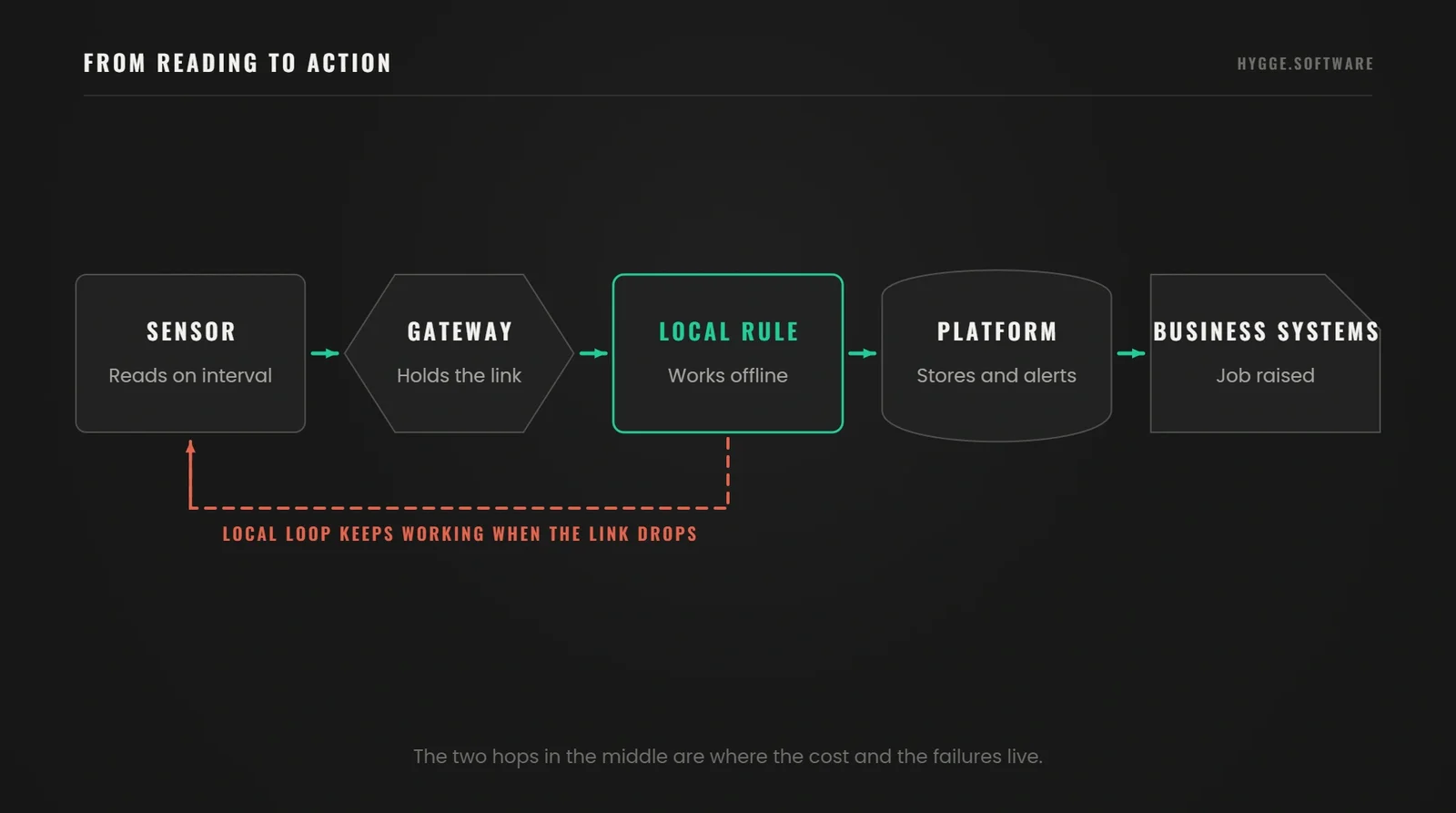
Most of the architecture follows from a single detail: many of these devices never touch the internet themselves. A garment tag is passive, carries no battery and no radio of its own, and wakes only inside a reader's field. A temperature probe speaks a low-power protocol to a gateway in the back office, and the gateway holds the single connection the site has. That is why internet of things in retail industry projects run through a few hops. A tagged item goes from tag to reader, gateway and platform. A battery sensor skips the reader. The two in the middle are where the cost and the failures live. We price those two first. A single scenario in one store needs one gateway, plus a probe per asset or enough readers to cover the read zones. A quote built on device count leaves out the readers and gateways.
The connection layer deserves separate attention for a practical reason. It is the part with a physical install, a battery, a maintenance rota and a failure mode that no amount of software fixes. That is as true of stores as it is of a distribution centre, and it is the half that vendors demonstrate least.
How IoT Fits into Smart Retail
The smart retail definition in common use covers three capabilities that often get sold as one. They are connecting physical objects, analysing what they report, and automating a response. We treat the third as the gate. Before a device is specified we want the name of the person who acts on its output and the system that receives it on paper.
Connected devices
Tags, probes, counters, meters and gateways. Their job is to turn a physical fact into a record. Example: a reader logs that a specific garment left the stockroom.
Analytics
The layer that turns records into a judgement. Example: comparing counted stock against recorded stock to produce a confidence figure per line.
Automation
The layer that turns a judgement into an action with an owner. Example: raising a replenishment task when shelf availability for a line drops below the agreed threshold.
Retailers already running several layers of smart retail technology tend to find the gap in the third one. The device reports, the dashboard shows it, and nothing has a name attached. Retail software development work on these projects usually starts by naming the action, and the sensor is specified from it.
IoT Retail Use Cases That Carry Their Own Cost
The patterns below cover most IoT applications in retail that reach a second store. Read each as scenario, data source, action and the measure that proves it worked, then take the detail from the subsections underneath. Most fail at the fourth of those, because nobody agreed the measure.
Scenario, Source, Action and Measure
Each row names the data source, the action it should trigger and the number that proves it worked.
Stock accuracy and shelf availability
Source: item tags read by fixed or handheld readers. Action: a replenishment or recount task. Measure: counted stock against recorded stock, and the share of lines available on the shelf.
Price and label updates
Source: the pricing system pushing to electronic labels. Action: a shelf price that matches the till. Measure: price mismatches found per audit.
Cold-chain monitoring
Source: temperature and humidity probes. Action: an alert with a named responder and a recorded response. Measure: excursion minutes per unit, and time from breach to acknowledgement.
Equipment health and energy
Source: meters and controller telemetry. Action: a maintenance call before failure. Measure: unplanned downtime hours, and energy per store per trading hour.
Queue and traffic
Source: door counters or connected cameras. Action: open a till, move staff. Measure: queue length against staffing, and conversion by hour.
Self-service devices and lockers
Source: device status and door events. Action: remote diagnosis or a dispatch. Measure: device availability, and failed collections per thousand orders.
Asset tracking and replenishment
Source: tags on cages, trolleys and equipment. Action: recover or rebalance assets. Measure: assets missing per quarter, and time to locate.
RFID Inventory Tracking and Shelf Availability
Item tags change inventory from a number maintained by transactions to a number confirmed by observation. A handheld sweep of a department takes minutes and sees stock that was mis-scanned, returned to the wrong place or never put out.
Teams often confuse the jobs below, and each needs its own hardware, budget and event record. Counting what the store holds is a periodic handheld sweep with no fixed hardware. Each sweep is recorded as an object observation against the store location. Knowing whether a line is on the shelf needs reads at shelf level. That means fixed readers over each bay you cover or a rule that infers presence from the last sweep and the sales since. Knowing where an item is standing to the metre needs dense fixed readers and a location engine. That one is priced by the square metre of floor it covers, where the first two are priced by the store, and it answers a question most retailers do not have. Settle which of the three you are buying, and the cost follows. The first costs handhelds and labour. The second costs infrastructure in every bay you cover. The third adds a site survey on top.
Connected Shelf Labels and Price Updates
Electronic labels remove the paper round and turn a price change into a system action. A label that can flash also locates a line in a bay during picking.
The limits are worth stating. A label does not measure how much stock sits behind it, so it adds nothing to availability on its own. A label can change price every minute, and that does not mean a retailer should. The rules about price display still apply, and so does the trust of a regular customer.
Refrigeration and Cold-Chain Monitoring
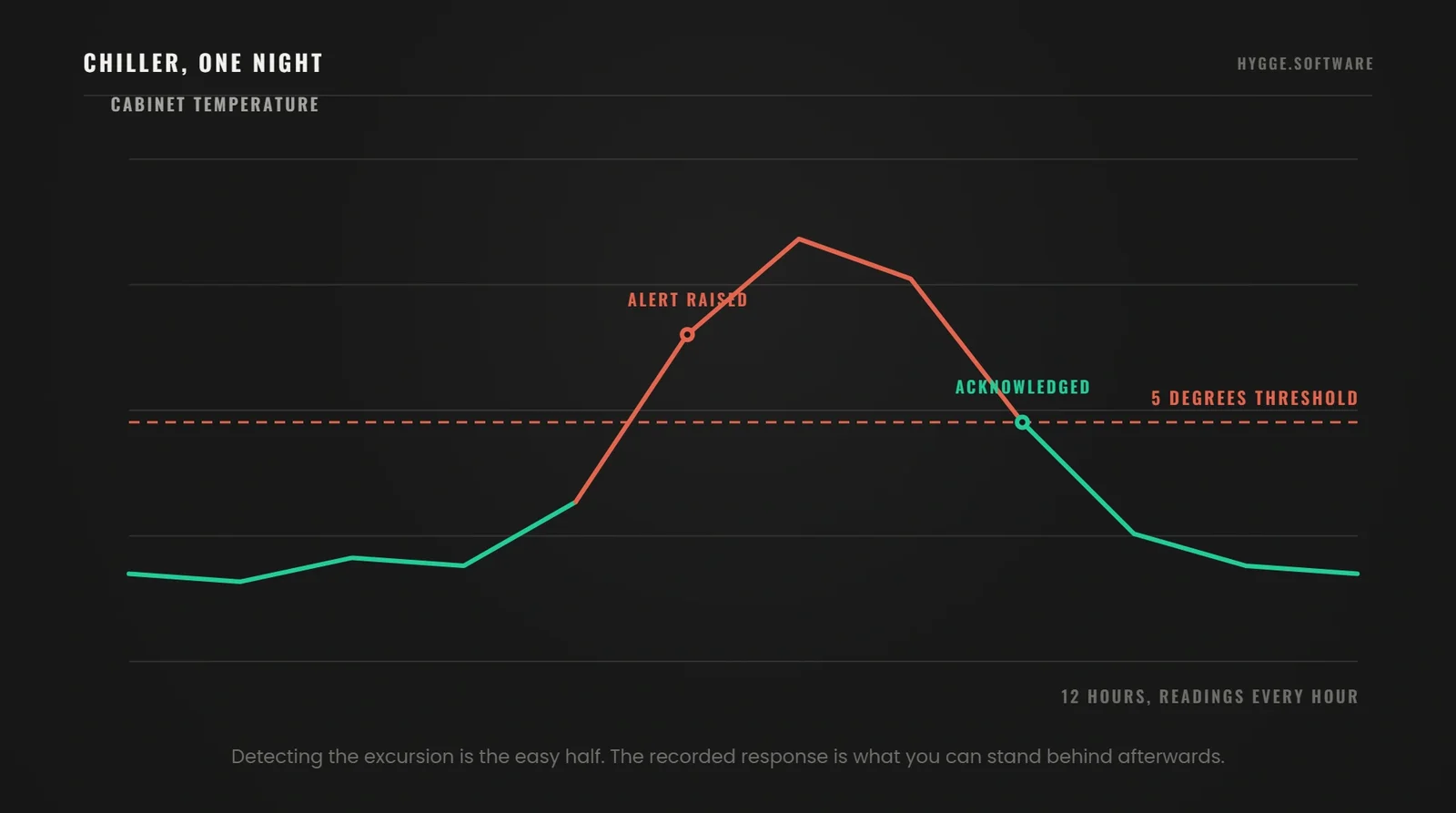
Probes report temperature on an interval, and the platform compares each reading against a threshold. A breach raises an alert with a named responder and a recorded response. The value sits in the last part. Detecting an excursion is the easy half; proving somebody acted, and when, is what turns the data into a record you can stand behind.
Thresholds belong to the product and the equipment. Chilled ready meals, fresh fish and ambient wine fail in different ways and on different clocks. A single site-wide threshold either floods the team with alerts or misses the one that mattered.
The compliance clock is worth tracking even for retailers outside the United States, because it shapes what suppliers will be able to provide. The FDA Food Traceability Rule requires Key Data Elements recorded against Critical Tracking Events. The records have to reach the agency within 24 hours of a request. The compliance date has moved to 20 July 2028, after Congress directed the agency not to enforce it earlier.
Source: FDA Food Traceability Rule, read October 2026.
Cold chain and equipment work both sit on the same foundation as remote monitoring software development: a device that reports, a rule that judges, and an owner who answers.
Equipment Health and Energy Monitoring
Compressors, ventilation and ovens report through their controllers. Add simple current measurement, and you can tell when something changed. Doors left open, a compressor running longer for the same load, a store drawing more power on a quiet day.
Keep the threshold alert and the prediction apart. A rule that fires when a chiller runs above its normal duty cycle is cheap, explainable and catches most of what matters. A model that predicts a bearing failure needs failure examples and a sensor close enough to the fault. It also needs someone who trusts the output enough to book an engineer before anything looks wrong.
Count the Failures Before Proposing a Model
Hygge writes a threshold rule until there are enough recorded failures to train on.
Yevhenii SukhovCTO & Co-Founder
"We ask one question at the scoping stage: how many real failures do you have on record, with the sensor data from the weeks before them? If the answer is under a dozen, we write a threshold rule, measure how often it is right, and revisit in a year with the data the rule collected."
Queue Monitoring and In-Store Traffic Analysis
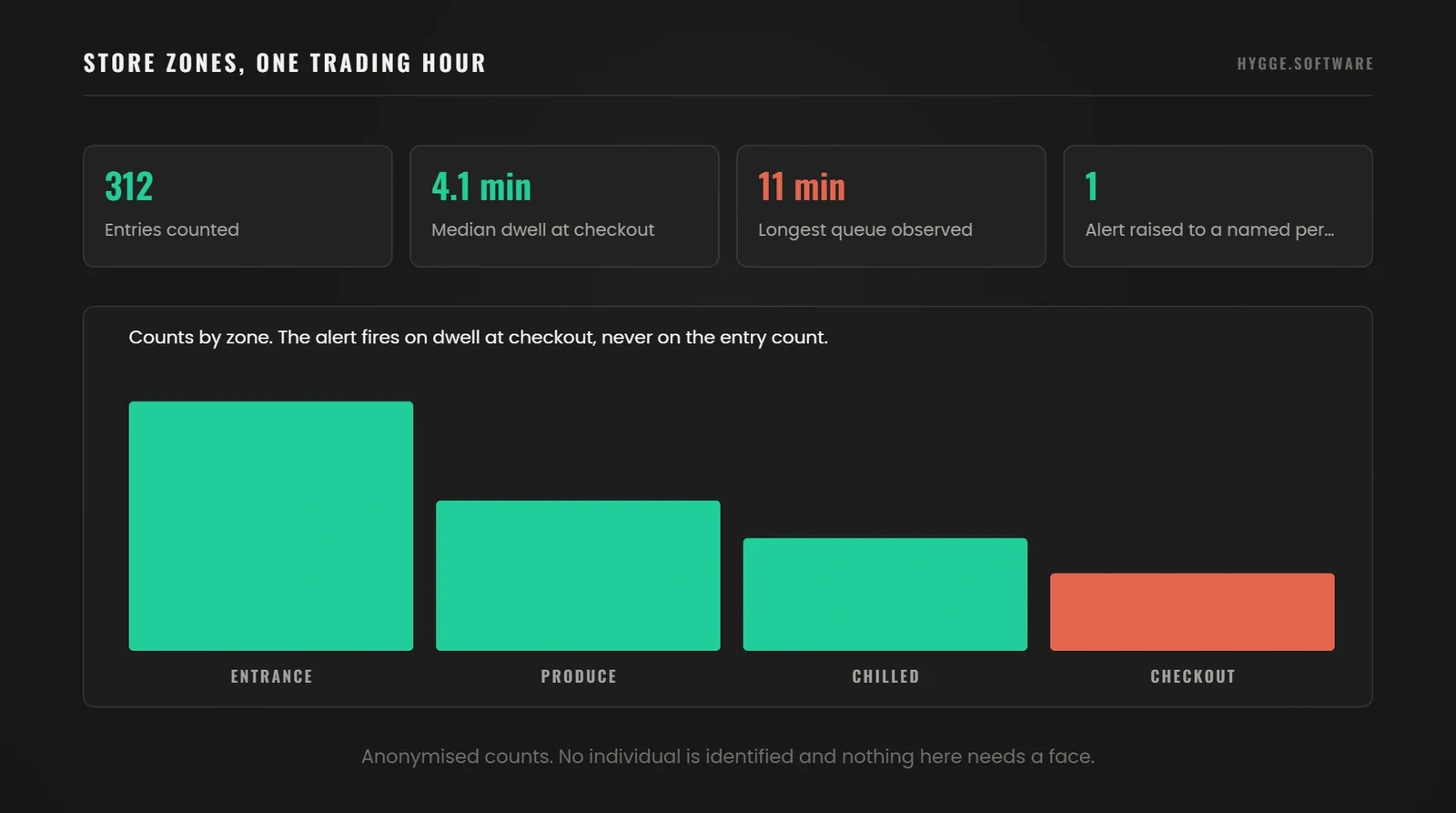
Door counters and connected cameras count people and show where they stand. That gives footfall by hour, dwell by zone, and a queue length that can trigger a till opening.
Design the action before the sensor. A queue alert that reaches a screen nobody watches is a cost with no return, and a queue alert that opens a till needs a staffing rule behind it. None of this requires identifying anyone. The sensible default is a system that counts shapes and keeps no images. That choice removes an entire category of risk and review.
Where cameras are already installed, this overlaps with video analytics software development, and it stops being a separate hardware programme.
Connected Self-Service Devices and Smart Lockers
Kiosks, vending units and parcel lockers report door events, bay occupancy, consumable levels and faults. That telemetry turns a van round into a scheduled visit and a customer complaint into a diagnosis.
A self-checkout is not automatically part of this. A till that runs a closed application reports only to its own vendor platform. It is a machine in your store, outside your connected estate. The difference shows up the first time you want availability in your own reporting.
Asset Tracking and Store Replenishment
Cages, trolleys, totes and portable equipment are capital that quietly leaves. Tags plus reads at loading doors give dwell time per site and a list of what never came back.
This answers a different question from stock tracking. Stock asks what a customer can buy. Assets ask what your operation is standing on. The replenishment signal here moves cages, trolleys and equipment back to where they are needed.
How a Connected Store Turns Device Data into Action
Follow one event the whole way. A probe in a chiller reads two degrees above its threshold at 03:14. The gateway forwards the reading. The platform checks it against the rule for that equipment and product group. It waits for a second reading to rule out a door opening. Then it raises an alert on the duty manager's device. The manager acknowledges, checks the cabinet, moves the stock and records the action. The event closes with a time, a person and an outcome attached.
Measurement, transport, judgement, action, acknowledgement. An installation missing the last two steps stops at telemetry.
Devices, Readers and Connectivity
Sensors measure, readers wake passive tags, gateways carry traffic from the local protocol to the network. Pick the radio from the job: coverage across a large floor, battery life in years, data volume, and how long a reading may take to arrive.
No technology wins across all four. A protocol that reaches the far corner of a warehouse on a coin cell sends small messages slowly; one that streams video needs power and bandwidth. Choose per device class. Expect IoT in retail stores to run more than one radio side by side, and make the gateway hide the difference from everything above it.
Local Processing and Cloud Services
Decide what the store can do with its link to the outside world cut. A threshold check, a local alert and a buffer of readings can all run on site. Fleet comparison, long-term trends and model training belong centrally.
Offline behaviour is an architecture choice with its own cost. If the answer matters during an outage, the rule runs locally and the readings queue for later upload. That has to be designed, tested and proven with the link physically pulled.
Integration with Inventory, POS and Business Systems
A device event is worth something once it is attached to a product, a location and a piece of equipment that your other systems recognise. That mapping is the project.
We model every device event the same way. Each event answers five questions. What object does it concern, by the identifier the rest of the business already uses? Where was it read, and where does the object sit afterwards? When did it happen, with the time zone attached? Why, as the business step and the resulting state? And how, carrying the sensor reading itself? Event types stay to a small set. An observation records objects, and an aggregation records something packed into something else. A transformation records inputs becoming different outputs, and an association binds an object to a location. We fix the vocabulary once at the start so that two systems reading the same event reach the same conclusion. That shape follows GS1 EPCIS, so a partner using the same GS1 codes can read the events with little translation work.
We set one rule before launch: a sensor reading is an observation, and a person decides any correction. A tag read that disagrees with the recorded stock raises a task. Whether it overwrites the number is a business decision about who owns that figure, and it belongs with the people who answer for it.
Source: GS1 EPCIS and CBV implementation guideline, read October 2026.
Who Owns the Store Code
Hygge names the owner of the location mapping in the first week.
 Alina Sukhova
CEO & Co-Founder
"The hardware is rarely what delays these projects. It is that the store code in the energy platform, the site code in the maintenance system and the location code in the stock system were created by three different teams in three different years. Someone has to own that mapping, and it is cheaper to name them in week one."
Joining device events to the systems that already run the business is ordinary system integration services work with a physical layer attached.
Which Retail IoT Use Case Should You Start With?
Score each candidate on what the problem costs today and whether the result can be measured. Check whether the data exists and how hard the install is. Then ask whether a named person will act on the output. The most technically interesting scenario is rarely the one that scores highest.
The supplier needs a filter of its own. Vendors bundle hardware, platform and analytics in different proportions. The market splits along a visible line: device makers who added software, and software firms who resell somebody else's devices. Ask which half you are buying from, because it predicts what they will do well and where you will be filling gaps yourself. Then ask questions with numeric answers. What is the expected battery life of the exact sensor being quoted? What annual replacement rate do they see on that model across their installed base? And who carries the spares budget in year two? A supplier who cannot answer those three has run pilots and no estate. Once one scenario scores highest, discuss your retail IoT pilot with the site list and the systems the data has to reach.
Where Each Retail Format Starts
The highest-scoring first project differs by what the format loses money on.
Grocery or convenience
The expensive problem is waste and compliance evidence. Cold-chain monitoring usually scores first, with a clear threshold, a measurable excursion and a responder who already exists. Defer it when the equipment is due for replacement inside a year, since the probes and the integration go with it.
Apparel or specialty
The expensive problem is stock that exists in the system and never reaches the shelf, so item tagging scores first. Defer it when the supplier base cannot apply tags at source, because tagging at the store turns a one-off into a permanent labour line.
A network with distributed equipment
The expensive problem is unplanned downtime across many sites. Equipment and energy monitoring scores first, since one gateway per site covers several assets. Defer it when nobody owns the maintenance budget, because the alerts will arrive with no route to a repair.
Start From the Problem That Costs You Most
Send the scenario, the sites and the systems the data has to reach. You get a device and integration plan and an honest view of what a pilot can prove.
What Can Go Wrong with Retail IoT?
The scenarios above describe what these systems do when they work. This section is about the conditions that decide whether they do.
Missed Readings, Poor Coverage and Unreliable Data
Tags sit behind foil packaging and metal shelving and go unread. Readers get mounted where the installer could reach, far from where the stock sits. Probes drift and report a steady lie. Gateways lose the link and the gap looks like good news on a chart.
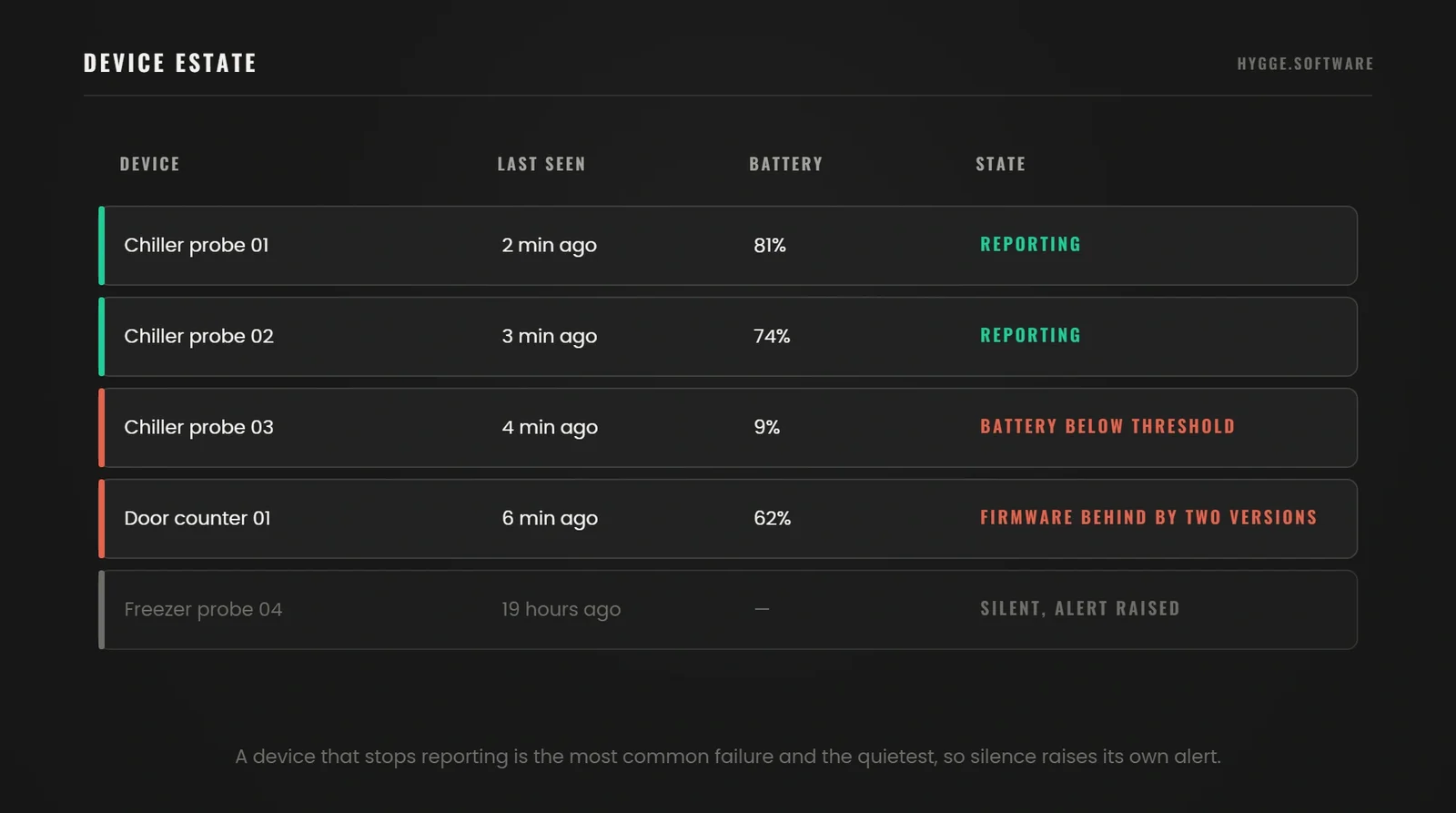
Each has a check we run on site before the pilot widens. Place a known set of tagged items in the worst spot in the department and measure the read rate. Put a calibrated reference probe beside the installed one for a week and compare. Alert on silence as well as on breach, because a sensor that stops reporting is the most common failure and the quietest.
Device Security and Customer Privacy
Every device needs its own identity and its own credential, so one compromised unit cannot speak for the estate. Plan the update path before purchase, since a device that cannot be patched becomes a liability on a schedule you do not control.
For anything that senses people, decide the purpose first and collect the minimum that serves it. Counting and dwell need no identity. A system that keeps no images is cheaper to run and easier to explain to a regulator, a works council or a customer who asks.
Maintenance, Updates and Vendor Dependence
Batteries fail, devices get knocked off brackets, firmware ages. Budget the replacement rate and hold a stock of spares, because a store with a third of its sensors dark produces data that misleads more than silence would.
Ask two questions of any vendor before signing. Can you export your own raw readings, in bulk, in a documented format. And if you stop paying, what keeps working. The answers decide whether you are buying a system or renting a view of your own building.
Audit the Estate You Already Have
Cameras, controllers and gateways already in your stores often cover the first scenario. We check what is installed and what it can report, and the shopping list comes out of that.
Keeping that estate answerable over years is remote device management work, and it is the line most pilots forget to budget.
How to Measure Value and Plan a Retail IoT Rollout
Record the current state, run one bounded scenario in one place, and compare the result against the full cost of running it. Those steps run in that order, and the first cannot be done after the fact.
Establish a Baseline and Choose Success Metrics
Pick two or three numbers tied to the problem: stock accuracy, time from alert to response, downtime hours, hours of manual checking, or waste written off. Capture them while the store still runs the old way, because reconstructing a baseline afterwards produces a number nobody trusts.
Account for what else changed. Seasonality, a refit, a staffing change and a supplier switch all move the same metrics. A pilot that ran through Christmas proves less than its chart suggests.
Include the Full Cost of Ownership
Count hardware, installation and connectivity. Add the software build, the integrations and licences. Then add maintenance and the replacement rate over the expected life. Separate the one-time spend from the monthly line, since the monthly line is what decides whether a successful pilot can become an estate.
The Install Is What Surprises Clients
Hygge quotes retail IoT from the site list and the access arrangements.
 Artem Petrov
CFO & Co-Founder
"The number that surprises clients is rarely the sensor price. It is the install: a technician visiting every site, twice if the first mount was wrong. We ask for the site list and the access arrangements before quoting, because fifty stores with out-of-hours access only is a different project from fifty stores an engineer can walk into."
Validate One Store Before Scaling
Run the scenario in a single site under real trading conditions. Include the busy hour, a deliberate loss of connectivity and a deliberately disabled device. Before widening, confirm that the data is good enough to act on and that the exceptions have a route. Check that the staff use the output and have stopped keeping a parallel note.
A worked example of the shape. A grocery chain monitors chillers in one store. The baseline is arithmetic read off the last full quarter. Take manual temperature checks per week and multiply by minutes per check and by hourly cost. Then add the units written off after unrecorded excursions, multiplied by unit cost. The pilot runs a full season, including the warmest fortnight. It reports excursion minutes per cabinet per week and the median minutes from alert to acknowledgement. It also reports false alerts per cabinet per week and the share of excursions with a recorded response. We write the widening condition as figures before the pilot opens. On a chiller scenario, that usually means acknowledgement time falling against the baseline. It also means false alerts held under one per cabinet per week, so staff keep reading them. The recorded-response share is the number a food-safety auditor will ask for. FDA traceability records are a separate set: lot codes for the foods on the agency's list. Where results fall short, the usual culprits are threshold tuning and probe placement.
How Hygge Runs a Retail IoT Pilot
These rules shape every connected-store project we take.
The action before the sensor. We name who responds and what they do before specifying hardware, because a scenario with no owner produces a dashboard and no change.
A baseline captured before install. Two to three weeks on the current process, the existing equipment and what the problem costs today. It ends in a measured starting point and a priced scope.
Identifiers settled in week one. Store codes, asset codes and product codes reconciled across the systems that will receive the events, with one named owner for that mapping.
Silence alerted the same as breach. A device that stops reporting is the most common failure and the quietest, so it raises an alert of its own.
Handover inside the build. Runbooks, a spares and battery replacement rate in the budget, and a named owner for the device estate after launch.
Our published projects carry the lessons. On the PlayFusionLabs CRM we put sales, projects and finance into one database in about two months. The schedule held because each record was given one owning system at the data-model stage. The same discipline decides whether a device event can attach to a product and a site at all. On CreAItivity we are shipping in the third year on the architecture chosen at the start. A sensor estate faces the same test: does it still hold in year three. For the build itself, explore IoT development services that cover the devices, the integration and the software between them.
Our Delivery Record
Numbers published on hygge.software and in the case studies linked above.
Build a Pilot That Can Prove Something
One site, a baseline captured before install, an agreed stop condition, and the integration into the systems that already run the business.
A Continue, Change or Stop Rule
Hygge agrees the three pilot outcomes at the site survey.
 Zinaida Shelomkova
Head of Delivery
"We give a pilot three outcomes at the start: continue, change, stop. Continue needs the metric moving and the staff using it. Change is for a good signal with bad ergonomics, which is usually the alert reaching the wrong device. Stop is for a signal the store cannot act on, and naming it early is what keeps the budget available for the scenario that works."
Figures in This Article
From the Incisiv benchmark of March 2026 and the FDA Food Traceability Rule.
Retail IoT FAQ
The questions retailers ask about the IoT in retail sector at the site survey.
 Where do IoT and retail actually meet?
What are the most common IoT retail examples?
How is the internet of things in retail market split?
Can a small retailer use IoT without rebuilding its entire technology stack?
Does every retail IoT device need its own internet connection?
Is 5G required for a connected store?
Can existing cameras and equipment be reused?
Does retail IoT always require artificial intelligence?
Can an online-only retailer benefit from IoT?
Scope Your Retail IoT Pilot
Send us the scenario, the sites involved and the systems the data has to reach. We will come back with a device and integration plan and an honest view of what the pilot can prove.
Describe the Store Scenario
The problem on the shop floor, the sites involved and the systems the data has to reach.
Get a Device and Integration Review
Hygge checks the devices, connectivity and data path against the scenario and your existing systems.
Receive a Pilot Plan
Devices, integration, timeline and pilot cost, plus the result the pilot is set to prove.