
AI MVP Development Roadmap: Scope, Team, Timeline and Budget
Scope, data checks, strategy, team, timeline and budget, in the order they hit the plan.
 Yevhenii Sukhov·Publication date·15 min read
A demo and version one of the full platform are different things, with different budgets. An AI MVP sits between them and answers one question: does this AI-driven workflow create value someone will pay for?
Founders lose money in two places. They build too much with no user on the other end, or they ship a thin demo that cannot survive real inputs. This AI MVP development guide covers the middle path, decision by decision, with the exit criteria that let you stop.
What Does It Take to Build an AI MVP?
One user group, one problem and one workflow. A data check that gates model work. The cheapest technical approach that clears the quality bar, usually an API with retrieval. A team of three to six people, part of them part-time. Two to sixteen weeks from kickoff to a product a pilot group can run, depending on the shape. A budget that covers discovery, data preparation, build, inference and a review path for weak answers.
What Is an AI MVP, and What Must It Prove?
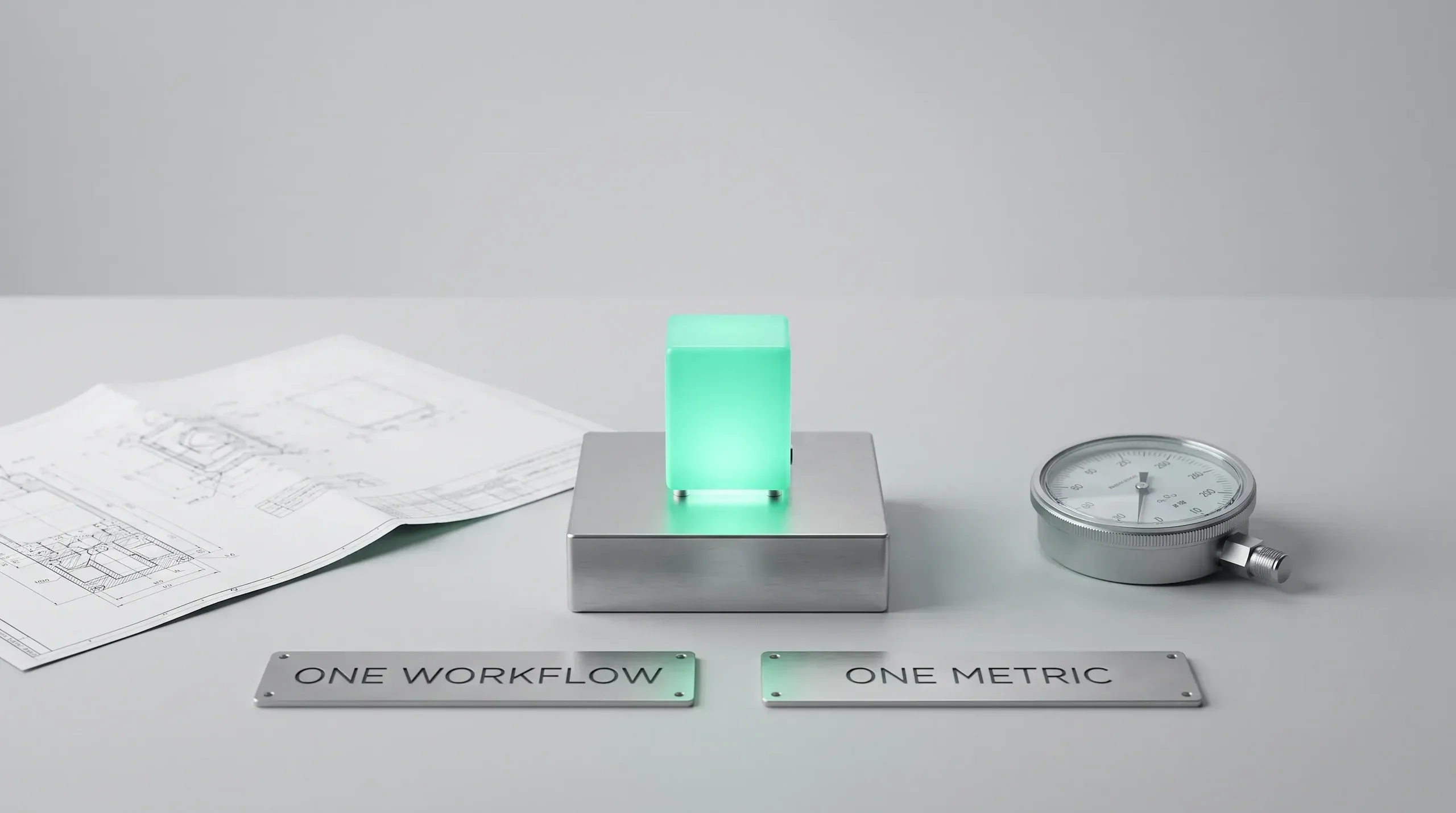
An AI MVP is a working product with one AI-driven workflow, used by real users, measured against one business metric. Everything that does not serve that metric waits. An MVP is successful when three things hold. The product reaches the quality bar on real data. Users adopt the workflow without being pushed. The unit economics hold when volume grows.
Proof to ask for
- Quality clears the bar on real data
- Users adopt the workflow without pressure
- Unit economics hold when volume grows
AI PoC vs Prototype vs MVP vs Full Product
These four words describe four different budgets, and mixing them is the most common reason an AI project overruns.
| Stage | Main Question | Real Users | Working AI | Product Interface | Main Outcome |
|---|---|---|---|---|---|
| Proof of concept | Can the model reach the quality we need? | No | Yes, on test data | None or a script | Evidence and a cost estimate |
| Prototype | How should the workflow feel? | A few, in a session | Often simulated | Clickable design | Agreed flow and scope |
| MVP | Does this create measurable value? | Yes, daily | Yes, on real data | Minimal working product | Adoption and a moved metric |
| Full product | Can it scale across the business? | Yes, many roles | Yes, monitored | Complete platform | Reliable operations and growth |
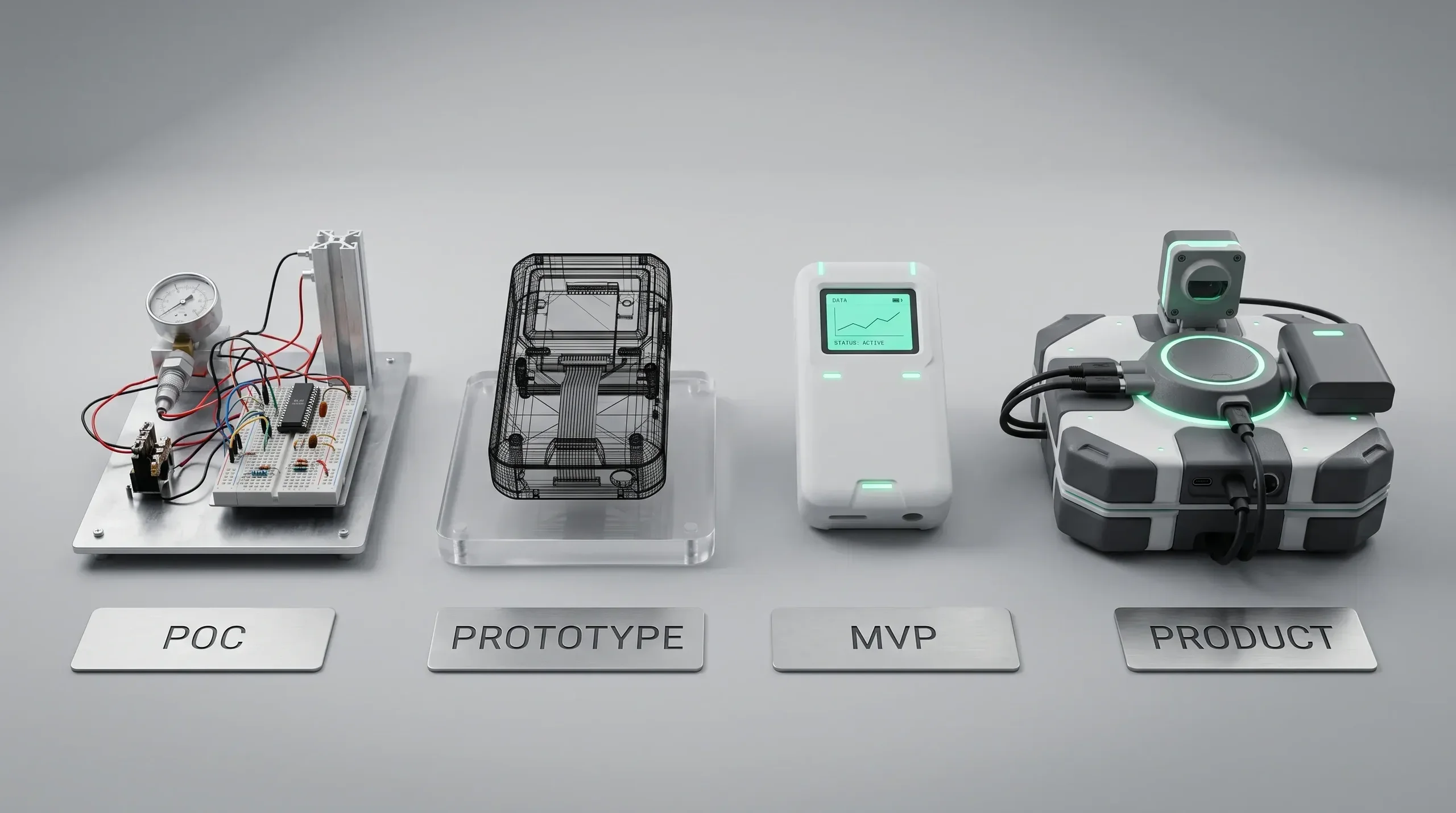
A proof of concept protects the budget when the hard part is technical, and a prototype protects it when the hard part is the workflow. Name the stage before asking for a quote. A team that prices a proof of concept as an MVP, or the other way round, will either overspend or deliver something nobody can use. Our AI development services are scoped against whichever of those four stages you are at.
Step 1. Define the Business Problem Before the AI Feature
Write the problem as one sentence with a number in it. "Support answers take 14 hours on average and we want 2." "Quotes need three days of manual checks." A sentence like that decides scope, model choice and the definition of done.
Then name the owner. One person who reports that number and can approve changes to the workflow. Projects without that person drift into research.
Step 2. Define the AI MVP Scope
Scope is the main cost lever. Every feature you add while the product has no users multiplies the timeline and the risk.
Start with One User, One Problem and One Core Workflow
Pick the role that feels the pain daily. Pick the single task they repeat. Build that path end to end, including the boring parts: login, permissions, and where the result lands.
What an AI MVP Should Include
These elements make the first release usable and measurable.
The core AI workflow
Input, model call, result, and the action the user takes on that result.
A correction path
Users fix wrong answers in one click, and the fix is stored as data.
Evaluation built into the MVP
A labeled set of real cases, scored on every change.
Basic operational plumbing
Auth, roles, logging, cost tracking and one integration that matters.
What to Leave Out of the First Release
Everything here can wait for the pilot results.
Extra roles and admin panels
One role is enough to prove the metric.
Multiple model options
Ship one approach. Compare later with real usage data.
Custom analytics dashboards
Export events and use a spreadsheet for the first weeks.
Everything that needs a second integration
Each connector adds scope, access requests and test cycles.
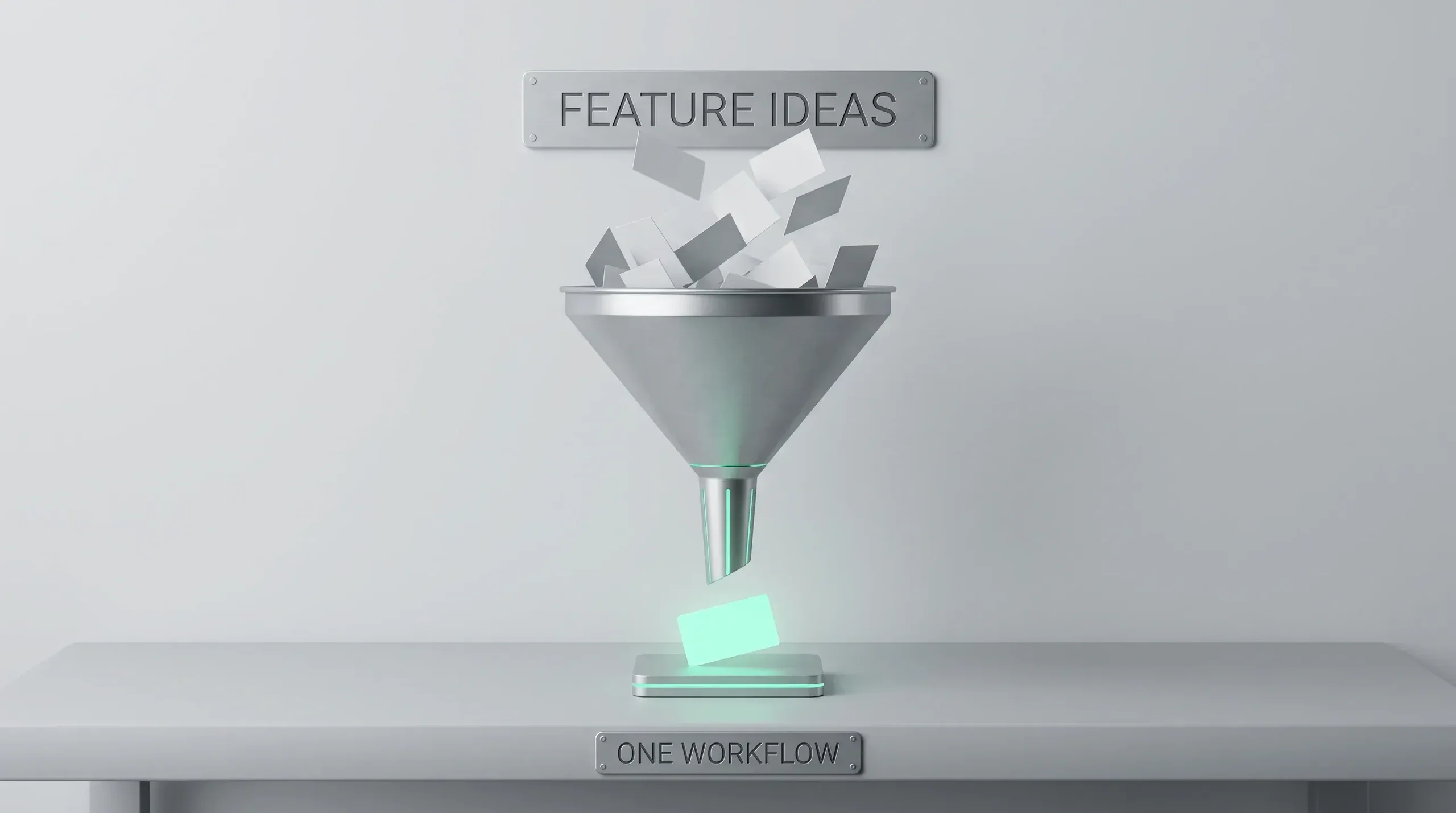
Use a Scope Filter for Every Feature
Ask three questions. Does this feature change the metric? Will the first user group refuse to work without it? Does it block the release if we skip it? Two answers of no send the feature to the backlog.
Ask this of every feature
- Does this feature change the metric?
- Will the first users refuse to work without it?
- Does it block the release if we skip it?
Step 3. Assess Data and AI Feasibility
Data decides whether the plan survives. This check takes days and saves months.
Answer these at the data check. Do the examples exist, and how many? Can you get legal and technical access to them? Do they represent production conditions, including the messy cases? Is there a way to judge a correct answer, either by a rule or by a person?
When the answer set is weak, the MVP scope changes. A retrieval product can start with any document set that covers the questions users ask, as long as it is current and well structured. A classification workflow on a hosted model needs a few hundred labeled test cases. Training your own classifier needs far more examples per class. A custom model needs consistent examples of the exact output you expect, plus a separate evaluation set the model never sees.
Data Access Moves the Date More Than the Model
Data access moves an MVP date more than any technical decision.
Yevhenii SukhovCTO & Co-Founder
"The blocker is rarely the model. It is access. A client agrees on the scope in week one, and the data sits in a system nobody can export from without a security review. We now put data access on the critical path of the first week, with names and dates, because that single item moves the MVP date more than any technical choice."
Step 4. Choose the Right AI MVP Development Strategy
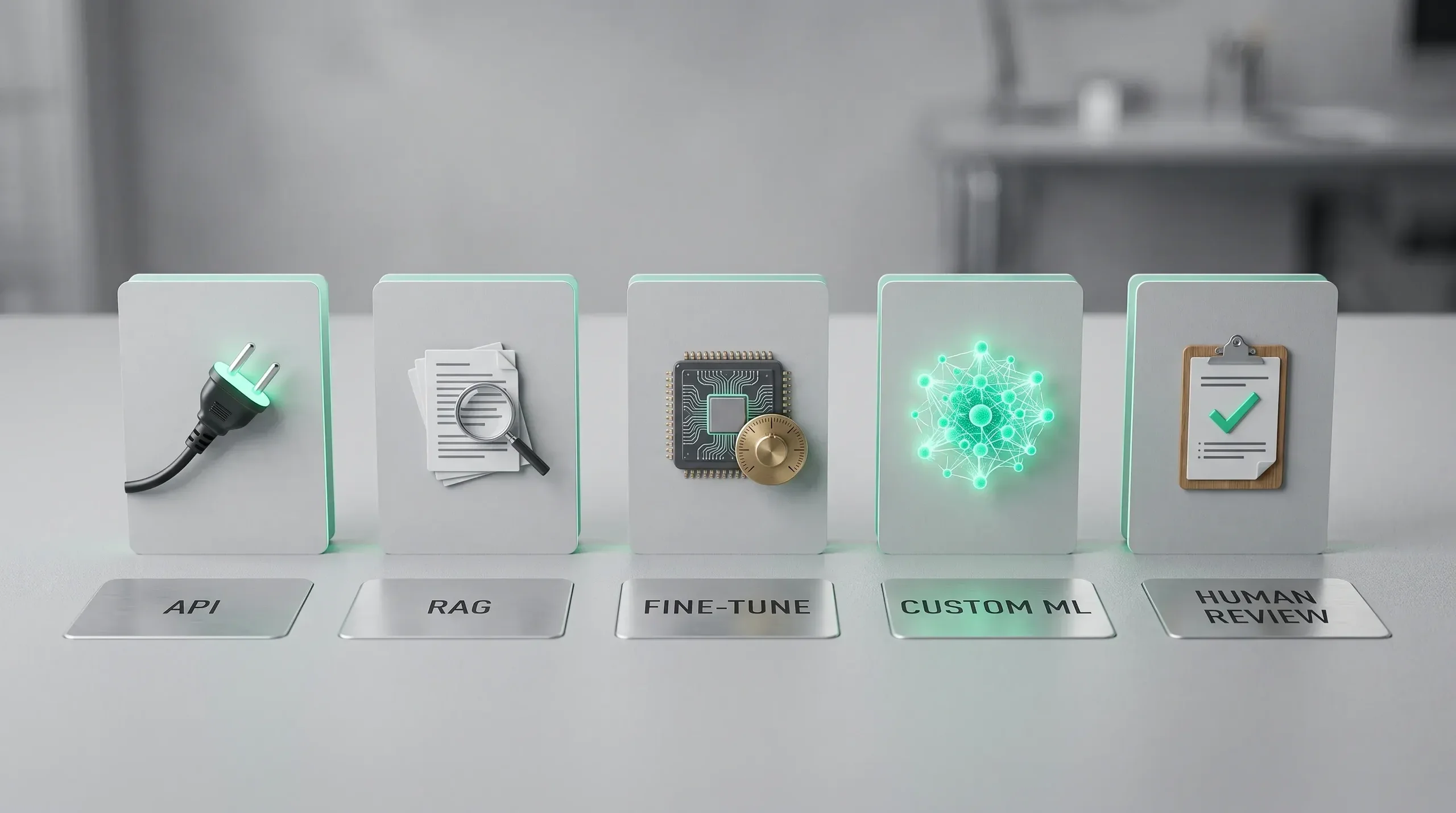
AI MVP development strategies differ in cost, speed and control. Pick the cheapest option that can clear the quality bar, then revisit after the pilot.
API-first AI MVP
A hosted model does the work through prompts and tools. Fastest to launch, lowest upfront cost, per-request pricing. Fits drafting, classification, extraction and summarization.
RAG-based MVP
The model answers from your documents through retrieval. Fits internal knowledge, policies, contracts and support content where answers must be grounded and traceable.
Fine-tuned model MVP
A smaller model is trained on your examples to hold a format, a tone or a narrow task at lower cost per call. Needs consistent training data and an evaluation set.
Custom ML MVP
A model built on proprietary signals, used for scoring, forecasting, vision or matching. Highest effort, and the right call when the model is the product.
Human-assisted AI MVP
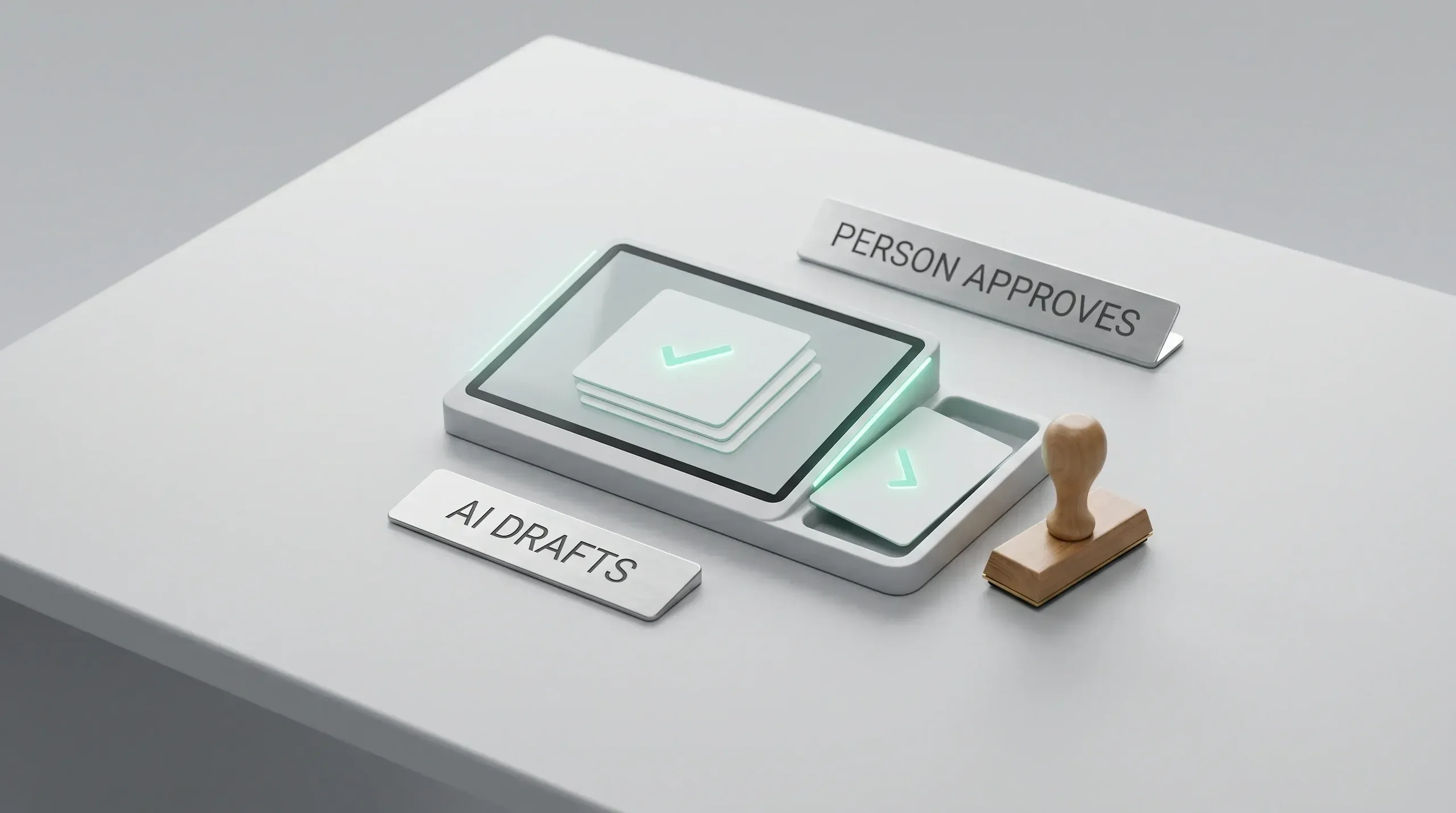
The system prepares, a person approves. The fastest way to launch in regulated or high-risk workflows, and a clean way to collect training data.
The AI MVP Development Process: A Stage-by-Stage Roadmap
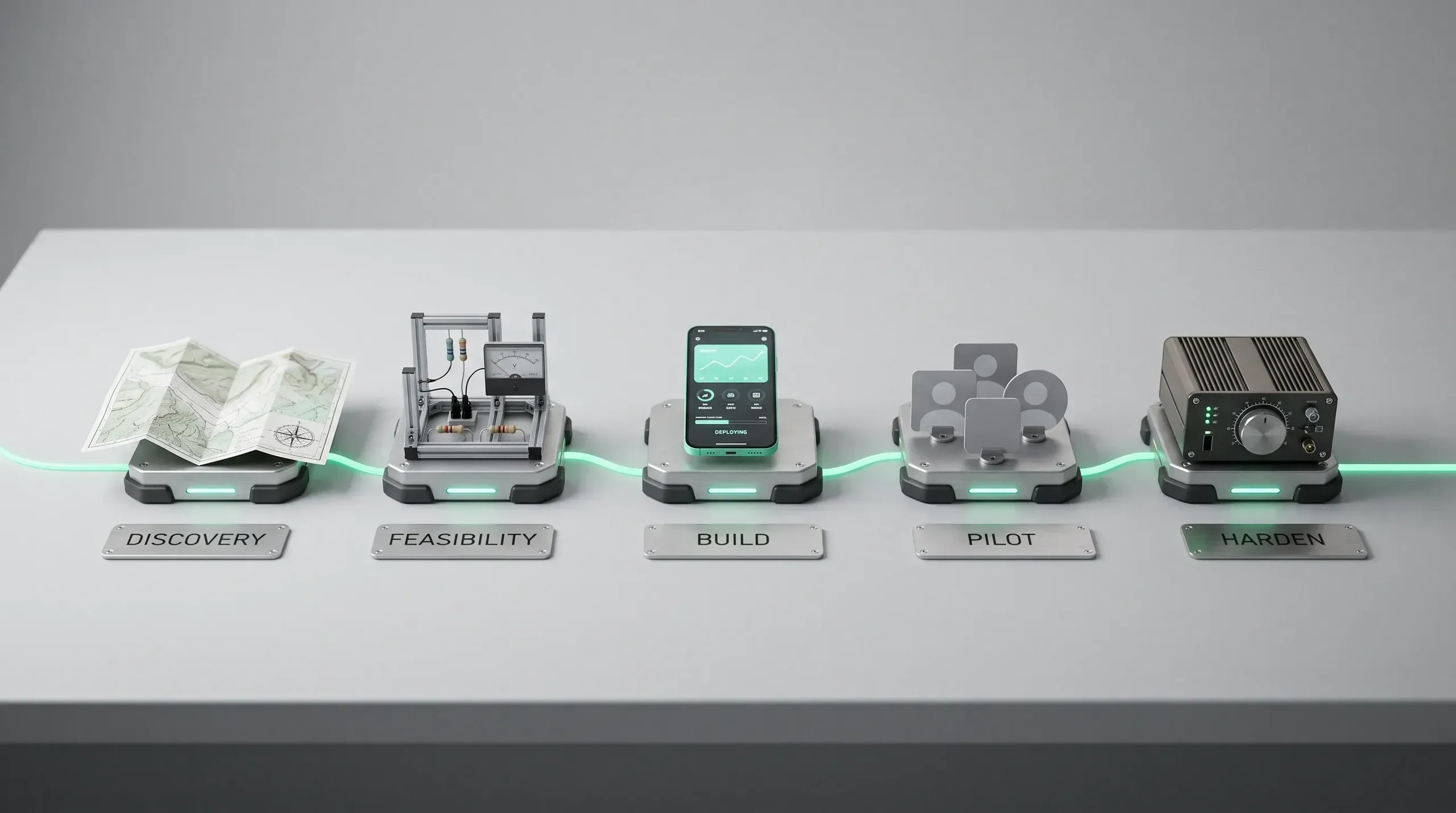
The AI MVP development process runs in five stages. Each stage ends with a decision and a deliverable that the next stage needs.
The stages are short on purpose. Discovery and the feasibility check take weeks, and they exist to stop a project early when the data or the quality bar cannot support the idea. The build and the pilot follow once that evidence is in.
Each stage also needs something from your side: a metric owner, sample data, test users or a budget owner. Plan those people into the calendar along with the engineering team.
Each Stage Ends With a Decision
Read it as a checklist: no decision, no deliverable, no next stage.
Stage 1. Discovery and scope, 1 to 2 weeks
Goal: agree the metric, the workflow and the data path. Actions: process mapping, data inventory, risk and compliance review, success criteria. Deliverable: scope, metric and a technical approach. Decision: proceed, narrow the scope or stop. Client side: the metric owner and access to systems.
Stage 2. Feasibility check, 1 to 3 weeks
Goal: prove the hard assumption on real records. Actions: build the evaluation set, test one or two approaches, measure quality and cost per request. Deliverable: scored prototype and a cost model. Decision: build, change approach or stop. Client side: sample data and a domain reviewer.
Stage 3. MVP build, 4 to 8 weeks
Goal: one workflow, end to end. Actions: data pipeline, model layer, application, correction path, logging, one integration. Deliverable: a product a pilot group can use daily. Decision: release to pilot. Client side: weekly review and test users.
Stage 4. Pilot, 2 to 4 weeks
Goal: measure value with real users. Actions: onboarding, quality review, prompt and model tuning, cost tracking. Deliverable: results against the baseline. Decision: scale, adjust or stop. Client side: users in the workflow and feedback within days.
Stage 5. Decide and harden, 2 to 4 weeks
Goal: prepare for scale or close the project cleanly. Actions: monitoring, access control, retraining plan, documentation, handover. Deliverable: production-ready system or a written conclusion. Decision: fund the next stage. Client side: budget owner and security review.
What Team Do You Need for AI MVP Development?
An AI MVP rarely needs a full-time team of ten. It needs a small core and specialists who join for a few weeks, which is how we staff software development for startups by default.
The core is a product owner with domain access, an AI engineer, a full-stack engineer and a part-time designer. Around that core, a data engineer joins when sources are messy, QA joins before the pilot, and DevOps sets up environments and cost monitoring. A domain reviewer from the client side scores answers every week.
A missing reviewer sinks more of these projects than a missing engineer does. Somebody has to say whether an answer is good, in the client's own language.
Staff Around the Decisions
Hygge staffs an MVP around the decisions it has to make.
 Zinaida Shelomkova
Head of Delivery
"We staff an MVP around the decisions that have to be made. Two senior engineers who can change the approach in a week beat a larger team that needs a spec for every step. The one role we never skip is the reviewer on the client side, because without their judgment the team optimizes a number nobody trusts."
How Long Does AI MVP Development Take?
Most AI MVPs reach a pilot group in two to sixteen weeks, and the pilot and hardening add another four to eight. An internal assistant over one document set sits at the short end. An AI SaaS product with billing and tenant separation sits at the long end.
The date moves on data access speed, the number of integrations, the depth of the compliance review, and how fast the client side answers questions. Only one of them is technical.
AI MVP Development Cost in 2026
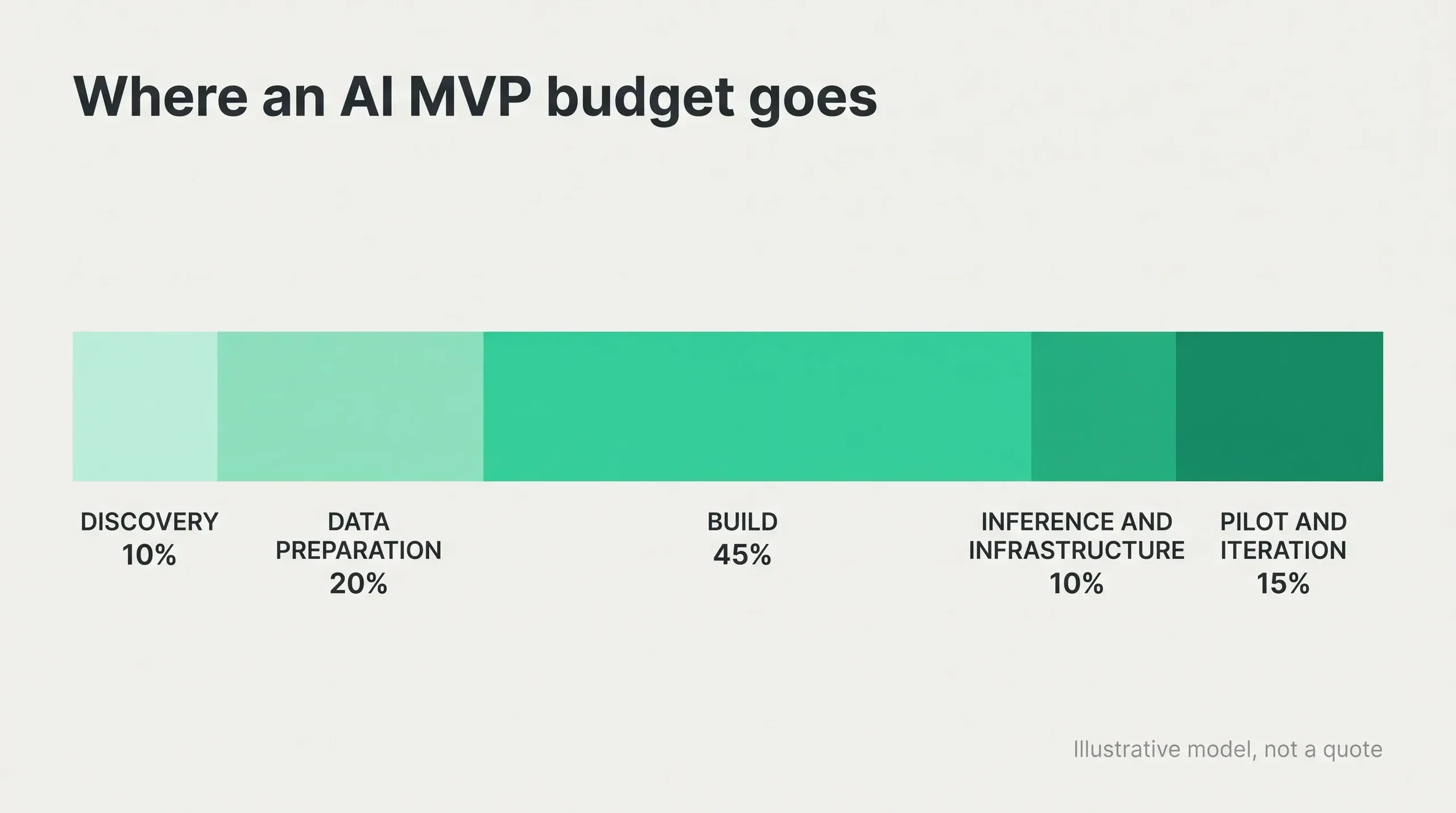
AI MVP development cost in 2026 depends on scope, data readiness and the model approach. An internal assistant over company documents typically costs $5,000 to $10,000, and a document or ticket processing workflow $7,000 to $12,000. An AI SaaS product for external users runs $15,000 to $25,000, because sign-up, billing and tenant separation come on top of the AI workflow. Custom models, several integrations or compliance work move the figure above these ranges. The budget covers five things: discovery, data preparation, build, inference and infrastructure, and the pilot. Inference is usually a small share of an MVP budget, while people time and data work stay the largest lines. Model it per request anyway, because reasoning models and long documents use many more tokens.
What Is Included in an AI MVP Budget?
These lines cover most of an AI MVP budget.
Discovery and scope
Process mapping, data inventory, risk review and the success metric.
Data preparation
Access, cleaning, structuring, annotation and the evaluation set.
Build
Application, AI layer, integration, correction path, logging and tests.
Inference and infrastructure
Model calls, vector storage, hosting, monitoring and environments.
Pilot and iteration
Onboarding, quality review, tuning and the decision report.
Main Cost Drivers
The number of workflows in scope. Data readiness and annotation volume. The chosen approach, from an API call to a custom model. Integration count and the access process behind each one. Latency and reliability targets. Compliance scope, including audit trails and data residency.
AI SaaS MVP Development Cost in 2026
A SaaS build carries items a single-workflow tool skips. Sign-up and billing, multi-tenant data separation, roles and permissions, usage limits and a basic admin view. Each item is standard work, and together they add weeks. For a mobile product, AI app development cost rises the same way at the MVP stage, because app store review and device testing join the plan.
The running cost is easier to model than founders expect. Public model pricing is published per million tokens, so a product with known volume can be costed from that volume. In October 2026, OpenAI's published API prices ranged from $0.10 per million input tokens for a small model to $10.00 for a flagship one, with output tokens priced higher. Multiply your expected requests by the tokens per request, then add retries and embeddings.
Get a Realistic Scope and Budget for Your AI MVP
Define the smallest product that can validate your idea, estimate the required team, and identify the technical risks before committing to full development.
Benefits of AI in MVP Development
The phrase covers two different things: a product with AI inside it, and AI tools used to build any MVP faster. AI for MVP development pays off in both, for different reasons. The first is the path we set out in our guide on how to build an AI product.
Benefits of Building an AI-Powered MVP
An AI workflow can remove a manual step that blocks growth, and that shows in the metric within weeks. It also creates data: every correction a user makes improves the next version. A working AI feature is easier to sell to early customers than a roadmap slide.
Benefits of Using AI During MVP Development
AI in MVP development speeds up the work around the product. Scaffolding, test generation, documentation drafts, data cleaning scripts and code review all move faster. The gain is real and bounded. Architecture, integrations, security and evaluation still need experienced engineers, so the saving shows up in build time.
Example AI MVP Scenarios: Scope, Team, Timeline and Budget
These shapes cover most AI MVP requests. Each card shows the scope, the team, a typical timeline and a budget range for scoping conversations, and each project gets an exact price after discovery.
The timeline grows with what sits around the model. An internal assistant over one document set is the smallest shape. A processing workflow adds an integration and a review queue. An AI SaaS product adds sign-up, billing, roles and tenant separation, which is why it needs the largest team.
Common AI MVP Shapes
Planning ranges for scoping conversations, before discovery fixes the number.
Internal assistant over company documents
Retrieval over one document set, a chat interface with source links and a correction path. Built by an AI engineer, a full-stack engineer and a part-time designer, with a reviewer on your side. Timeline: 2 to 4 weeks. Budget: $5,000 to $10,000.
Document or ticket processing workflow
Extraction and classification, a review queue, one integration and an evaluation set. Built by an AI engineer, a data engineer, a full-stack engineer and QA, with a reviewer on your side. Timeline: 3 to 5 weeks. Budget: $7,000 to $12,000.
AI SaaS product for external users
Sign-up, billing, roles, tenant separation, one AI workflow and usage limits. Built by a product owner, an AI engineer, two full-stack engineers, a designer, QA and DevOps. Timeline: 8 to 16 weeks. Budget: $15,000 to $25,000.
The same rules hold across all three. The first release covers one workflow for one role. The budget holds a reserve for rework after the pilot, because real usage always changes something.
How to Keep the MVP Lean Without Creating Technical Debt
Speed and debt are different decisions. Some shortcuts are free to reverse, and some become the product's foundation.
Take shortcuts in the interface, in admin tools, in reporting and in manual onboarding. Those areas are cheap to replace later.
Keep quality in four places: the data model, authentication and permissions, the evaluation harness, and the boundary between your application and the model provider. A product that hides the provider behind one interface can switch models in days. A product that calls the API from twenty places cannot.
Common AI MVP Development Mistakes
The patterns that stall AI MVPs after the demo.
Starting from the model before the metric
The tool is chosen first, and the scope bends to fit it.
Scoping three workflows at once
Three half-finished paths prove nothing and cost more than one finished path.
No evaluation set
Quality becomes an argument, and every release is a debate.
Demo data only
Clean samples hide the cases that break the pipeline in week two.
No correction path
Users meet a wrong answer with nowhere to send it, and adoption drops.
Ignoring cost per request
Unit economics appear after launch, when redesign is expensive.
Treating the pilot as a launch
The pilot is a measurement, and it needs an agreed baseline.
No owner for the metric
Without one person accountable for the number, the MVP has no finish line.
When Should You Build an AI PoC Before the MVP?
Build a proof of concept first when the technical risk is the main risk. Signals: the task has never been solved on data like yours, accuracy targets are strict, the data is noisy or thin, or latency and cost limits are tight.
Skip the proof of concept when the approach is proven for the task, the data is accessible, and the real question is whether users will adopt the workflow. In that case the MVP is the cheaper experiment.
A proof of concept costs a fraction of the MVP and takes one to three weeks. It ends with a number.
How Hygge Software Approaches AI MVP Development
Hygge Software builds custom software and AI products for US and European companies. Seven years of production delivery, 200+ projects completed end to end.
Every AI MVP starts with the metric and the data path. The feasibility check runs on the client's real records, and the build is scoped from its results. The MVP covers one workflow end to end, with an evaluation set and cost tracking built in. Scope is fixed and the cost is an exact number, with the code in the client's repository at every milestone.
Two published case studies show the pattern. On IntellicAIr, sealed bidding existed in no third-party service, so it was built as its own component with onboarding for three roles, and active development took around six months. On Smarter Humans, AI content generation and a retrieval chat shipped inside a product Hygge has run for seven years, and a 20-second document load dropped by 93%.
Delivery Record
Numbers published on hygge.software and in the case studies.
Turn Your AI Idea into a Testable Product
Start with a focused scope, a measurable product hypothesis, and a technical approach that fits your data, timeline, and budget.
AI MVP Planning Checklist
- The problem is one sentence with a number in it.
- One person owns that number and can approve workflow changes.
- One user group, one problem and one workflow are named.
- Data access is confirmed in writing, with dates.
- An evaluation set of real cases exists.
- The technical approach is the cheapest one that clears the quality bar.
- The correction path for weak answers is part of the first release.
- Cost per request is modeled at expected pilot volume.
- The pilot has a baseline, a duration and a decision date.
- The budget holds a reserve for rework after the pilot.
Build Only What Your AI MVP Needs to Prove
An AI MVP earns its budget when it answers one question with evidence. Keep it to one workflow, real data, a measured pilot and a decision date. Then the cost stops being a guess, because both sides can see what drives the number.
Plan Your AI MVP with a Clear Scope and Budget
Get a scoped plan with the team, timeline, technical approach and an exact price for the first release.
AI MVP Development FAQ
Direct answers to the questions founders ask at the planning stage.
 How much does it cost to build an AI MVP in 2026?
How long does AI MVP development usually take?
What features should an AI MVP include?
What team is required to build an AI MVP?
Should a startup build an AI PoC before developing an MVP?
How do you know whether an AI MVP is successful?
Scope Your AI MVP
Send the idea, the data you hold and the result the MVP has to prove. Hygge scopes the smallest version that can prove it and sends a plan with the team, timeline and price.
Describe the Idea and the Data
The user problem, the data you hold today and the result the MVP has to prove.
Get a Scope Review
Hygge checks the data, the model approach and the technical risks, and cuts the scope to what the test needs.
Receive an MVP Plan
Scope, team, timeline and budget for the first release, with the metric that decides the next stage.