


AI in Retail Marketing: Use Cases for Personalisation, Campaigns and Customer Retention
Which marketing decisions need a model, which are rules you already pay for, and how to measure the difference.
 Yevhenii Sukhov·Publication date·14 min read
AI in retail marketing decides things: which shoppers to contact, which products to show, what the message says and when it goes. Automation carries those decisions out. Keeping the two apart is what lets you improve a campaign instead of arguing with a black box. This guide helps you pick one scenario, check the data it needs and measure the result against a baseline.
Where Does AI Add Value in Retail Marketing?
Artificial intelligence in retail marketing earns its place in four jobs, and a fifth is usually mislabelled. Models rank products for a specific shopper, estimate what a shopper is likely to do next, draft message variants from a verified catalogue, and choose a send time or channel from past response. The fifth, sending a message when a condition is met, is marketing automation for retail and it is a rule, however the vendor describes it.
That distinction matters commercially. Rules are cheap, explainable and fast to change. Models cost data, evaluation and maintenance, and they earn that cost only where a rule cannot be written down. Much of what is sold as AI for retail marketing is a rule engine with a recommendation block attached. Retail marketing automation does most of the work, and buyers pay twice when nobody says which part is which.
The Jobs, and Which of Them Needs a Model
For each: the task, the data it needs, what the model decides, what the system does with the decision, and how you check it.
| Task | Data It Needs | What the Model Decides | What the System Does | How You Check It |
|---|---|---|---|---|
| Product recommendations | Interactions, purchase history, catalogue attributes, stock | Which items to rank highest for this shopper | Renders a block or inserts items into a message | Against popular items and current rules |
| Predicted audiences | Purchase history with dates, category cycles | Probability of a next purchase inside a window | Builds a segment | Against a recency rule, per category |
| Message content | Verified catalogue, brand rules, past performance | Candidate subject lines and body variants | Presents them for human approval | A reviewer and a holdout |
| Send time and channel | Past opens, clicks and purchases per person | When and where this person responds | Schedules inside the permitted window | Against a fixed send time |
| Retention | Purchase cycles per category, returns, open complaints | When a shopper is due to buy again, and who is drifting from their pattern | Sends a reminder or a useful offer after suppression checks | Against the category rule, with a holdout |
| Triggered sends | An event and a consent state | Nothing | Fires the sequence | That it stops on purchase and on opt-out |
How Can AI Make Retail Personalisation More Relevant?
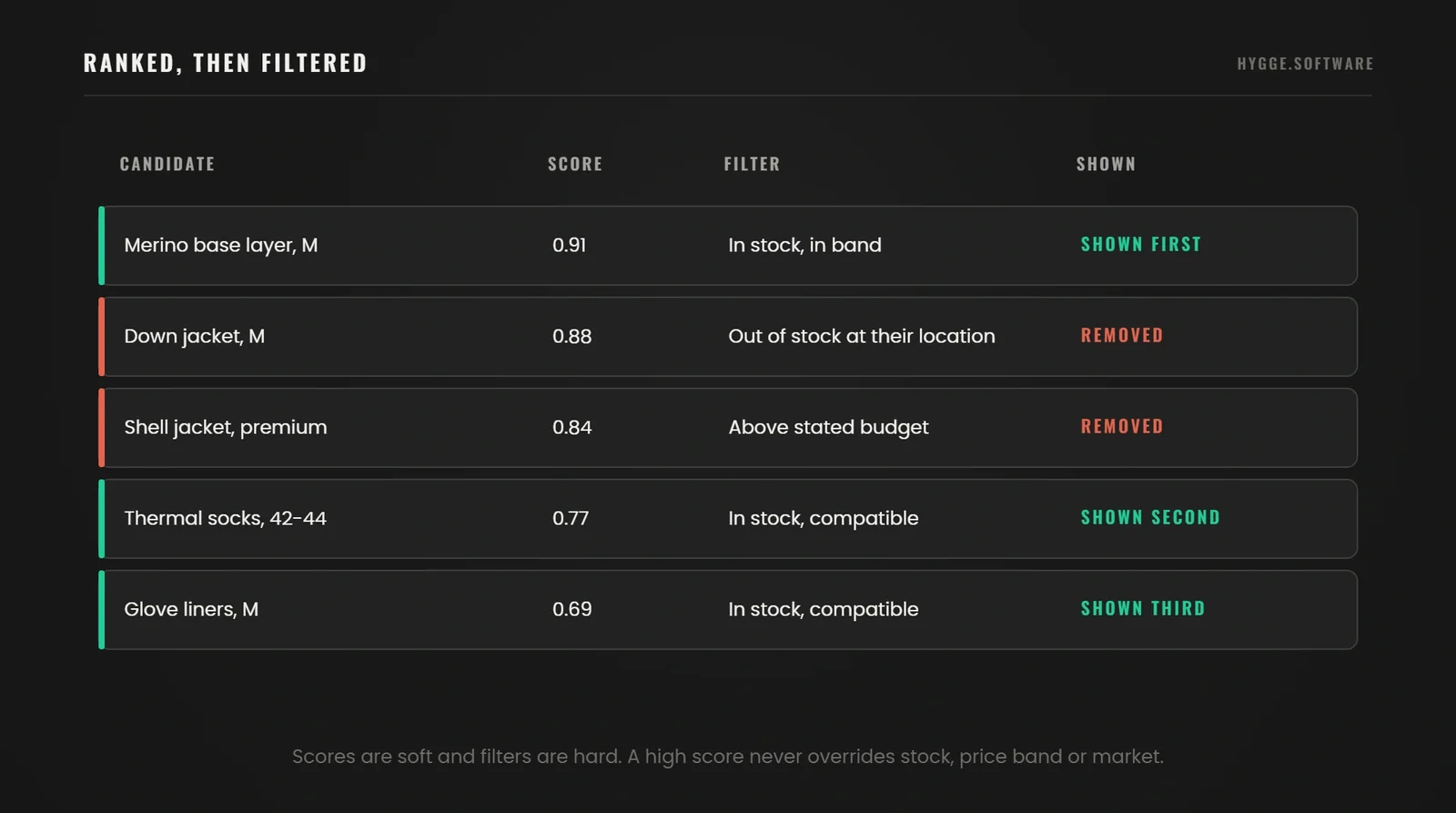
Relevance is interest crossed with what the shopper is able to buy. Recommending an item that is out of stock, over budget, unavailable in their country or in the wrong size is worse than recommending nothing. The filtering step is where most of the engineering sits.
Recommend Products That Fit the Customer and the Available Catalogue
Most of it rides on three signals: what this shopper has viewed and bought, what shoppers with similar behaviour went on to buy, and the attributes of the products themselves. The model ranks candidates. Then hard filters run: in stock for their location, inside their observed price band, compatible with what they already own, and permitted to be advertised in their market. We built this pattern for Offra, a gift app: retrieval runs over real retailer listings, a pricing algorithm keeps results inside the stated budget, and whole categories are excluded whatever the input says. Building those filters into a storefront is everyday retail software development work.
Decide the fallback before launch, because a new visitor has no history at all. Popular in the category, popular in their stated preference, or a curated set are all defensible. A blank block is what you get when nobody chose.
Use Predicted Audiences Without Confusing Rules with AI
"Has not purchased in 60 days" is a rule. It updates automatically, it costs nothing, and everyone can explain it. "Probability of purchasing in the next 30 days is below 0.2" is a model output, and it needs training data, evaluation and monitoring.
The second is better only where purchase cycles vary enough that a single window is wrong for most of the catalogue. A retailer selling both coffee and furniture has that problem. A retailer selling one category usually does not, and starting with the rule is the cheaper way to find out.
The Rule Ships First and Stays as the Baseline
Hygge ships the rule first and makes the model beat it.
Yevhenii SukhovCTO & Co-Founder
We ship the rule first and keep it as the baseline the model has to beat. If the model cannot beat a sixty-day recency segment on your data, that is a useful result and it cost two weeks.
How Can AI Improve Retail Marketing Campaigns?
A campaign has five decisions in it: who, what offer, what message, when, and on which channel. A model can inform any of them. The automation platform sequences the actions and enforces the rules. No platform does all five well. Retail marketing campaign automation is the part every platform does competently. Platforms differ in ranking and prediction, so ask which of the five decisions a given product makes for you.
Generate and Adapt Campaign Content with Human Review
Models draft quickly from a verified product feed and a set of brand rules. That speed is most of the value: twenty subject lines in a minute, body copy per segment, and ad variants that keep the same claim.
The review step is mandatory and specific. Every generated claim about price, specification, availability, delivery or promotional terms is checked against the source system before it goes out. A model will happily write a confident sentence about a discount that does not exist. Translations are reviewed by someone who speaks the language, since a plausible mistranslation of a legal term is a liability.
We recently estimated a campaign content tool with four AI agents: ideas, copy, images and scheduling. The approval loop alone took three to six working days, one of the larger modules in the plan. That is where the responsibility sits.
Coordinate Triggers, Channels and Send Times
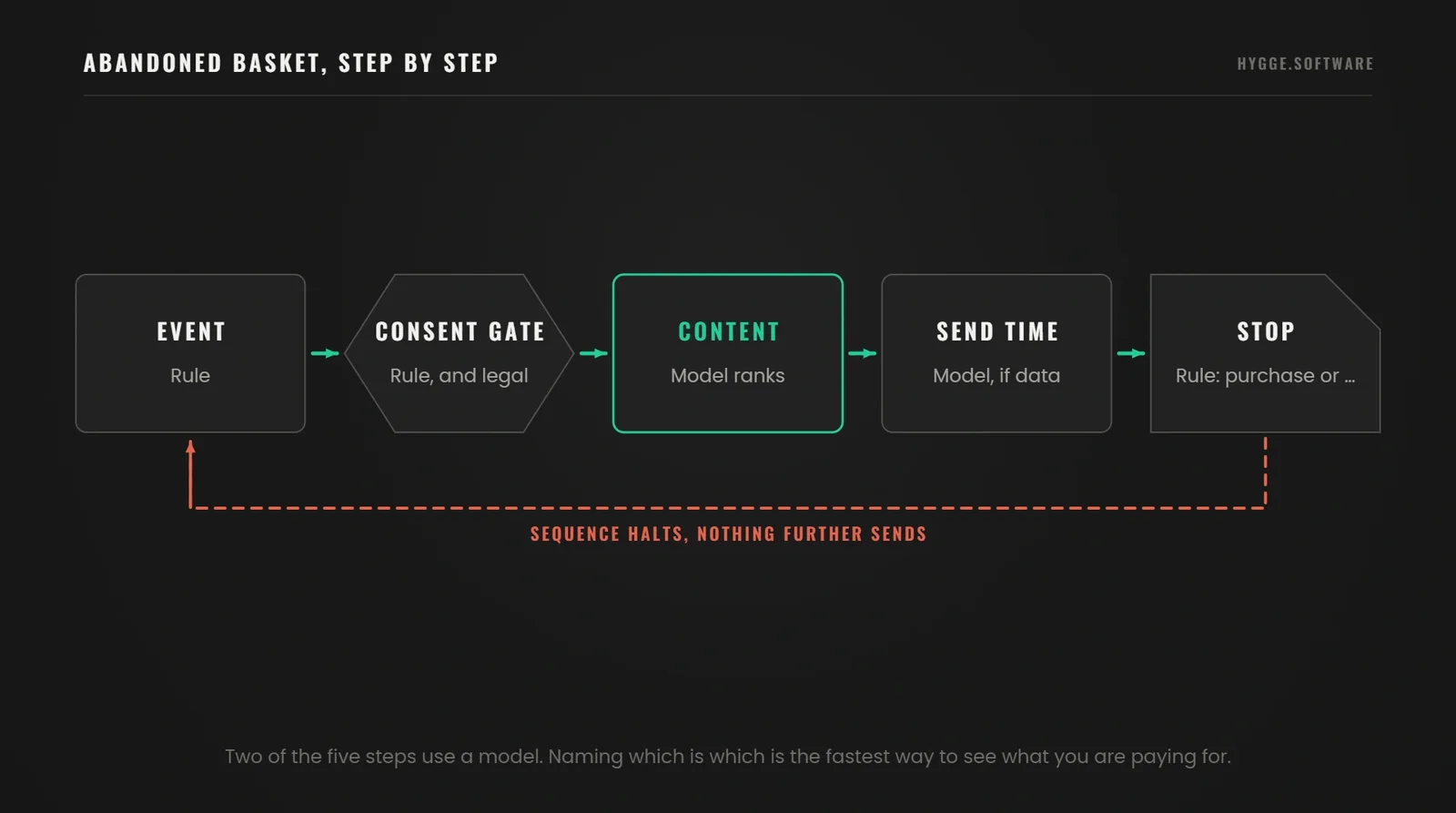
An abandoned basket sequence shows the division in full. The event fires when a basket sits untouched past a threshold, which is a rule. The consent and suppression check runs next, which is also a rule and a legal requirement. Content selection can use a model to pick which of the basket items to feature and what to recommend alongside them. The send time can use a model where you have enough per-person history. And the sequence stops on purchase or opt-out, which is a rule and the most important one in it.
Name which step is which on the vendor call. It is the fastest way to see what you are paying for.
A Person Signs Off Every Claim the Model Writes
Hygge budgets the human approval loop as its own module.
 Yanina Miasnykova
COO
Generated copy goes out under the retailer's name, so a person signs off every claim about price, stock or terms. When we scope a content tool, the approval loop gets its own budget line, and it stays in the plan when the budget gets tight. Cutting it is the fastest way to publish a discount that does not exist.
Separate the Rules From the Model
Send one campaign you run today and the platform you run it on. You get a step-by-step view of which decisions are rules, which could use a model, and which you are already paying for twice.
How Can AI Support Retention Without Relying on Constant Discounts?
Retention is a repeat purchase that would otherwise not have happened. A discount is one way to cause it and the most expensive, because it also goes to everyone who would have bought anyway.
Detect Lapse Risk and Repurchase Opportunities
A model can estimate when a shopper is due to buy again and flag a deviation from their own pattern. The important design choice is the window, and it is set per category. Coffee reorders in weeks, running shoes in months, a mattress in years. One lapse definition across a mixed assortment labels the mattress buyer as churned and the coffee buyer as healthy, and both are wrong.
Compare the model against the obvious rule, per category, and look at the errors category by category. An average hides the category where the model is useless.
Choose Helpful Actions and Protect Customer Trust
Rank the cheap actions first. A replenishment reminder timed to the shopper's own cycle. A compatible accessory for something they own. A back-in-stock notice for something they looked at. A reminder of a loyalty benefit already earned. Each of those is useful without costing margin.
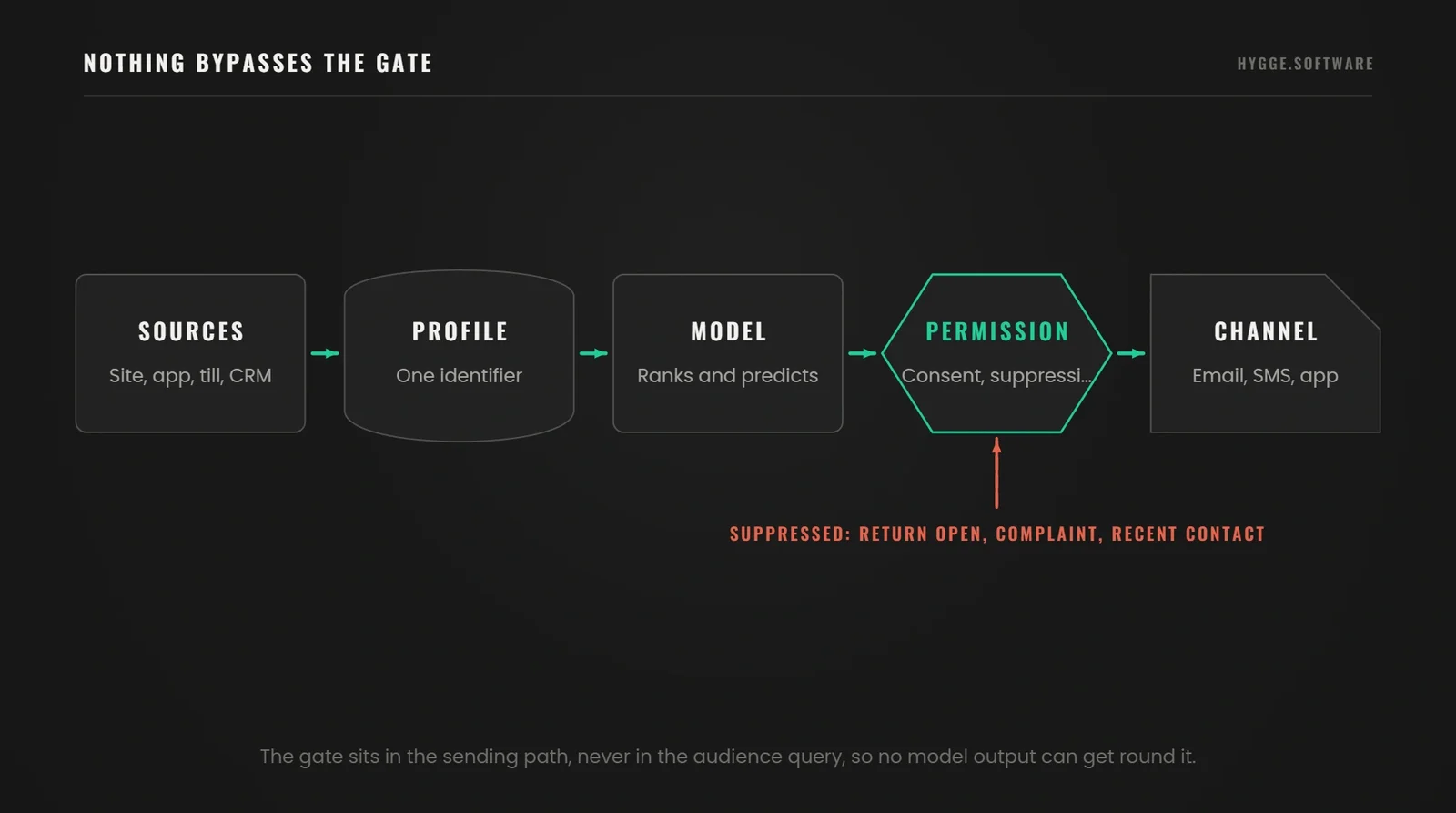
Then write the suppression rules, because the fastest way to lose a customer is a cheerful message at the wrong moment. Suppress after a return, during an open complaint, when the item is unavailable, when they have had a message in the last few days, and when they are already mid-purchase.
Actions Ranked by What They Cost You
Work down this list before reaching for a discount. Each line states when it fits and when it backfires.
Replenishment reminder
Fits consumables with an observable cycle. Backfires when the cycle is guessed from one purchase.
Compatible accessory
Fits anything with a real accessory relationship in the catalogue. Backfires when "related" means "bought in the same session by somebody".
Back-in-stock notice
Fits a product the shopper viewed. Backfires when sent weeks later with no context.
Loyalty benefit reminder
Fits a benefit already earned and unused. Backfires when it reads as a new offer in disguise.
Service or content follow-up
Fits a considered purchase with a setup step. Backfires when it is a sales message wearing a help heading.
Discount
Fits a genuine margin decision taken knowingly. Backfires when it trains customers to wait, which it does faster than most teams expect.
The Message That Costs You a Customer Is the Right One at the Wrong Moment
Hygge writes the suppression list before the audience query.
 Alina Sukhova
CEO & Co-Founder
The message that costs you a customer is usually the correct one sent at the wrong moment, to somebody who is waiting on a refund. The suppression list is the part of the brief nobody writes down.
What Data and Integrations Do Retailers Need?
You need four: reliable events, product data you can trust, purchase history joined to a person, and the permission state for every contact channel. A separate customer data platform is one way to hold them, and no scenario requires one. Joining them is AI integration work more than model work.
Connect Customer Events, Purchases and Product Data
The website, the app, the till, the customer record and the catalogue all have to agree on who a person is and what a product is. That means a stable customer identifier, a product identifier that survives catalogue changes, and an event stream that records cancellations and returns as well as purchases.
A pair of rules saves trouble later. A returned order never counts as a purchase, and a model trained on gross orders will keep recommending what people send back. And a shared device does not mean a shared person. A household tablet produces one profile with two sets of behaviour, so keep them separate unless someone signed in.
Apply Consent, Suppression and Frequency Rules
Permission is checked before the action, at the moment of sending. Under PECR you may not send electronic mail marketing to individuals unless "they have specifically consented to electronic mail from you". The exception is an existing customer who bought or negotiated to buy a similar product from you. Even then, the soft opt-in applies only where you "gave them a clear chance to opt out of getting marketing emails or texts when you collected their details, and in every message". Bought-in lists and prospective customers are outside it.
Every message carries your real identity and a working opt-out, and opt-outs are acted on promptly and screened against before the next send. Three separate questions sit behind any audience: is there a lawful basis for holding the data, is this specific message permitted on this channel for this person, and is automated profiling of this kind within what you told them.
Source: Electronic mail marketing, ICO guide to PECR, read October 2026.
Check the Data and Permissions for One Scenario
Send the scenario you want to run and the systems holding the events, the catalogue and the consent state. You get what has to be joined, what is missing, and whether a model is needed at all.
How Should Retailers Measure the Impact of AI Marketing?
Compare against something. A platform reporting that a campaign drove revenue is reporting attributed revenue, which counts sales that followed a message. Some of those would have happened anyway, and the share that would have is exactly what you are trying to find out.
Compare AI with a Rules-Based Baseline
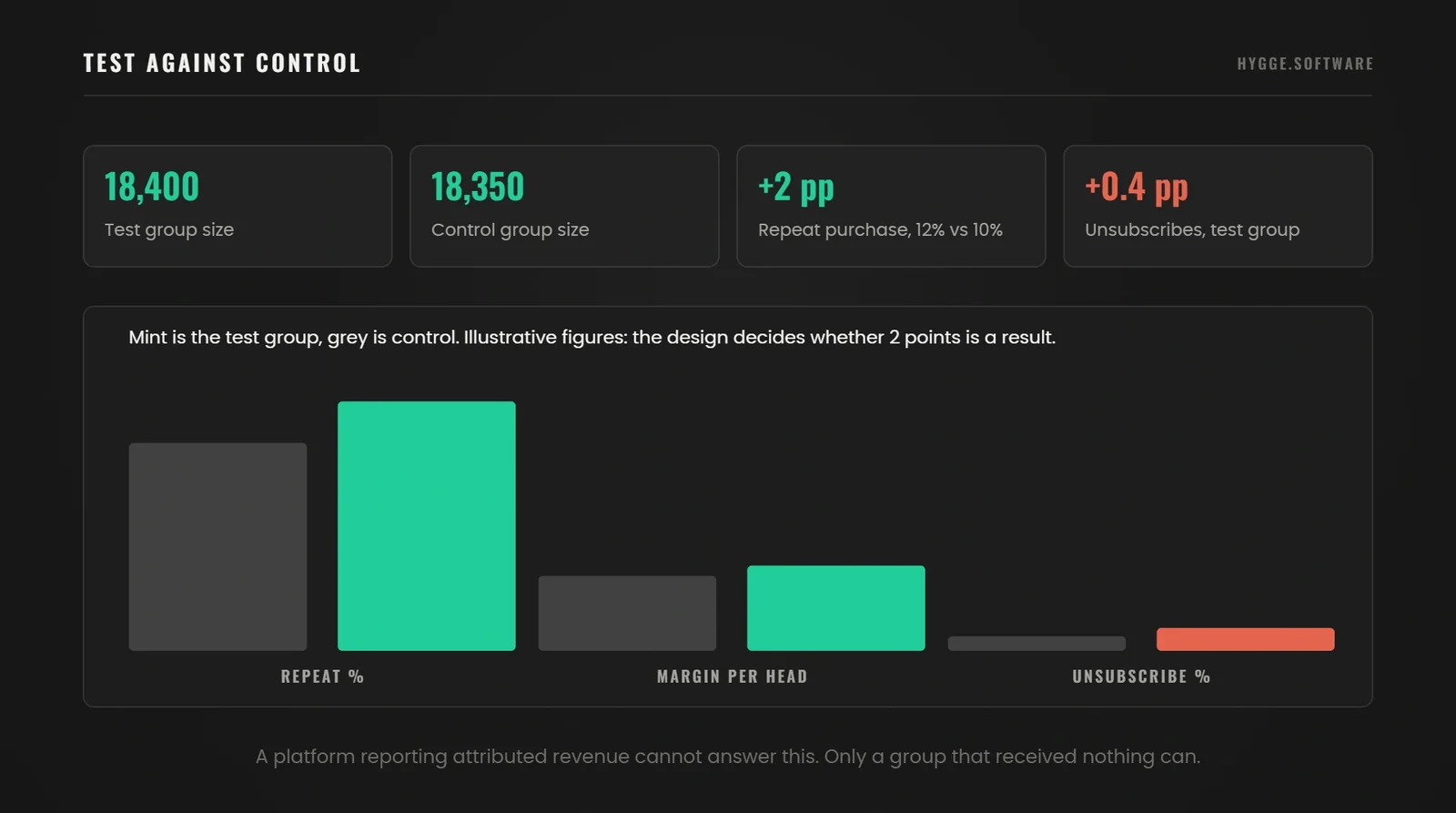
Two different questions need two different tests. Does contacting this group at all beat contacting nobody: that needs a holdout group who receive no message. Does the model beat the rule we run today: that needs the model on one random half and the existing rule on the other, with everything else held constant.
Teams routinely run the second test and report it as the answer to the first.
Track Repeat Purchases, Margin and Negative Signals
Measure three things: repeat purchase inside an agreed window, conversion, and margin after discounts and returns. Then subtract the cost of the messages and the system. Track unsubscribes, complaints and message frequency beside the revenue figures, because a campaign that lifts this quarter by burning the list is a cost that appears next quarter.
A worked example with illustrative figures. The test group repeat-purchases at 12% and the control at 10%, a difference of 2 percentage points. Whether that is a result depends on the group sizes, how they were split, how long the window was, and whether anything else ran at the same time. With a few hundred people per group a 2-point gap is noise. Agree the design before the campaign runs, because no analysis afterwards can rescue a test that was not randomised.
How Can Retailers Start with One Practical AI Use Case?
Pick on three things: the business problem has a cost you can state, the data exists today, and the result can be checked against a baseline. The most technically interesting scenario is rarely the one that scores highest on all three.
Choose Between Platform Features and Custom Development
Check what your current platform already does. Most marketing platforms ship recommendation blocks, simple propensity scores and send-time optimisation, and for many retailers that is enough for the first year.
Custom work earns its place against a confirmed gap: a recommendation that has to respect constraints the platform cannot express, a prediction the platform does not offer, or a volume that makes the per-contact pricing absurd. That is the work our machine learning development services cover. Compare on four things and write the answers down: quality against your baseline, what the integration costs, who maintains it, and what happens when it breaks at six on a Friday.
The model is rarely the large line. In our own estimates across 44 projects, the AI module takes a median of three working days; integrations, data preparation, testing and deployment take the rest.
Pilot, Review and Expand Only After Validation
Marketing automation works for retail companies in general. A pilot shows which of the five decisions a model improves in yours. Scoping that pilot is where our AI consulting work usually starts.
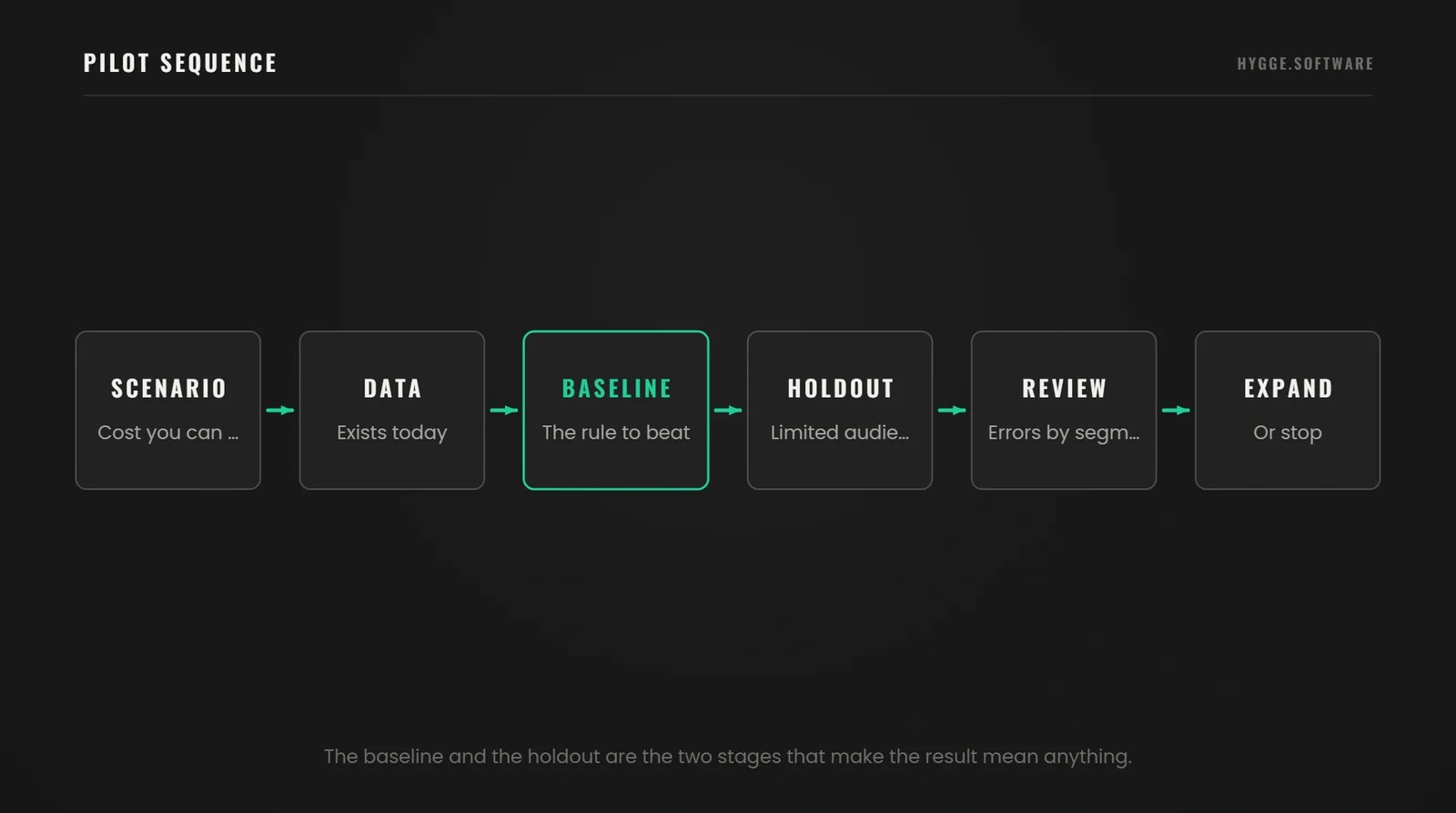
Pick the scenario. Prepare the data. Define the baseline you have to beat. Run on a limited audience with a holdout. Review the result and the errors, separately by segment. Then expand, or stop.
Name the person who can halt the campaign, and build the fallback before launch: when the model is unavailable, the system serves the rule-based version. A personalisation block that renders empty during an outage is worse than one that shows the bestsellers.
Every Campaign Reserves a Group That Gets Nothing
Hygge reserves a holdout on every campaign it runs.
 Zinaida Shelomkova
Head of Delivery
Every campaign we run reserves a group that gets nothing. It costs a little revenue and it is the only way anybody can say afterwards whether the thing worked.
How Hygge Runs an AI Marketing Project
These rules shape every project of this kind we take.
The rule ships first. We build the rule-based version, run it, and keep it as the baseline. The model has to beat a number that already exists.
The permission gate is built before the model. Consent, suppression and frequency are enforced in the path that sends, so no model output can bypass them.
Filters are hard, scores are soft. The filters described above run after ranking, and no model score can override them.
A holdout group. Without it, the only measurement left is attribution.
Handover inside the build. A named owner for the model, a documented fallback, and an alert when the serving path fails so the rule takes over automatically.
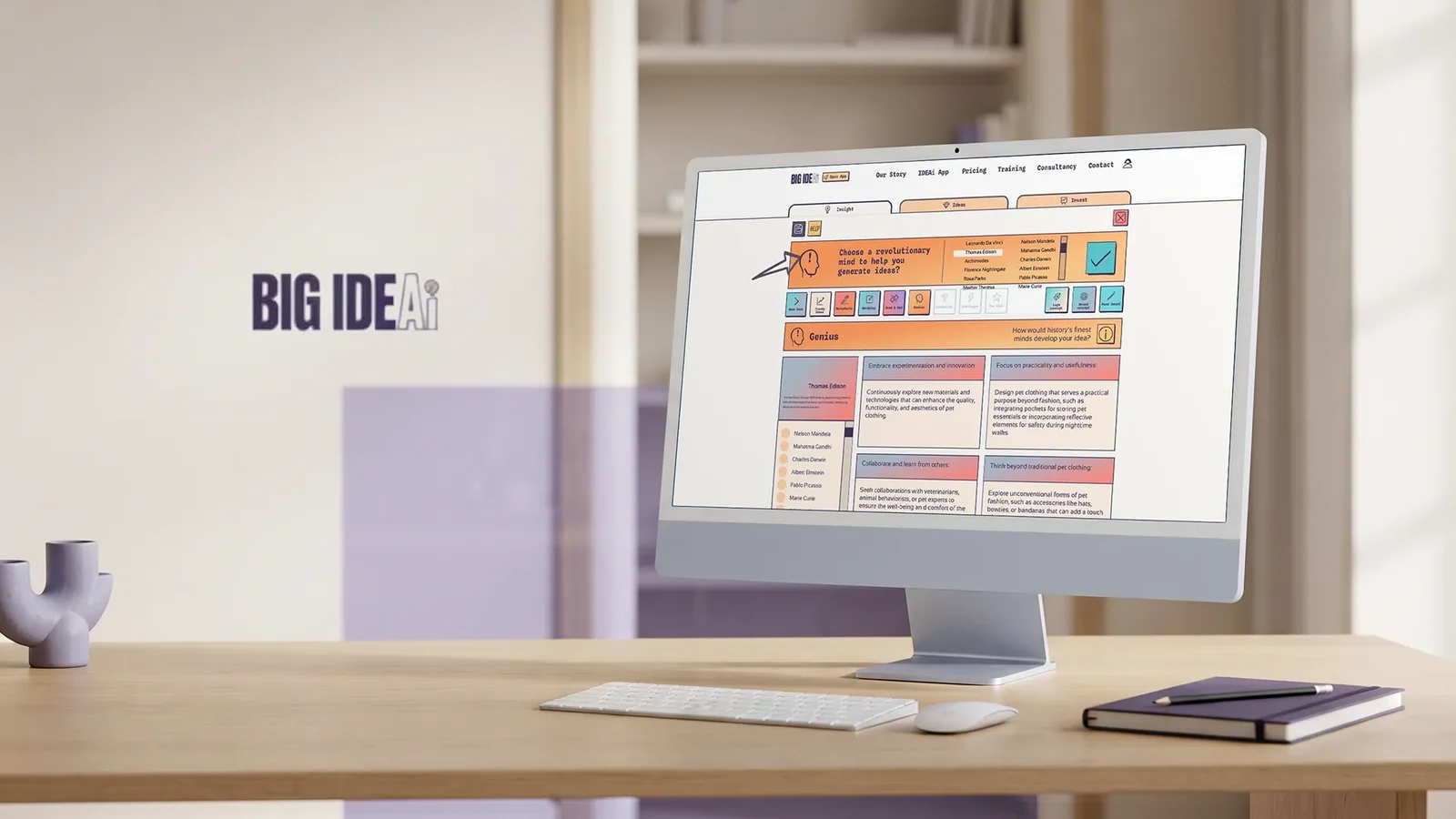
Two published projects show this approach in practice. Offra, the gift finder described above, was built in about a month across three milestones, ahead of the Black Friday season. CreAItivity, a UK creative-tech client, is in its third year of working with us, with three products built for the same team. A recommendation block faces the same test over that kind of time: it has to keep working through catalogue changes, traffic peaks and model replacements.
Published Projects Behind This Approach
Short description under the heading placeholder. Lorem ipsum dolor sit amet, consectetur adipiscing elit.

Offra
An AI gift finder built in about a month for a startup whose marketing was booked against a Black Friday date.
- 3 milestonesDelivered before the holiday launch window
- 100 %Of results are products a buyer can order
- ~1 monthAgainst a Black Friday date that could not move
CreAItivity
Creative agency software that runs a UK agency's ideation method without a facilitator, now in its third year.
- 36 widgetsCarry a method that needed a facilitator
- 20+ yearsOf agency practice turned into software
- 3rd yearOn the architecture chosen at the start
Compare the Platform Against a Model on Your Data
Name the scenario and the platform you run. You get a clear view of what the platform already covers and whether a custom model is worth the maintenance.
Our Delivery Record
Numbers published on hygge.software and in the case studies linked above.
AI in Retail Marketing FAQ
The questions marketing teams ask when they scope the work.
 Can physical stores use AI marketing without an online shop?
How can AI personalise marketing for new customers?
Should retailers launch email, SMS and app campaigns together?
Can AI support campaigns in multiple languages?
Will AI replace the retail marketing team?
Can AI work with seasonal products and fast-changing stock?
Scope One AI Marketing Scenario
Send one scenario you want to run, the platform you run campaigns on and the systems holding events, catalogue and consent. We will come back with what the platform already covers, what needs building, and how the result can be measured.

Describe the Scenario
One campaign or decision you want to improve and the platform you run it on.
Get a Platform and Data Review
Which steps are rules, which could use a model, and what your platform already covers.
Receive a Scoped Plan
The data and permission checks, the integration work, a baseline to beat and how the result will be measured.